Andrew Sparrow
2026-02-02 15:33:00
Gordon Brown calls for inquiry into ‘shocking’ leaking by Mandelson of government information when he was PM
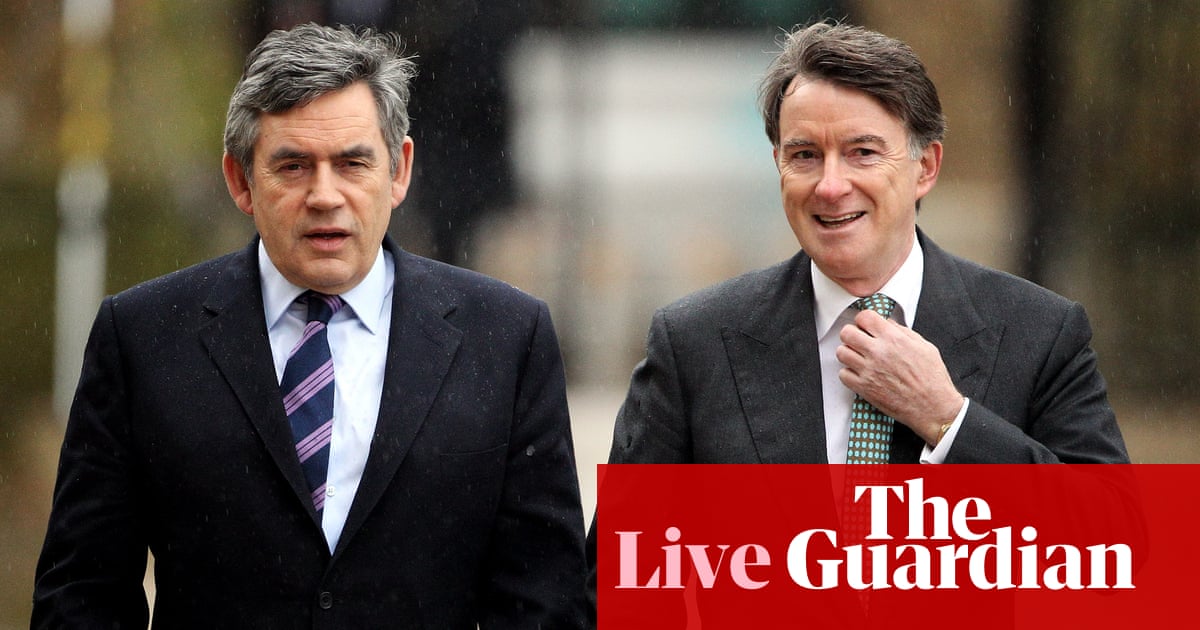
Gordon Brown, who was prime minister when Peter Mandelson passed at least one confidential memo addressed to him to Jeffrey Epstein (see 12.41pm), has described the leak as “shocking” and written to the cabinet secretary demanding an inquiry.
In a statement, Brown says:
I have today asked the cabinet secretary to investigate the disclosure of confidential and market sensitive information from the then business department during the global financial crisis.
On September 10 last year, I wrote to the cabinet secretary to ask him to investigate the veracity of information contained in the Epstein papers about the sale of assets arising from the banking collapse and communications about them between Lord Mandelson and Mr Epstein.
That enquiry led to a response on November 19 that no departmental record could be found of any information or communication from Lord Mandelson to Mr Epstein on these issues.Given the shocking new information that has come to light in the latest tranche of Epstein papers, including information about the transfer to Mr Epstein of at least one highly sensitive government document as well as other highly confidential information, I have now written to ask for a wider and more intensive inquiry to take place into the wholly unacceptable disclosure of government papers and information during the period when the country was battling the global financial crisis.
Given the public interest in this, I have asked that the results of the inquiry be published and done so as soon as possible.
Brown and Mandelson was close friends and allies in the late 1980s and early 1990s, when New Labour was taking shape. They fell out bitterly when Mandelson backed Tony Blair, not Brown, for Labour leader in 1994. In 2008 Brown stunned Westminster when he persuaded Mandelson to quit his job as a European commissioner and return to cabinet. The two men had a good working relationship until the 2010 election, but then fell out again over who was to blame for Labour’s defeat.
The revelation that Brown asked for an investigation in September last year into potential leaking by Mandelson is new. Brown says he was told that “no departmental record could be found of any information or communication from Lord Mandelson to Mr Epstein on these issues”. But that is not surprising, and it suggests the investigation was not very thorough. When cabinet ministers leak information, they tend not to use their work email accounts.
Key events
Starmer makes statement to MPs about his trip to China and Japan
In the Commons Keir Starmer is making a statement about his trip to China and Japan.
There is extensive Guardian coverage of the China trip here.
And here is an article by Rowena Mason about the deals that were firmed up or agreed during the trip.
Peter Mandelson gave Jeffrey Epstein advance notice about the timing of the announcement of the €500bn bailout to save the Euro, Steven Swinford from the Times reports.
The latest episode of the Guardian’s Politics Weekly podcast is out. It features Pippa Crerar and Kiran Stacey discussing Peter Mandelson.
SNP writes to Met police calling for criminal investigation into evidence Mandelson leaked market sensitive information
The SNP is also calling for a police investigation into Peter Mandelson.
In a letter to Sir Mark Rowley, the Metropolitan police commissioner, Stephen Flynn, the SNP’s leader at Westminster, says:
I write to inform you of potential criminal misconduct regarding Lord Peter Mandelson – specifically the offence of misconduct in public office which, if proven, carries a maximum sentence of life imprisonment …
In recent days, following the release by the US Department of Justice of files relating to Jeffrey Epstein, serious allegations are now emerging as to sensitive, state information that may have been passing between Mandelson and Epstein. These published emails, many of which occurred in the midst and aftermath of the financial crash, appear to suggest that market sensitive information was being shared with Jeffrey Epstein – a billionaire, convicted paedophile. The files also suggest that Mandelson and his family may also have been in receipt of significant amounts of money from Epstein.
If such allegations are investigated and proven, it is gravely serious – for Peter Mandelson, for the Labour prime ministers who appointed him and for the UK government as a whole. That is why I believe it is now clearly in the public interest that all of these newly released emails and files, and Mandelson’s entire period in UK Labour governments, must now be criminally investigated.
The grounds for such a criminal investigation are already well established in law.
In attorney general’s Reference No 3 of 2003 [2004] EWCA Crim 868 the court said that the misconduct must amount to:
“… an affront to the standing of the public office held. The threshold is a high one requiring conduct so far below acceptable standards as to amount to an abuse of the public’s trust in the office holder.”
These widespread allegations and the suspicion of criminal activity need to be urgently addressed; I therefore believe it is now essential that a formal, criminal investigation is now initiated by the Metropolitan police.
Gordon Brown calls for inquiry into ‘shocking’ leaking by Mandelson of government information when he was PM
Gordon Brown, who was prime minister when Peter Mandelson passed at least one confidential memo addressed to him to Jeffrey Epstein (see 12.41pm), has described the leak as “shocking” and written to the cabinet secretary demanding an inquiry.
In a statement, Brown says:
I have today asked the cabinet secretary to investigate the disclosure of confidential and market sensitive information from the then business department during the global financial crisis.
On September 10 last year, I wrote to the cabinet secretary to ask him to investigate the veracity of information contained in the Epstein papers about the sale of assets arising from the banking collapse and communications about them between Lord Mandelson and Mr Epstein.
That enquiry led to a response on November 19 that no departmental record could be found of any information or communication from Lord Mandelson to Mr Epstein on these issues.Given the shocking new information that has come to light in the latest tranche of Epstein papers, including information about the transfer to Mr Epstein of at least one highly sensitive government document as well as other highly confidential information, I have now written to ask for a wider and more intensive inquiry to take place into the wholly unacceptable disclosure of government papers and information during the period when the country was battling the global financial crisis.
Given the public interest in this, I have asked that the results of the inquiry be published and done so as soon as possible.
Brown and Mandelson was close friends and allies in the late 1980s and early 1990s, when New Labour was taking shape. They fell out bitterly when Mandelson backed Tony Blair, not Brown, for Labour leader in 1994. In 2008 Brown stunned Westminster when he persuaded Mandelson to quit his job as a European commissioner and return to cabinet. The two men had a good working relationship until the 2010 election, but then fell out again over who was to blame for Labour’s defeat.
The revelation that Brown asked for an investigation in September last year into potential leaking by Mandelson is new. Brown says he was told that “no departmental record could be found of any information or communication from Lord Mandelson to Mr Epstein on these issues”. But that is not surprising, and it suggests the investigation was not very thorough. When cabinet ministers leak information, they tend not to use their work email accounts.
Faisal Islam, the BBC’s economics editor, has written a good article about the conversation Alistair Darling had with Jamie Dimon, the JP Morgan chief executive, about the proposed tax on bankers’ bonuses in 2009. Islam says Darling, who is now dead, told him about the “painful and angry” call. Darling also wrote about it in his memoir. Darling said:
Mr Dimon was very, very angry … he said that his bank bought a lot of UK debt and he wondered if that was now such a good idea. I pointed out that they bought our debt because it was a good business deal for them. He went on to say they were thinking of building a new office in London but they had to reconsider that now.
Referring to the news that, if Dimon was being “threatening”, it was because he was advised to do so by Mandelson (see 9.38am), Islam says:
That this may have been orchestrated partly via Epstein, with Mandelson emailing advice, while Britain’s business secretary sitting on the financial crisis cabinet of Prime Minister Gordon Brown, is staggering.
Islam has posted a longer extract about the call from Darling’s book on social media.
Ed Davey calls for police investigation into Mandelson over ‘potential misconduct in public office’
Ed Davey, the Lib Dem leader, says Peter Mandelson should be investigated over a potential misconduct in public office offence. Davey says:
The Epstein files suggest Peter Mandelson leaked sensitive government information to a convicted sex offender while serving as a minister, and even suggested a US bank should threaten the government to lower its tax bill.
These allegations are incredibly serious, it is now only right that the police investigate Peter Mandelson for potential misconduct in public office.
(While misconduct in public office is in theory a wide-ranging offence, as this CPS briefing explains, it tends to get used to prosecute officials, not politicians.)
Mandelson engaged in ‘shocking’ betrayal by leaking information to Epstein, says Labour peer
Catherine MacLeod, a former special adviser to Alistair Darling who is now a Labour peer, has said that it was “awful” to learn that Peter Mandelson was advising banks how lobby against a tax on bonuses being proposed by Darling when he was chancellor.
Referring to the revelation that Mandelson, via Jeffrey Epstein, suggested that it would be good for JP Morgan to “mildly threaten” Darling (see 9.38am), MacLeod told Radio 4’s the World at One:
It is awful that one of Alistair Darling’s colleagues was suggesting this … Quite a lot of important and influential bankers employed whatever tactics they thought would get them somewhere with Alistair Darling.
She also said that revelations about Mandelson leaking internal government information when he was business secretary to Epstein were “absolutely shocking”. (See 12.41pm.) She said that this amounted to “betrayal” and that Mandelson was letting down his colleagues. “There is nothing that can be said in its defence.”
A vast trove of Epstein documents has been released in the US, and reporters are still going through them. One shows Mandelson forwarding a memo written by one special adviser to Gordon Brown, the then PM, to Epstein. There is at least one other example of Epstein having a business-related internal goverment memo from around this time, without it being clear how Epstein obtained it.
Darren Jones, chief secretary to PM, to make statement to MPs about Epstein files
Keir Starmer is making a statement in the Commons on his trip to China and Japan at 3.30pm. But there may be more interest in the statement coming afterwards (from around 5pm?). It’s from Darren Jones, the chief secretary to the PM, and it is about “the release of files by the US Department of Justice”, ie the Epstein files.
EU signals readiness to talk with UK on closer economic integration at summit ‘soon’
But the EU has indicated that it is ready to talk to the UK about closer economic links with soon, Jakub Krupa reports on his Europe live blog.
Paula Pinho, chief spokesperson for the European Commission told reporters today:
Our single market is really one of the treasures of the EU or, if I were to put it into a British context, it’s really the jewel of the crown, right?
So we very much appreciate that these advantages of the single market are recognised by prime minister Starmer.
Now, we will be having a summit with UK soon, I understand there’s not a final date yet agreed, but this will be the occasion to discuss with UK what, exactly they, have in mind, and how they propose to go about it.
So that’s all we can say for the moment.
The EU has declined to comment on suggestions that the UK could restart its push to be associated with the SAFE, or Security Action for Europe, plan, as proposed by Keir Starmer over the weekend. Jakub Krupa has details on his Europe live blog.
Nick Macpherson, who was permanent secretary at the Treasury from 2005 to 2016 and who is now a member of the House of Lords, has said that it is “breathtaking” to see how City banks were getting information via Jeffrey Epstein.
Commenting on one of the emails flagged up by the tax campaigner Dan Neidle (see 12.41pm), Macpherson said:
Alistair Darling and the official Treasury were always aware that investment banks had an inside track to Number 10. But the brazen nature of that inside track is rather breath-taking.
At the lobby briefing the PM’s spokesperson did not give details of how Keir Starmer would like the Lords to toughen up its disciplinary rules. He just said “we want to work with the Lords to modernise the disciplinary procedures and make it easier to remove lords who have brought the house into disrepute”.
Asked if the PM wanted these new procedures to be retrospective, the spokesperson said that he had set out Keir Starmer’s view about not wanting Mandelson to remain in the Lords. (See 12.44pm.)
No 10 says PM wants Mandelson permanently removed from Lords – but won’t commit to legislation taking away his peerage
Keir Starmer would like Peter Mandelson to be permanently removed from the House of Lords, Downing Street has said.
Starmer also believes that Mandelson should no longer use his title.
But the PM has stopped short of backing calls for Mandelson to be formally stripped of his title – something that would require primary legislation, and which has not been done since the first world war.
Although having a life peerage is generally seen as being synonymous with being a member of the House of Lords, in practice they are different. It is theoretically possible for someone to be expelled from the Lords for life while remaining a peer.
The spokesperson also said that the cabinet secretary has been asked to review all of Mandelson’s contacts with Jeffrey Epstein while he was a cabinet minster.
At the daily lobby briefing this morning, asked about calls for Mandelson to have his peerage reviewed, the PM’s spokesperson said:
The prime minister has asked for this to be urgently looked at. And the prime minister believes that Peter Mandelson should not be a member of the House of Lords or use the title.
However the prime minister does not have the power to remove it.
He is calling on those in the Lords to work with the government to modernise disciplinary procedures in the house to allow for the easier removal of lords who have brought the house into disrepute.
The prime minister has asked the cabinet secretary [Chris Wormald] to review all available information regarding Peter Mandeslon’s contacts with Jeffrey Epstein during his period as a government minister, and to report back to him.
The spokesperson also said that, if Mandelson is called to testify before the US Congress about Epstein, he should. He said:
On the issue of testifying, the prime minister has always said that anyone who’s got information should be prepared to share that information in whatever form they are asked to do that, because you can’t be victim centred if you are not prepared to do that.
Under a law passed in 2014, any member of the Lords who is jailed for at least a year already loses their membership
And, under a law passed in 2015, the conduct committee has the power, not just to recommend that a peer be suspended from the Lords for breaking the code of conduct, but to be expelled permanently. The committee did recommend expulsion in 2020 in the case of a peer accused of sexually exploiting a woman, but the peer, Lord Ahmed of Rotherham, announced he was retiring from parliament before the recommendation could be put to a vote.
At the lobby briefing the spokesperson did not give details of how Starmer would like these arrangements to be changed.
The spokesperson repeatedly said that Starmer does not have the power to remove Mandelson’s peerage. While this is true, because removing a peerage would require primary legislation, it is the government that decides what bills are debated by parliament.
Legislation to remove a peerage has not been passed since the Titles Deprivation Act 1917 and this bill did not deal with an individual; instead, it targeted a handful of Germans and Austrians who had peerages as a result of British heritage and who were supporting the enemy in the war.
The government believes there is no precedent for a bill being passed to remove a peerage from an individual.
Keep reading