
The automotive industry is currently undergoing one of its most profound architectural shifts in a century, moving away from mechanical complexity toward a future defined by silicon and code. At the center of this transformation, Stellantis is significantly expanding its strategic partnership with Qualcomm, pushing the boundaries of their collaboration far beyond the digital cockpit and connectivity features that have defined previous generations of smart vehicles.
While the initial stages of the Stellantis-Qualcomm alliance focused heavily on enhancing the in-car infotainment experience and seamless mobile integration, the new roadmap targets the extremely foundation of the vehicle. By leveraging Qualcomm’s digital chassis solutions, Stellantis aims to implement a unified compute power architecture that spans the entire vehicle, integrating the cockpit, connectivity, and advanced driver assist systems (ADAS) into a single, cohesive digital ecosystem.
This evolution marks a critical step in Stellantis’ broader mission to master the software-defined vehicle (SDV). By transitioning from a decentralized model of dozens of independent electronic control units (ECUs) to a centralized, high-performance computing architecture, the automaker is positioning itself to deliver more consistent, scalable, and upgradable driving experiences across its diverse global brand portfolio.
Moving Beyond the Cockpit: The Emergence of the Digital Chassis
For years, the “digital” aspect of a car was largely confined to the dashboard—the screens, the navigation, and the smartphone mirroring capabilities. While these features were essential for consumer satisfaction, they operated as isolated silos within the vehicle’s electrical architecture. The current expansion of the Stellantis and Qualcomm partnership seeks to dissolve these silos.
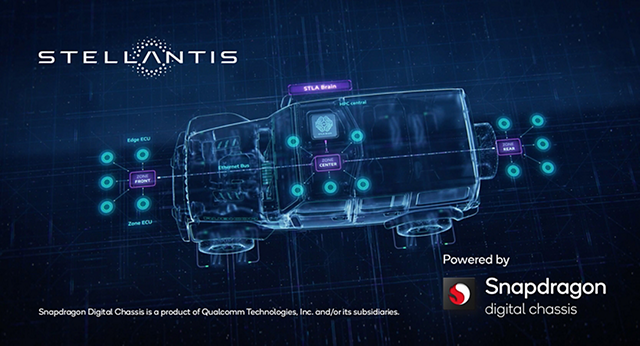
The concept of a “digital chassis” represents a holistic approach to vehicle intelligence. Rather than treating the infotainment system and the safety systems as separate entities, Qualcomm’s technology allows for a unified compute platform. This means the same underlying high-performance silicon can process the high-definition graphics required for a premium cockpit while simultaneously managing the massive data throughput needed for real-time sensor fusion in advanced driver assistance systems.
This integration is facilitated by the Snapdragon Digital Chassis, a scalable platform designed to provide the hardware and software foundation for modern automotive needs. By utilizing this platform, Stellantis can ensure that the “brain” of the vehicle is capable of handling the increasing computational demands of autonomous features and complex connectivity without the latency or inefficiency caused by fragmented hardware.
The Shift to Centralized Computing and Software-Defined Vehicles
To understand why this move is so significant, one must understand the technical hurdles of traditional automotive architecture. Historically, vehicles have relied on a “distributed” architecture, where every major function—from power windows to engine timing—is controlled by its own dedicated, low-power processor. While reliable, this approach creates a “wiring harness nightmare” and makes it nearly impossible to perform comprehensive, vehicle-wide software updates.

The move toward a software-defined vehicle (SDV) flips this model on its head. In an SDV, the hardware is standardized and powerful, while the functionality is defined by software that can be updated, refined, and even completely overhauled throughout the vehicle’s lifecycle. This is often referred to as “centralized computing.”
By implementing unified compute power across the entire vehicle, Stellantis can achieve several key technical advantages:
- Reduced Complexity: Consolidating functions into fewer, more powerful central computers reduces the number of individual components and the massive amount of wiring required, potentially lowering manufacturing costs and vehicle weight.
- Enhanced Over-the-Air (OTA) Capabilities: A unified architecture allows for seamless OTA updates. Instead of updating a single module, Stellantis can deploy comprehensive software improvements that enhance everything from battery management to driving assistance features simultaneously.
- Scalability: A centralized platform allows the automaker to scale features across different vehicle segments. A premium Maserati can utilize the full suite of high-end compute capabilities, while more accessible brands within the Stellantis portfolio can use the same fundamental architecture with different software configurations.
- Improved Safety through Sensor Fusion: Advanced driver assist systems require the real-time processing of data from cameras, radar, and LiDAR. A unified compute platform provides the massive bandwidth and processing speed necessary to fuse this data instantly, leading to more accurate and reliable safety interventions.
Driving the Future of Advanced Driver Assist Systems (ADAS)
Perhaps the most impactful area of this expanded partnership is the integration of ADAS. As the industry moves toward higher levels of automation, the demand for computational “horsepower” is growing exponentially. Modern ADAS requires not just the ability to see an object, but the ability to predict its movement, understand its context, and make split-second decisions to ensure passenger safety.
By integrating Qualcomm’s advanced processing capabilities directly into the vehicle’s digital chassis, Stellantis can support more sophisticated ADAS functions. This includes improved lane-keeping assistance, more precise adaptive cruise control, and eventually, the higher-level autonomous driving capabilities that consumers increasingly expect. The unified architecture ensures that the data flowing from the vehicle’s sensors is processed with minimal latency, a non-negotiable requirement for safety-critical systems.
this compute power enables better “contextual awareness.” A vehicle that can process its surroundings through a unified lens is better equipped to handle complex urban environments, unpredictable pedestrian behavior, and varying weather conditions, making the transition from driver assistance to autonomous driving smoother and safer.
The Strategic Importance for Stellantis
For Stellantis, this partnership is not merely a technical upgrade; This proves a strategic necessity in a rapidly consolidating market. As tech giants and specialized EV manufacturers enter the automotive space, traditional automakers must prove they can compete not just in mechanical excellence, but in digital sophistication.
The ability to offer a vehicle that becomes “better over time” through software is a massive competitive differentiator. In the traditional model, a car began to age the moment it left the dealership. In the software-defined era, a vehicle can receive new features, improved efficiency, and enhanced safety protocols long after the initial purchase. This creates a new type of customer relationship, one based on continuous engagement rather than a single transaction.
By leaning into the Qualcomm partnership, Stellantis is effectively outsourcing much of the high-risk, high-capital development of silicon and foundational software, allowing them to focus their internal resources on vehicle integration, brand-specific user experiences, and the unique driving dynamics that define their diverse lineup of brands.
Key Takeaways: The Digital Evolution of Stellantis
- Expansion of Scope: The Stellantis-Qualcomm partnership is moving from cockpit-centric features to a full-vehicle “digital chassis” approach.
- Unified Architecture: The goal is to replace fragmented, decentralized ECUs with a centralized, high-performance computing platform.
- Software-Defined Focus: This move is a cornerstone of Stellantis’ strategy to master Software-Defined Vehicles (SDVs), enabling better OTA updates and feature scalability.
- Safety and ADAS: Unified compute power is critical for the high-speed data processing required by next-generation Advanced Driver Assist Systems.
- Competitive Advantage: The transition allows for a vehicle that evolves over time, providing a significant edge in the modern automotive market.
As the automotive industry moves closer to a future defined by autonomy and connectivity, the battle for dominance will increasingly be fought in the realm of semiconductors and software architecture. The expansion of the Stellantis and Qualcomm partnership suggests that the race to build the ultimate “computer on wheels” is accelerating.
We will continue to monitor Stellantis’ official technical filings and Qualcomm’s product roadmap for updates on specific vehicle models slated to debut this new digital chassis architecture.
What do you think about the move toward software-defined vehicles? Will you prioritize software features and OTA updates when choosing your next car? Let us know in the comments below and share this article with your network.
Keep reading