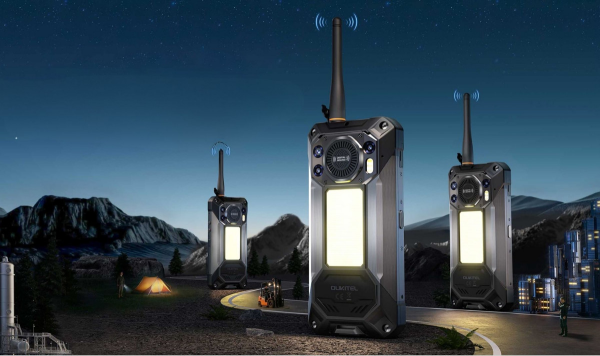
The landscape of emergency communication is shifting as the demand for connectivity in the most remote corners of the globe grows. For those operating in high-risk environments or facing the unpredictability of natural disasters, the traditional reliance on mobile networks is often an unacceptable risk. To address this gap, the Chinese company Oukitel has introduced the WP61, a device designed not merely as a smartphone, but as a comprehensive survival tool.
The rugged satellite smartphone is engineered to provide critical connectivity in regions where standard mobile coverage is nonexistent. From high-altitude mountains and expansive deserts to coastal waters and territories devastated by natural disasters, the WP61 aims to ensure that users remain reachable when traditional infrastructure fails. This shift toward integrated satellite and radio capabilities marks a significant step in the evolution of “ruggedized” tech, moving beyond simple water resistance toward genuine lifeline utility.
Beyond its satellite capabilities, the device integrates a diverse array of hardware designed for extreme conditions. By combining satellite links with traditional radio and specialized sensors, Oukitel is targeting a demographic that includes emergency responders, industrial workers, and outdoor enthusiasts who require more than just a durable screen.
Advanced Communication and Survival Hardware
The WP61 distinguishes itself through a multi-layered approach to communication. Recognizing that satellite connectivity is only one part of the equation, Oukitel has embedded a DMR (Digital Mobile Radio) device within the smartphone. This allows users to communicate over several kilometers without relying on any mobile network, providing a vital secondary layer of connectivity for teams working in close proximity in remote areas.

Power management is a primary concern for survival tools, and the WP61 addresses this with a massive 20,000 mA⋅h battery. This capacity is designed not only to extend the phone’s operational life but similarly to allow the device to function as a power source for other mobile devices, effectively turning the phone into a portable energy hub during emergencies.
To withstand the harshest environments, the device is built to several rigorous standards. It carries IP68 and IP69K ratings for water and dust resistance and meets the MIL-STD-810H military standard for durability. These certifications ensure the device can survive the shocks, vibrations, and extreme temperatures typical of field operations.
Specialized Tools for First Responders
The WP61 incorporates hardware that extends its utility into the realm of professional rescue and industrial safety. Integrated into the chassis is an outdoor flashlight capable of a 1,200-lumen light flux, providing significant illumination in total darkness. To ensure that voice communication is possible even in high-noise environments, the device features speakers with a power output of 130 dB.
For specialized roles, such as firefighting, the phone includes thermal sensors and dedicated software for creating heat maps. This capability allows users to identify heat signatures and potential hazards that are invisible to the naked eye. Oukitel has indicated that some models will be equipped with night vision systems, and the platform allows for the integration of other sensor devices tailored for industrial needs.
The Broader Context of Chinese Rugged Tech
The emergence of the WP61 fits into a larger trend of Chinese manufacturers competing on the basis of high specifications and aggressive pricing. Historically, some Chinese mobile devices faced reputations for using lower-quality components; however, current market trends suggest that these brands have reached a quality level comparable to well-known global labels.
Despite the technical advantages, consumers often face logistical hurdles when acquiring these specialized devices. Many are available primarily through online channels, and warranty support can be complex, sometimes requiring devices to be sent back to China for repair, which can lead to extended downtimes for the user.
| Feature | Specification |
|---|---|
| Battery Capacity | 20,000 mA⋅h |
| Durability Standards | IP68, IP69K, MIL-STD-810H |
| Lighting | 1,200-lumen outdoor flashlight |
| Audio | 130 dB speakers |
| Connectivity | Satellite, DMR Radio, Mobile Networks |
As the WP61 enters the market, the focus remains on its ability to serve as a multi-functional tool for those whose professions or hobbies place them in the path of danger. With the integration of thermal mapping and satellite communication, the device represents a convergence of consumer electronics and professional emergency equipment.
Further updates regarding the availability of the night vision models and specific industrial sensor integrations are expected as the product rollout continues.
Do you believe satellite integration will become a standard feature for all rugged phones, or will it remain a niche tool for professionals? Share your thoughts in the comments below.