
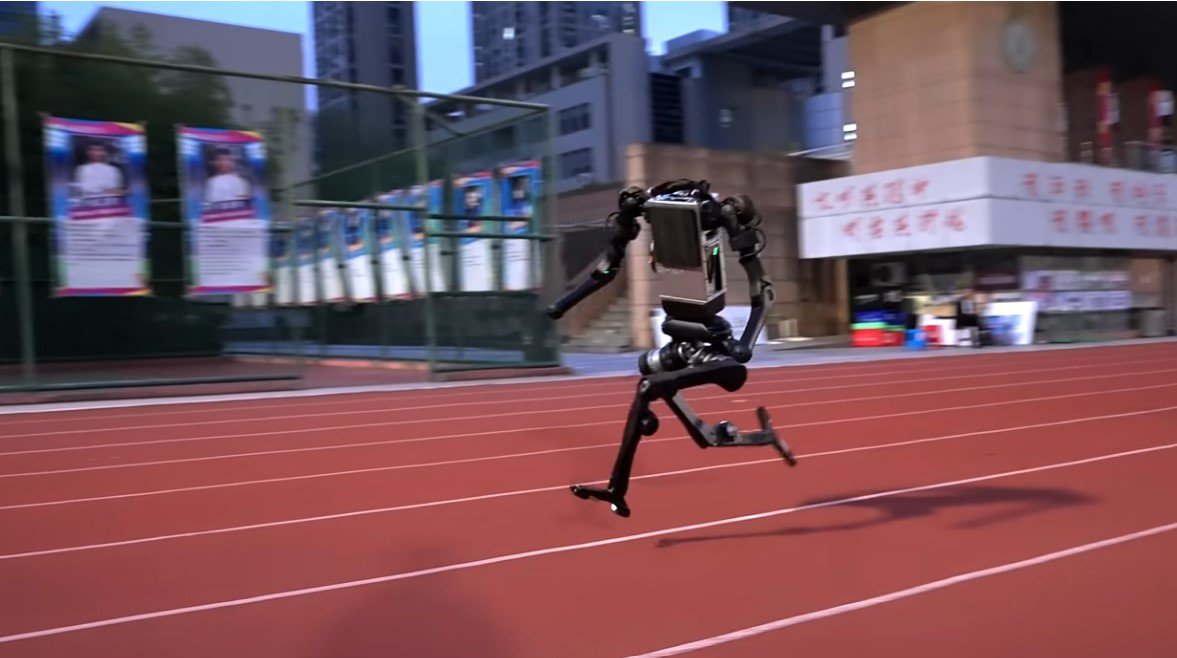
The boundary between human athletic achievement and robotic precision is blurring. In a development that has captured the attention of the global sports and tech communities, a humanoid robot from China has demonstrated sprinting capabilities that rival some of the fastest humans to ever walk the earth.
The Unitree humanoid robot H1 has recorded a sprinting speed of 10.1 meters per second, a feat that places its performance in the realm of elite Olympic athletes. This breakthrough in robotics highlights the rapid acceleration of humanoid development, moving beyond simple balance and walking toward high-velocity locomotion that mimics human biomechanics.
According to reports from Chosun Ilbo, the Chinese robotics firm Unitree (Unitree Robotics) released footage of the H1 robot executing a 100-meter dash, with measurement equipment confirming the 10.1m/s velocity. The company has framed this achievement as approaching the world-record standards set by legendary sprinter Usain Bolt.
Breaking Down the Velocity: H1 vs. Elite Athletics
To place the H1’s performance into perspective, a speed of 10.1 meters per second is a staggering benchmark for a humanoid machine. While Usain Bolt’s world record for the 100m sprint is the gold standard of human speed, the H1’s ability to maintain such a high velocity suggests a significant leap in motor control and power output for bipedal robots.

The development is part of a broader push by China to accelerate its robotics industry. By focusing on the H1’s ability to handle high-speed movement, Unitree is addressing one of the most difficult challenges in robotics: maintaining stability and balance while moving at high speeds on two legs.
The technical achievement is not just about raw speed but the synchronization of sensors and actuators. For a robot to reach 10.1m/s, it must manage rapid weight shifts and precise foot placement to avoid collapsing—a challenge that has historically limited humanoid robots to slow, cautious strides. As noted by Seoul Shinmun, the H1’s performance was captured in a video demonstrating its 100m running capabilities.
Key Technical Milestones of the H1 Sprint
- Recorded Speed: 10.1 meters per second.
- Distance Tested: 100-meter sprint.
- Developer: Unitree (Unitree Robotics), a Chinese robotics firm.
- Comparison: Performance levels described as approaching the records of Usain Bolt.
The Broader Impact on Humanoid Robotics
The emergence of the H1’s sprinting capabilities signals a shift in the goals of humanoid development. For years, the industry focused on “human-like” movement in terms of dexterity and walking. Now, the focus is shifting toward “super-human” or “elite-human” physical capabilities. When robots can move at 10.1m/s, the potential applications expand from simple warehouse assistance to emergency response and high-speed industrial logistics.
Industry analysts suggest that this level of agility is a prerequisite for robots to operate in complex, real-world environments where quick reactions and rapid movement are necessary. The ability to sprint allows a robot to navigate spaces more efficiently and react to dynamic obstacles in real-time.
This development also places Unitree in direct competition with other global leaders in the humanoid space. As China continues to invest heavily in the robotics sector, the race to create a robot that can match—or exceed—human athletic performance is becoming a primary metric of success. Reports from Hankook Ilbo emphasize that the H1’s speed is a testament to the rapid progress being made in the region.
What This Means for the Future of Sport and Tech
As a sports editor, I see this not just as a win for engineering, but as a provocative question for the future of athletics. We are entering an era where the “mechanical athlete” can mimic the output of the world’s best humans. While the H1 is not competing in the Olympics, its ability to hit 10.1m/s suggests that the gap between biological muscle and mechanical actuators is closing.
The implications extend beyond the track. The data gathered from the H1’s sprints can be used to improve prosthetic limbs and exoskeleton technology, potentially allowing humans with mobility impairments to achieve higher speeds of movement through bio-mechanical integration.
The global community is now watching to see if Unitree can translate this burst of speed into sustained endurance and agility across different terrains. A 100-meter dash on a flat surface is one thing; maintaining that velocity on uneven ground is the next great hurdle for the H1.
With the H1 now pushing the boundaries of velocity, the next checkpoint for the industry will be the integration of this speed with advanced autonomous navigation and environmental interaction. Further updates on the H1’s capabilities and official performance data are expected as Unitree continues to refine its humanoid platform.
Do you believe robotic athletes will eventually compete in their own leagues, or will they remain purely industrial tools? Share your thoughts in the comments below.