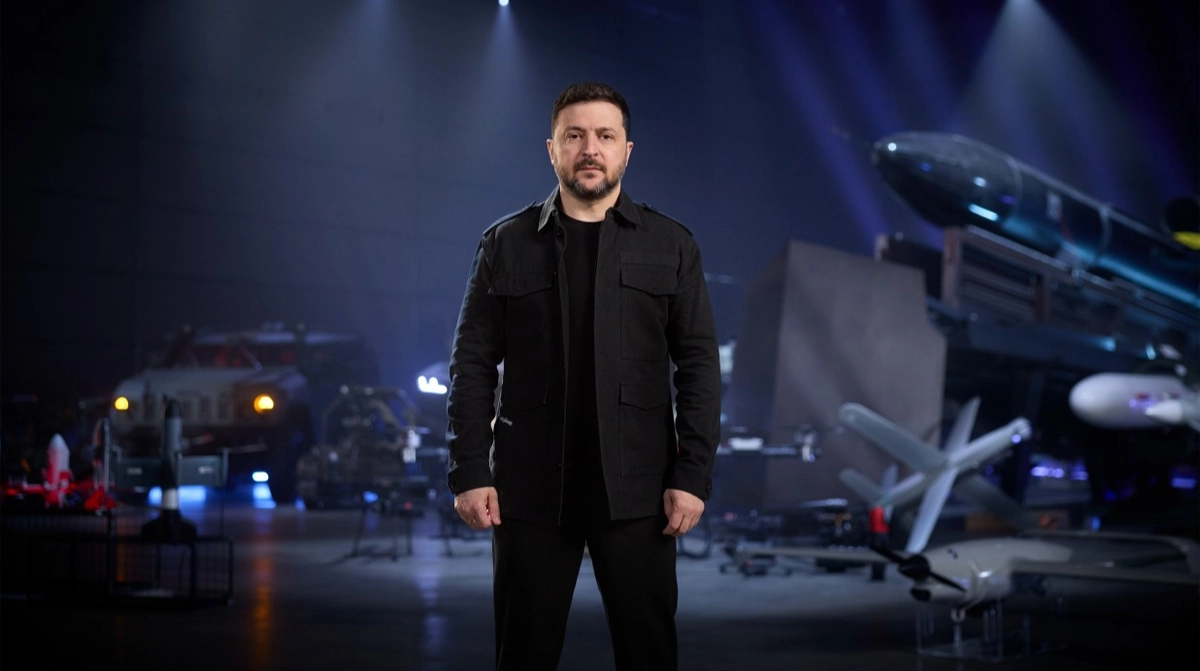
President Volodymyr Zelenskyy has announced a significant milestone in the evolution of Ukraine’s military capabilities, revealing that the country has successfully developed a powerful domestic defense industry capable of executing complex operations without the need for traditional infantry. This shift toward a roboticized approach to warfare was highlighted by a recent “unique” operation where a Russian position was captured entirely through the use of unmanned systems.
The operation, which Zelenskyy described as a first in the history of the full-scale war, saw the capture of an enemy position exclusively using drones and ground robotic platforms. According to the President, the operation resulted in the surrender of Russian forces without the involvement of infantry and without any losses to the Ukrainian Defense Forces TSN.ua.
This development underscores a broader strategic pivot in how Ukraine is managing its security and international partnerships. By building a robust domestic defense infrastructure over the last four years, Ukraine is moving toward a model of cooperation based on technological autonomy and industrial strength rather than sole reliance on external deliveries.
The integration of these technologies is already showing scale. Zelenskyy noted that domestic robotic complexes have carried out more than 22,000 missions in the last three months alone TSN.ua, signaling a systemic change in how the Armed Forces of Ukraine (AFU) engage the enemy on the ground.
The Rise of Ground Robotic Complexes (GRCs)
The success of the recent operation relies on a suite of indigenous Ukrainian developments known as Ground Robotic Complexes (GRCs) or Nazemni Roboty-Kompleksy (NRK). These platforms are designed to perform high-risk tasks, from reconnaissance to direct combat and the capture of positions, effectively removing soldiers from the immediate line of fire.
President Zelenskyy specifically highlighted several domestic developments that are currently demonstrating high efficiency on the battlefield. These include platforms such as “Ratel,” “Termit,” “Ardal,” “Rys,” “Zmey,” “Protektor,” and “Volya” TSN.ua.
The use of these GRCs represents a fundamental change in tactical warfare. By leveraging unmanned platforms to secure positions and force surrenders, Ukraine is reducing the human cost of offensive operations. The ability to capture control of a position “exclusively” with drones and robotic systems suggests a level of coordination and technological maturity that allows for the remote management of a battlefield environment.
Strategic Shifts in Defense Cooperation
Beyond individual tactical successes, the President emphasized that Ukraine has spent the last four years building a new defense industry. This industrialization is intended to change the model of cooperation with international partners. Rather than acting simply as a recipient of military aid, Ukraine is positioning itself as a producer of cutting-edge military technology.
This transition is critical for the long-term sustainability of the Ukrainian defense effort. By developing a domestic pipeline for drones and robotic complexes, Ukraine reduces its vulnerability to delays in foreign supply chains and creates a feedback loop where frontline combat data is used to rapidly iterate and improve domestic hardware.
Operational Readiness and the Easter Truce
Although the focus on robotic warfare continues, the Ukrainian leadership is also managing the complexities of temporary ceasefires. In a series of updates on April 11, 2026, President Zelenskyy outlined the parameters for the Armed Forces of Ukraine’s response during a potential Easter truce Fakty ICTV.
Zelenskyy stated that Ukraine would adhere to a “regime of silence” provided there are no attacks from the Russian Federation. But, he clarified that the AFU would respond “mirrorly” to any violations. Which means that the absence of Russian strikes in the air, on land, and at sea would result in a corresponding absence of Ukrainian responses Fakty ICTV.
The President noted that these response parameters were determined following consultations with military leadership, including Commander-in-Chief Oleksandr Syrskyi, Secretary of the NSDC Rustem Umerov, and representatives of the Security Service of Ukraine (SBU) Obozrevatel. Every Ukrainian unit retains the right to respond to provocations to ensure the safety of the forces during the holiday period.
Key Takeaways on Ukraine’s Defense Evolution
- Robotic Breakthrough: For the first time in the full-scale war, a position was captured using only drones and GRCs, with no infantry involvement and zero Ukrainian losses.
- Industrial Scale: Domestic robotic complexes have completed over 22,000 missions in the last three months.
- Technological Suite: Key domestic platforms include Ratel, Termit, Ardal, Rys, Zmey, Protektor, and Volya.
- Strategic Pivot: Ukraine is shifting from a recipient-only model to a producer-partner model in its international defense cooperation.
- Mirror Response: During the Easter truce, Ukraine will maintain silence unless provoked, responding mirrorly to any Russian aggression.
As Ukraine continues to integrate unmanned systems into its core strategy, the focus remains on maximizing the efficiency of these “robotic” operations to preserve human life while maintaining pressure on the front. The next official updates regarding the status of the Easter truce and the deployment of new GRC models are expected as the holiday period concludes.
World Today Journal encourages readers to share this report and leave comments regarding the impact of autonomous systems on modern conflict.
Keep reading
- 致癌油引爆民怨!「725反毒油」20萬白衣軍湧凱道 震撼人潮畫面曝光 – Yahoo新聞
- Moyen-Orient : Israël prépare une « vaste opération » et de nouvelles implantations en …
- Alex Mariah Peter Reveals 30-Kilogram Weight Loss Transformation (archyworldys.com)
- Canine Pregnancy Diagnosis: X-Ray Reveals Fetus, 1-3 Days Post-Mating (world-today-news.com)