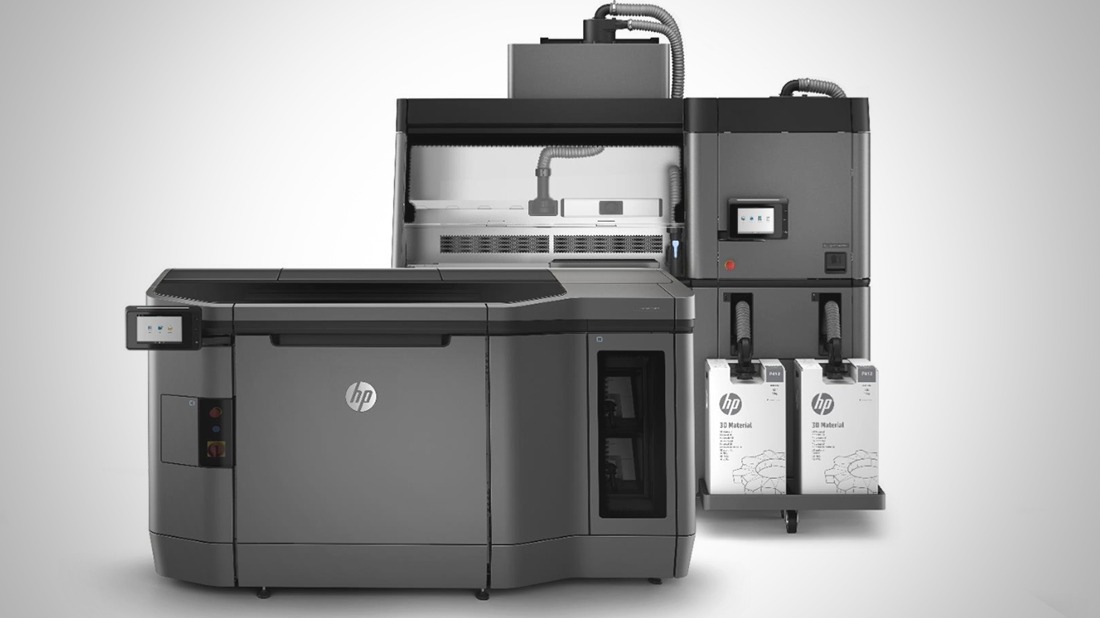
HP has unveiled its compact Multi Jet Fusion 1200 3D printer, bringing industrial-grade additive manufacturing technology to smaller facilities through a 12-liter build volume system. Announced at the RAPID+TCT 2026 trade show, the MJF 1200 represents HP’s effort to make its established Multi Jet Fusion technology more accessible to businesses that previously lacked the space or budget for larger industrial systems.
The printer is designed to deliver strong, accurate, and watertight parts with fine detail by using a combination of fusing and detailing agents with area-wide fusing technology. This approach enables the production of complex geometries that cannot be made by other manufacturing methods, according to HP’s technical documentation on the Multi Jet Fusion process.
HP positions the MJF 1200 as a solution for design prototyping and low-volume production, with early testers reporting that it helps validate designs without requiring changes to existing workflows. The system comes bundled with Magics Print for HP, a build-preparation software powered by Materialise that handles nesting, part orientation, and build layout to streamline the printing process.
Automated features including material mixing, build preparation, and unpacking are intended to reduce manual intervention, making the technology more accessible to operators without extensive 3D printing expertise. HP states that these automation capabilities contribute to consistent part quality and improved operational efficiency in small to medium-sized production environments.
The HP Multi Jet Fusion 1200 is expected to ship from early 2027, following its announcement at RAPID+TCT 2026. This timeline allows for final testing and preparation before market release, with HP targeting facilities that want to bring manufacturing capabilities closer to where product development occurs.
In related developments, HP announced a High Productivity print mode for its existing Jet Fusion 5600 series that boosts output by 20%. This enhancement aims to increase throughput for current users of the 5600 series without requiring hardware changes, demonstrating HP’s ongoing investment in improving its established product lines.
The Jet Fusion 5600 series will also gain support for HP 3D High Reusability PA 12 Glass Beads, a material formulated to produce stiff, dimensionally stable parts suitable for functional applications requiring mechanical precision. This material expansion addresses customer demand for engineering-grade polymers that maintain accuracy across multiple build cycles.
HP Multi Jet Fusion Dual Tone technology, which enables printing in white and grey to create textures, QR codes, markings, and labels, is scheduled to arrive on the 5600 series in late 2026. This capability allows for functional marking and identification directly during the printing process, eliminating post-processing steps for certain applications.
According to Alex Moñino, SVP and GM of HP Additive Manufacturing Solutions, these advancements reflect HP’s focus on bringing industrial-grade capabilities closer to where ideas take place. He noted that the company marked a decade of innovation in additive manufacturing with these portfolio updates, emphasizing accessibility and workflow integration.
The announcement also revealed that ADDMAN recently purchased 13 new HP printers to expand its installed base of HP equipment, indicating continued confidence in HP’s technology among manufacturing service providers. This investment suggests growing adoption of Multi Jet Fusion systems in production environments requiring reliable, repeatable results.
For medical sector applications, LualdiLabs participated as a beta tester for the MJF 1200, exploring how the compact system could bring manufacturing closer to clinical settings. CEO Redouane Selmoune described the technology as “a new model of care,” pointing to potential applications in producing patient-specific medical devices or surgical guides at the point of care.
Design prototyping firm Anima Design also tested the MJF 1200, with Eric Paris, their Design Prototyper, stating that the machine “delivers industrial-grade parts in a compact format” and helps validate designs without changing workflows. This feedback highlights the printer’s suitability for iterative design processes where speed and accuracy are critical.
The 12-liter build volume of the MJF 1200 positions it between desktop and industrial systems, offering a mid-range option for businesses that need more capacity than benchtop printers provide but do not require the full scale of HP’s larger Jet Fusion systems. This size allows for printing multiple parts simultaneously or producing moderately sized functional prototypes.
HP’s Multi Jet Fusion technology distinguishes itself from other 3D printing methods through its agent-based fusing process, which selectively applies thermal energy to powdered material. Unlike laser-based systems that trace patterns point-by-point, MJF uses inkjet arrays to deposit fusing and detailing agents across the entire build area, followed by energy exposure to fuse the material uniformly.
This area-wide approach contributes to faster print speeds and more consistent mechanical properties in the Z-axis (vertical direction) compared to some layer-by-layer techniques. The technology also enables high detail resolution and smooth surface finishes, reducing the need for extensive post-processing in many applications.
Material reusability is another key aspect of HP’s Multi Jet Fusion system, with unused powder being recoverable and recyclable for future builds. The High Reusability PA 12 Glass Beads material specifically addresses concerns about material degradation over multiple cycles, maintaining consistent part quality even after several uses.
As HP prepares for the 2027 launch of the MJF 1200, the company continues to emphasize the importance of integrated solutions that combine hardware, software, and materials. The bundling of Magics Print for HP reflects this strategy, aiming to simplify the entire workflow from file preparation to finished part.
The development of these technologies occurs within the broader context of growing interest in distributed manufacturing and on-demand production capabilities. By making industrial 3D printing more accessible in terms of size, cost, and operational complexity, HP aims to enable more businesses to adopt additive manufacturing for prototyping, tooling, and end-use parts.
For the latest updates on HP’s Multi Jet Fusion product lineup and release schedules, interested parties can refer to HP’s official additive manufacturing news channels and product pages. The company typically provides detailed specifications, pricing information, and availability timelines through these official communication channels as launch dates approach.
What are your thoughts on the role of compact industrial 3D printers like the HP MJF 1200 in expanding access to advanced manufacturing technologies? Share your perspective in the comments below and help spread the conversation by sharing this article with others interested in manufacturing innovation.
Worth a look