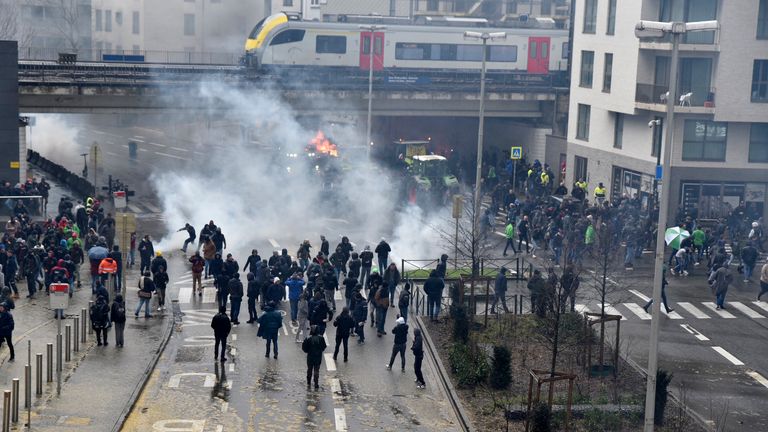
In the evolving landscape of Belgian politics, language and rhetoric continue to serve as lightning rods for public discourse. Recently, Vooruit leader Conner Rousseau found himself at the center of a renewed debate regarding his choice of words following a protest in Brussels. The incident, which centered on his use of the term “krapuul” (scum/rabble) to describe participants in a demonstration, has once again highlighted the tension between political expression and the expectations of public office.
Rousseau, who has navigated a series of high-profile controversies throughout his tenure, addressed the situation by shifting the focus toward the challenges faced by law enforcement officers tasked with maintaining order in the capital. By stating that he felt sympathy for the police officers working the front lines of the protest, the politician attempted to reframe the narrative from one of insult to one of solidarity with public servants. This episode underscores the ongoing friction between the right to free speech and the decorum expected of political leaders in an increasingly polarized European climate.
The Context of the Controversy
The term “krapuul” carries significant weight in the Dutch language, often used to denote individuals perceived as rowdy, criminal, or fundamentally disruptive to societal norms. When applied to protesters, it inevitably draws sharp criticism from civil liberties groups and political opponents who view such labels as dehumanizing. The incident in Brussels—a city that frequently serves as a focal point for large-scale demonstrations—was marked by significant police presence, as reported by VRT NWS, the Belgian public broadcaster that tracks such developments in the capital.

Rousseau’s comments came in the wake of a demonstration where police were subjected to physical and verbal abuse. In his defense, the Vooruit leader argued that his frustration was directed specifically at the violent elements within the crowd, rather than the act of protesting itself. This distinction is crucial in the Belgian political context, where the thin line between legitimate dissent and public disorder is a subject of constant debate in the Federal Parliament.
Political Repercussions and the Rhetoric of Leadership
For a political figure like Conner Rousseau, every public utterance is measured against his party’s platform and the broader electoral climate. The use of inflammatory language often forces a choice: retreat and apologize, or double down and justify the intent. By emphasizing that he “had pity” for the officers, Rousseau opted for a strategic pivot. He sought to align himself with the security forces, a move often favored by centrist and center-left parties looking to avoid being perceived as “soft on crime” during periods of urban unrest.

However, critics argue that such language from a national politician does little to de-escalate tensions. In a diverse and densely populated city like Brussels, where social cohesion is a primary concern for local government, the vocabulary used by national leaders can have ripple effects on local policy and community relations. The City of Brussels authorities have frequently called for moderation in political discourse to prevent further polarization, particularly during times of intense public protest.
The Role of Law Enforcement in Public Protest
The challenges faced by the Brussels police are well-documented. According to recent reports from the Federal Police, maintaining safety during large-scale demonstrations requires a delicate balance between facilitating the right to assemble and preventing damage to public property or harm to individuals. When politicians weigh in on these events, they often shift the public conversation away from the root causes of the protests and toward the management of the symptoms—namely, the police response.
Rousseau’s attempt to highlight the plight of the officers is reflective of a broader European trend where politicians are increasingly vocal about the pressures on police forces. Whether this stance will bolster his standing among voters or alienate those who value a more cautious approach to language remains to be seen in the upcoming polling data. In Belgium, where coalition governments are the norm, maintaining a broad appeal is essential for survival in the political arena.
Looking Ahead at the Political Landscape
As the political season intensifies, the scrutiny of Rousseau’s rhetoric is unlikely to subside. The impact of such statements on party unity and voter sentiment will be a key metric to watch as the next cycle of regional and federal elections approaches. The Vooruit party, currently navigating a complex period of transition and consolidation, will need to manage these individual controversies carefully to ensure they do not overshadow their broader policy goals, such as social welfare reform and economic stability.

The next major checkpoint for these discussions will be the upcoming parliamentary sessions, where the behavior of protesters and the subsequent police responses are expected to be debated in detail. For now, the episode serves as a reminder of the volatility of modern political communication, where a single word can ignite a firestorm that persists long after the protest itself has dispersed.
What are your thoughts on the balance between political candor and the impact of inflammatory language? Join the conversation in the comments section below and share this report with your network to keep the dialogue moving.
Related reading