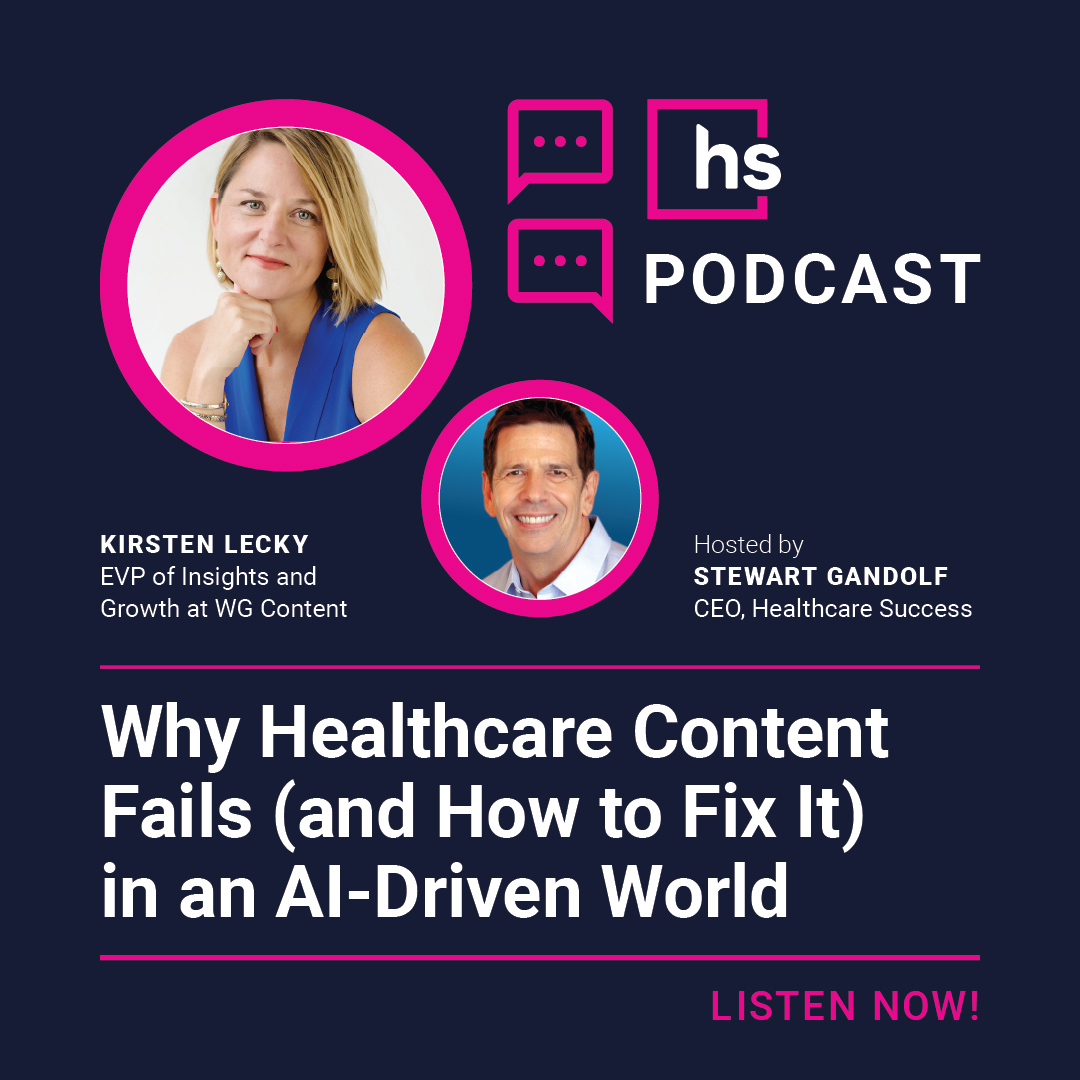
The Dual Mandate: Navigating Healthcare Content Strategy in the AI Era
The digital landscape for medical providers is undergoing a seismic shift. For years, the playbook for healthcare organizations was relatively straightforward: optimize for specific keywords, maintain a functional website and ensure clinical accuracy. However, the rapid integration of generative AI and Large Language Models (LLMs) is rewriting these rules in real time. As patients transition from typing queries into traditional search engines to engaging in conversational interactions with AI, the fundamental way healthcare brands are discovered—and subsequently chosen—is changing.
In this evolving environment, a successful healthcare content strategy in the AI era must move beyond simple visibility. It requires a sophisticated balance between two competing priorities: the technical science of discoverability and the human art of building trust. If an organization can be found but fails to inspire confidence, the digital journey ends in a bounce rather than a booking. Conversely, if a provider is highly trusted but remains invisible to AI-driven search, their expertise remains untapped.
As we observe these shifts, it is becoming clear that “marketing” in the clinical space is perhaps better understood as “communication.” The goal is not merely to acquire patients through aggressive tactics, but to inform, educate, and guide individuals toward the care they need. This requires navigating complex internal dynamics, mastering new technical optimization standards, and maintaining an unwavering commitment to health literacy.
The Shift from Search to Recommendation: Understanding AEO
Traditional Search Engine Optimization (SEO) has long been the cornerstone of digital visibility. The objective was to rank highly for specific terms, providing a list of options for the user to browse. However, the rise of conversational AI is introducing a new paradigm: Answer Engine Optimization (AEO). Unlike traditional search engines that present a directory of links, AI models like ChatGPT, Claude, and Google’s AI Overviews are designed to synthesize information and provide direct recommendations.
This transition from “listing options” to “making recommendations” fundamentally alters AI-driven search behavior. When a user asks an AI, “Where is the best orthopedic surgeon for ACL repair in Berlin?” the model does not just look for keywords; it looks for context, reputation, and holistic brand signals. If your organization is not part of the AI’s synthesized answer, you may effectively cease to exist in the eyes of the modern consumer. To remain competitive, healthcare marketers must shift their focus from repetitive keyword targeting to building a comprehensive, contextual content ecosystem.
This new approach demands that organizations provide depth across various topics, and audiences. Instead of creating dozens of thin pages targeting slight variations of a single keyword, the focus must turn to building authority through comprehensive content that helps AI models understand a brand’s full scope. This includes everything from specialized service line details to the underlying values and philosophies of the institution. In the age of LLMs, the machines are no longer just looking for matches; they are looking for meaning.
the importance of “reputation signals” cannot be overstated. AI models prioritize information that is validated across the web. This means that provider biographies, clinical awards, research citations, and patient testimonials are no longer just “nice-to-have” marketing assets; they are critical data points that AI uses to verify your expertise and include you in its recommendations. To succeed in AEO, your digital footprint must be consistent, authoritative, and deeply integrated across the entire web ecosystem.
The Science and the Art: Balancing Discoverability and Trust
To master a modern content strategy, leaders must view their work through a dual lens: the science of being found and the art of being chosen. This distinction is vital for maintaining patient discoverability and trust in a landscape where the speed of information often outpaces the depth of understanding.
The “science” of content is technical and analytical. It encompasses traditional SEO, the emerging field of AEO, and the management of technical metadata. This side of the strategy ensures that when a patient—or an AI—searches for a specific medical condition or specialty, your organization appears in the results. It is about technical precision, site architecture, and ensuring that your digital presence is structured in a way that both humans and machines can easily parse.

The “art,” however, is what happens once the user arrives at your site. What we have is the realm of storytelling, credibility, and emotional connection. Once a patient has discovered your institution, they are looking for reasons to trust you with their health. This is achieved through transparent communication, compelling patient narratives, and the clear articulation of your clinical credentials. While the science gets you through the door, the art is what convinces the patient to move forward with an appointment.
As a physician, I have seen how critical this “art” is during the most vulnerable moments of a patient’s journey. Technical accuracy is a baseline requirement, but it is rarely what builds a lasting relationship. Patients do not just want to know that a surgeon is highly trained; they want to know the philosophy behind their care and how they treat the person, not just the pathology. A content strategy that ignores the human element in favor of pure technical optimization will inevitably fail to convert discovery into meaningful action.
The Stakeholder Paradox: Why Content Fails in the Review Room
One of the most persistent and underestimated challenges in healthcare marketing is not the lack of strategy, but the breakdown of the execution process—specifically during the clinical review phase. This is where stakeholder alignment becomes the primary determinant of success or failure. In a healthcare setting, content must satisfy multiple, often conflicting, objectives.
On one hand, marketing teams must ensure content is optimized for search intent, adheres to brand voice, and remains accessible to a lay audience. medical subject matter experts (SMEs) and clinicians are responsible for clinical accuracy and professional authority. This creates a natural tension. A clinician may feel that a piece of content is “too simple” or lacks the sophisticated terminology required to maintain professional credibility. However, when marketing teams allow academic or overly technical language to dominate, they risk diluting the message and severely impacting the content’s effectiveness.
This tension directly affects health literacy. Research consistently shows that even highly educated patients prefer clear, scannable, and plain language when seeking medical information. When the review process allows technical jargon to override accessibility, the content becomes a barrier rather than a bridge. If a patient cannot easily understand the information being presented, they are likely to abandon the site in favor of a source that communicates more effectively. In this sense, “simplifying” content is not a reduction of quality, but an increase in utility.
To mitigate this, healthcare leaders must move from a model of “subjective opinion” to one of “objective strategy.” This requires orienting stakeholders to the goals of the project from the extremely beginning. Rather than presenting a finished draft for approval, successful organizations involve clinicians early in the process, helping them understand that a single webpage is only one part of a larger, interconnected digital ecosystem. By setting clear expectations—explaining why certain language choices are made and how different types of content serve different stages of the patient journey—marketing teams can build the trust necessary to navigate the review process without sacrificing performance.
Maintaining Quality in the Age of Accelerated Production
The advent of generative AI in healthcare marketing has introduced an unprecedented pressure for speed and scale. AI tools allow for the rapid generation of drafts, social media posts, and educational materials, which can significantly reduce production timelines and costs. However, this efficiency comes with a profound risk: the “watered-down” content trap.
There is a growing danger that the healthcare digital landscape will become flooded with “vanilla” content—generic, repetitive, and ultimately unhelpful information that is merely a regurgitation of existing web data. Because many AI models are trained on existing internet content, they risk creating a feedback loop where machines are essentially “eating each other,” producing increasingly diluted versions of the same information. In a field as sensitive as medicine, where accuracy and differentiation are paramount, this trend is particularly hazardous.
To combat this, healthcare organizations must adopt an “AI-forward, human-centered” approach. AI should be utilized to handle mundane, repetitive tasks—such as initial research, outlining, or metadata generation—thereby freeing up human experts to focus on high-value, high-impact work. The goal should be to use AI to enhance human expertise, not to replace it. The most valuable content will always be that which provides unique clinical insights, original research, or deeply personal human stories—elements that a large language model cannot authentically replicate.
the “speed, quality, budget” trilemma remains as relevant as ever. While AI can provide speed and budget efficiency, organizations must be disciplined in ensuring that quality is not the casualty. In healthcare, the cost of a quality compromise is not just a lost lead; it is a potential issue of clinical misinformation and professional liability. Maintaining a rigorous, human-led editorial process is the only way to ensure that the speed of AI does not compromise the integrity of the brand.
Key Takeaways for Healthcare Leaders
- Content has two distinct roles: It must be optimized for discoverability (the science of SEO/AEO) and designed for trust (the art of storytelling and credibility).
- The search paradigm is shifting: Move from keyword-centric SEO to context-centric AEO to ensure your brand is recommended by AI models.
- Prioritize health literacy: Avoid the “technical trap” during clinical reviews. Use plain language and scannable formats to ensure content is accessible to the actual audience.
- Align stakeholders early: Prevent content failure by orienting clinicians to the broader digital strategy before the review process begins.
- Use AI as an enhancer, not a replacement: Leverage AI for efficiency, but rely on human expertise to provide the unique, high-quality insights that build true authority.
As digital discovery continues to evolve, the organizations that thrive will be those that view content not as a commodity to be produced, but as a vital medium of communication. By balancing the technical demands of the AI era with an unwavering focus on human connection and clinical truth, healthcare providers can ensure they are not only found but, more importantly, chosen.
For further updates on healthcare innovation and digital health policy, please subscribe to our newsletter and share this analysis with your professional network.