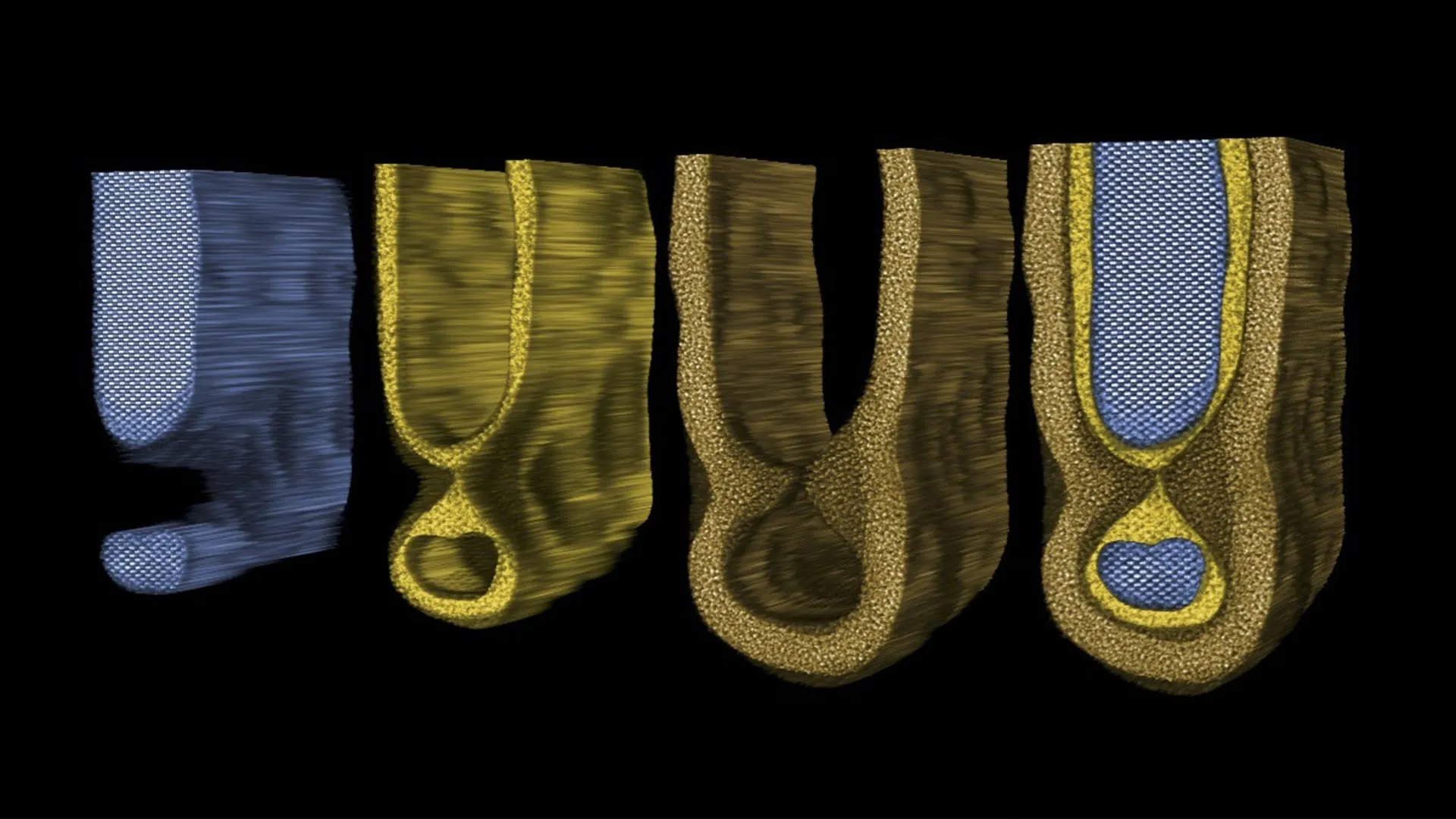
Scientists have achieved a significant breakthrough in semiconductor research by developing an imaging technique capable of revealing atomic-scale defects inside computer chips for the first time. This advancement, led by researchers at Cornell University in collaboration with industry partners, allows scientists to visualize imperfections so small they are measured in single atoms—flaws that can disrupt electron flow in transistors critical to modern electronics.
The technique, based on advanced electron microscopy, enables researchers to map the precise positions of atoms within transistor channels that are only 15 to 18 atoms wide. Using this method, the team identified tiny structural irregularities nicknamed “mouse bites” due to their appearance in the imaging data. These defects form during the complex manufacturing process and can interfere with how electrons move through a chip’s conducting pathways, potentially affecting performance, power efficiency, and reliability.
The research was conducted through a partnership between Cornell University, Taiwan Semiconductor Manufacturing Company (TSMC), and Advanced Semiconductor Materials (ASM). According to the findings published in Nature Communications on February 23, 2026, the imaging approach combines high-resolution electron ptychography with an electron microscope pixel array detector (EMPAD) to capture detailed scattering patterns. This computational method reconstructs the internal structure of transistors with exceptional clarity, making it possible to observe features previously invisible to conventional imaging tools.
David Muller, the Samuel B. Eckert Professor of Engineering at Cornell’s Duffield College of Engineering, led the project. He emphasized that the ability to see these atomic-scale flaws provides a critical tool for debugging and fault-finding during chip development. “Since there’s really no other way you can see the atomic structure of these defects, What we have is going to be a really significant characterization tool,” Muller stated in the Cornell University release accompanying the study.
The study’s lead author was doctoral student Shake Karapetyan, who contributed to the development and application of the imaging protocol. The research team focused on advanced transistor architectures used in logic chips, where channel dimensions continue to shrink in line with industry scaling trends. At such small scales, even a single missing or misplaced atom can significantly alter electrical behavior, making defect detection essential for maintaining yield and performance in high-volume production.
Electron ptychography, the core technique employed, works by scanning a focused electron beam across a sample and recording how electrons scatter after passing through the material. Rather than forming a direct image, the detector captures diffraction patterns that are then processed using algorithms to reconstruct a high-resolution map of the atomic structure. This approach overcomes limitations of traditional electron microscopy, which often suffers from lens aberrations and low contrast at atomic scales.
The collaboration with TSMC and ASM ensured that the research addressed real-world manufacturing challenges. TSMC, as a leading producer of advanced logic chips, has a direct interest in improving defect detection to enhance process control. ASM, which supplies materials and equipment for semiconductor fabrication, contributed expertise in thin-film deposition and interface engineering relevant to the silicon, silicon dioxide, and hafnium oxide layers examined in the study.
Because computer chips are foundational to devices ranging from smartphones and vehicles to AI data centers and quantum computing systems, improvements in defect characterization could have wide-ranging implications. The ability to identify and understand the origin of atomic-scale flaws may help refine fabrication techniques, reduce variability, and extend the limits of Moore’s Law as transistor dimensions approach fundamental physical boundaries.
The Nature Communications paper, titled “Atomic-scale imaging of defects in semiconductor transistors via electron ptychography,” details the methodology and validation steps used to confirm the presence of mouse-bite defects. Researchers compared their imaging results with computational models and cross-sectional analyses to ensure the observed features represented genuine structural variations rather than artifacts of the imaging process.
While the current study focused on specific transistor structures, the researchers suggest the technique could be adapted to other components within chips, including interconnects, gates, and insulating layers. Future work may involve applying the method to monitor defect evolution during different stages of fabrication or under operational stress conditions, such as high temperature or voltage bias.
As semiconductor manufacturing pushes toward nodes below 3 nanometers, the need for precise metrology at the atomic level grows increasingly urgent. Traditional inspection methods based on optical or scatterometry techniques lack the resolution to detect individual atom displacements, making electron-based approaches like ptychography vital for next-generation quality control.
The Cornell-led team has not announced plans to commercialize the imaging tool directly, but the knowledge gained could inform the development of future diagnostic equipment by microscope manufacturers or be integrated into in-line monitoring systems used in fabrication facilities. For now, the primary value lies in advancing scientific understanding of how defects form and behave at the limits of miniaturization.
This research builds on years of development in electron ptychography, a technique first demonstrated for biological imaging but increasingly adapted for materials science. Its application to semiconductor defects represents a convergence of advances in detector technology, computational reconstruction, and sample preparation methods that now allow routine atomic-scale imaging of beam-sensitive materials.
For readers interested in following developments in semiconductor metrology and advanced imaging techniques, official updates from Cornell University’s Department of Materials Science and Engineering, as well as publications from Nature Communications, provide authoritative sources. The study remains accessible through the journal’s open-access options, allowing broader engagement from researchers, engineers, and technologists worldwide.
Stay informed about breakthroughs in technology and science by sharing this article with colleagues and joining the conversation in the comments below.