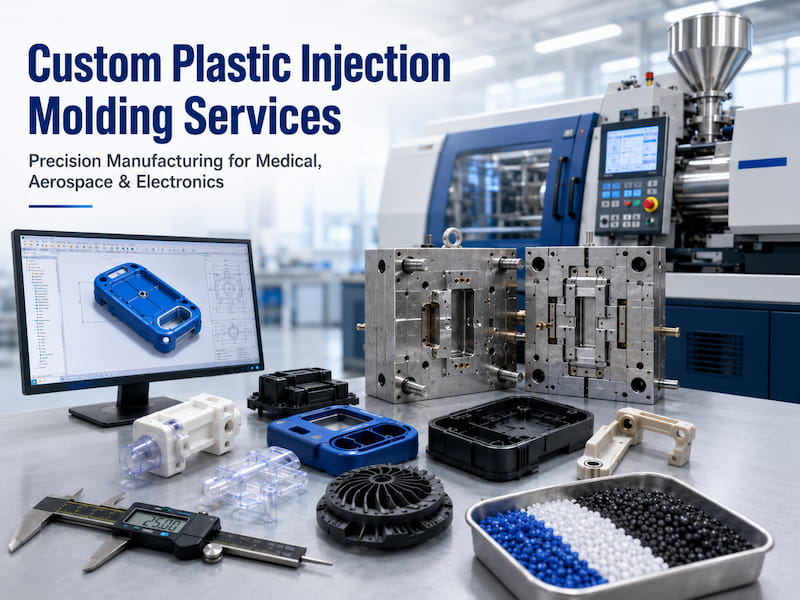
While it is easy to view injection molding as a straightforward production method of melting plastic, injecting it into a tool, cooling it, and ejecting the finished part, operational reality is considerably more intricate.
Part geometry, resin properties, wall thickness, gate placement, mold temperature, injection speed, cooling conditions, dimensional tolerances, and the intended operating environment all influence the finished product. A mistake in any of these areas can result in warpage, cracking, weak weld lines, sink marks, incomplete filling, dimensional instability, or premature product failure. For this reason, the best injection molding companies work as engineering and manufacturing partners from the earliest design stage through production, assembly, testing, and delivery.
What Are Custom Plastic Injection Molding Services?
Custom plastic injection molding is a manufacturing process in which a mold and production method are developed around the specifications of a particular component. Unlike manufacturers producing generic plastic products, custom injection molders create parts according to a client’s exact product design, performance requirements, dimensional tolerances, material specifications, and regulatory obligations.
The process typically begins with a digital part design or product concept. Engineers evaluate whether the design can be manufactured consistently using injection molding and identify changes that could improve strength, appearance, moldability, cycle time, or cost. Once the design and material have been approved, a production mold is created. Plastic resin is heated until it can flow, injected under pressure into the mold cavity, cooled until it becomes dimensionally stable, and then ejected. Although the basic production cycle may take only seconds or minutes, developing a reliable molding process requires extensive engineering, testing, and validation.
The Custom Injection Molding Process and Material Selection
A successful project generally progresses through several connected stages, starting with product and application review and moving through design for manufacturability, mold design, and material selection. Choosing a plastic resin is not simply a matter of selecting the strongest or least expensive material, as every polymer offers a different combination of mechanical, thermal, and chemical properties.
For instance, ethylene-vinyl acetate (EVA) illustrates why material selection must connect directly to the application. EVA is a flexible, lightweight thermoplastic copolymer known for its impact resistance, low-temperature toughness, water resistance, stress-crack resistance, and electrical insulation properties, making it useful in applications ranging from electrical components and medical supplies to seals, packaging, orthotics, and sporting goods. A knowledgeable molder evaluates both the resin’s published properties and how those properties may change during processing, as excessive heat, moisture, residence time, or shear can degrade certain polymers and prevent the finished component from performing as expected.
High-Precision Injection Molding and Specialized Capabilities
High-precision injection molding is used when small dimensional changes could affect product assembly, performance, safety, or reliability in medical device housings, aerospace connectors, electronic enclosures, and fluid-management parts. Producing tight-tolerance plastic parts requires control over polymer shrinkage, fiber orientation, temperature, pressure, moisture, cooling rate, and post-molding conditioning.
Beyond standard production, custom molders often provide specialized techniques such as overmolding and insert molding. Overmolding applies one material over another substrate or previously molded component—such as a flexible thermoplastic elastomer over a rigid plastic handle—to create soft-touch grips, protective seals, or vibration-damping surfaces. Insert molding places a separate component, such as a threaded metal insert, bushing, or electrical terminal, inside the mold before plastic is injected around it to create a strong connection and reduce later assembly steps.
Quality Management and Regulatory Standards
Quality management is essential when molded components are used in regulated or mission-critical products. Many custom molding partners maintain certifications such as ISO 9001:2015 to establish a framework for continuous improvement, process control, document control, lot traceability, and inspection. For medical applications, suppliers must align with strict regulatory standards; as of February 2, 2026, the United States Food and Drug Administration’s Quality Management System Regulation incorporates ISO 13485:2016 by reference for applicable finished medical device manufacturers, requiring organizations to follow rigorous quality-management rules to ensure finished devices consistently meet specifications, according to FDA regulatory guidance.
When evaluating a custom injection molding partner, manufacturers should assess technical expertise, prototyping capabilities, DFM support, secondary operations like CNC machining or ultrasonic welding, and failure-analysis services. By aligning early with an experienced engineering partner, organizations can mitigate risks, control costs, and deliver high-quality plastic components that perform reliably across demanding industrial applications.
Keep reading