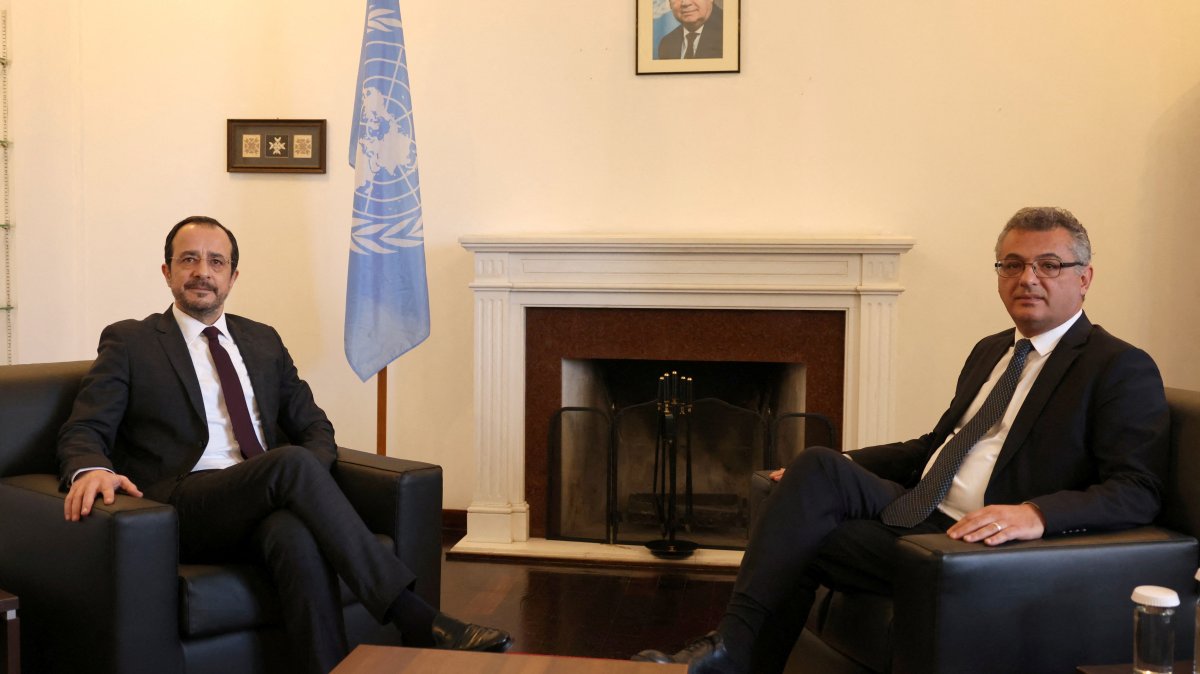
Nicosia – Renewed diplomatic efforts to resolve the decades-long division of Cyprus gained momentum this Tuesday as Greek Cypriot leader Nikos Christodoulides and Turkish Cypriot leader Tufan Erhürman held a ninety-minute meeting focused on rebuilding trust and restarting negotiations. The meeting, held at the residence of the head of the United Nations Peacekeeping Force in Cyprus (UNFICYP), Khassim Diagne, signals a potential shift in the stalled peace process, though significant hurdles remain.
The island of Cyprus has been divided since 1974, when Turkey invaded in response to a Greek Cypriot coup. The internationally recognized Republic of Cyprus controls the southern two-thirds of the island, while the Turkish Republic of Northern Cyprus (TRNC), recognized only by Türkiye, administers the north. Numerous attempts to reunify the island under a bi-zonal, bi-communal federation have failed, most recently in 2017 at Crans-Montana, Switzerland. The current discussions represent a fresh attempt to overcome longstanding disagreements and find a path toward a lasting settlement. The complexities of the Cyprus dispute are rooted in historical grievances, political differences, and competing claims to territory and resources.
A Focus on Confidence-Building Measures
According to statements released by Christodoulides following the meeting, the discussions centered on reviewing progress made on existing confidence-building measures (CBMs) and establishing guiding principles for negotiators to advance the process. These CBMs are designed to foster a more positive environment for dialogue and reduce tensions between the two communities. Specific areas of focus included crossing points between the Greek Cypriot and Turkish Cypriot sides, which allow citizens to move freely across the dividing line, and other practical steps to improve daily life for both communities. The leaders agreed to meet again soon to assess further developments and determine if conditions are ripe for resuming formal negotiations.
Christodoulides emphasized the “open and honest” nature of the conversation, noting that broader substantive issues were also addressed. He indicated a commitment to preserving the framework established in previous United Nations-led efforts, suggesting a continuation of the bi-zonal, bi-communal model as the basis for a potential solution. This framework envisions a Cyprus comprised of two constituent states, one Greek Cypriot and one Turkish Cypriot, with a federal government overseeing areas of common concern. However, significant disagreements persist regarding the powers of the federal government, the property rights of displaced persons, and the future of Turkish troops stationed in Northern Cyprus.
UN Involvement and International Pressure
The meeting took place against a backdrop of renewed international engagement in the Cyprus issue. Christodoulides has requested a meeting with UN Secretary-General António Guterres in March to brief him on the progress of the talks and seek his support for a renewed diplomatic push. He also plans to convene the Greek Cypriot National Council, a body comprising political leaders, to gather their views and build consensus around a negotiating strategy. The UN has been involved in mediation efforts in Cyprus for decades, and its continued role is seen as crucial to any potential breakthrough.
The UN Security Council is scheduled to vote on the renewal of the mandate for UNFICYP, the peacekeeping force stationed in Cyprus, in the coming months. The Security Council Report notes that the vote will take place against the backdrop of these renewed talks. UNFICYP has been present on the island since 1964, tasked with maintaining a ceasefire and preventing further violence. The renewal of its mandate is often used as leverage to encourage both sides to engage in meaningful negotiations. The current mandate is set to expire on January 31, 2026.
The Role of Political Equality
A key point of discussion, according to Christodoulides, was the reaffirmation of the principle of political equality between the two communities. This principle, which has been a central tenet of UN-led negotiations, aims to ensure that both Greek Cypriots and Turkish Cypriots have equal rights and representation in any future federal government. However, interpretations of political equality differ, with Turkish Cypriots emphasizing the need for effective participation in decision-making and safeguards against domination by the Greek Cypriot majority. The UN’s readout of the Secretary-General’s recent meetings with both leaders highlights the importance of addressing this issue to build trust and move the process forward.
A New Leadership Dynamic
The current round of talks is also notable for the change in leadership on the Turkish Cypriot side. Tufan Erhürman assumed office in October 2025, replacing Ersin Tatar. Erhürman, leader of the Republican Turkish Party (CTP), is seen as more open to compromise than his predecessor, who advocated for a two-state solution – a position rejected by the international community and the Greek Cypriot side. This shift in leadership has created a window of opportunity for renewed dialogue and a potential re-engagement with the UN-backed negotiating framework. Erhürman’s willingness to engage in discussions based on the principle of political equality is viewed as a positive sign by international observers.
The CTP’s platform emphasizes a commitment to finding a comprehensive solution to the Cyprus problem through negotiations, based on the principles of bi-zonality, bi-communality, and political equality. Erhürman has also expressed a desire to improve relations with the Greek Cypriot community and to address the humanitarian concerns of displaced persons. His approach represents a departure from the more nationalistic rhetoric of the previous administration and signals a willingness to explore new avenues for dialogue.
Challenges and Obstacles Remain
Despite the positive signals, significant challenges remain. Deep-seated mistrust between the two communities, coupled with diverging views on the core issues of the conflict, continue to pose formidable obstacles. The issue of Turkish troops stationed in Northern Cyprus remains a major sticking point, with the Greek Cypriot side demanding their complete withdrawal. The property rights of displaced persons – both Greek Cypriots who were forced to leave their homes in the north and Turkish Cypriots who were displaced from the south – remain unresolved. Finding a just and equitable solution to this issue is crucial for achieving a lasting settlement.
The differing perspectives on the future governance structure of a unified Cyprus also present a challenge. Greek Cypriots generally favor a strong central government with significant powers, while Turkish Cypriots prefer a more decentralized system that guarantees their autonomy and protects their rights. Reconciling these competing visions will require creative solutions and a willingness to compromise on both sides. The international community, particularly the UN and key stakeholders such as the United States, the European Union, and Türkiye, will play a vital role in facilitating these discussions and encouraging a constructive outcome.
The status of Varosha, a formerly thriving coastal city abandoned during the 1974 conflict and now under Turkish Cypriot control, also remains a contentious issue. The Greek Cypriot side demands the return of Varosha to its original inhabitants, while the Turkish Cypriot side has taken steps to resettle the area, a move condemned by the UN Security Council. Resolving the status of Varosha is seen as a test of the commitment of both sides to finding a mutually acceptable solution.
The economic disparities between the two communities also present a challenge. The Greek Cypriot side has benefited from EU membership and has a significantly higher standard of living than the Turkish Cypriot side. Addressing these economic imbalances and ensuring that both communities share in the benefits of a unified Cyprus will be essential for achieving long-term stability.
Looking ahead, the meeting between Christodoulides and Erhürman represents a crucial step in the ongoing efforts to revive the Cyprus negotiations. The upcoming meeting with UN Secretary-General Guterres in March will be a key moment to assess the progress made and to chart a course for future discussions. The success of this renewed diplomatic push will depend on the willingness of both sides to engage in constructive dialogue, to compromise on their long-held positions, and to prioritize the interests of all Cypriots.
The next confirmed checkpoint is the anticipated meeting between President Christodoulides and UN Secretary-General António Guterres in March. Further updates on the Cyprus negotiations can be found on the website of the United Nations Peacekeeping Force in Cyprus (https://unficyp.unmissions.org/). We encourage readers to share their thoughts and perspectives on this important issue in the comments below.
Keep reading
- Cyclospora Outbreak: Is Prewashed Lettuce Safe? How to Reduce Your Risk
- Wall Street Plummets as Fed Inflation Stance and Iran Tensions Shake Markets
- How Micro-Influencers Build Profitable Brand Partnerships (archynewsy.com)
- NBA’s Adam Silver Says Moda Center Renovation Negotiations Have Gone Off Track (time.news)