
The Czech Republic’s national anthem, “Kde domov můj,” serves as a unifying symbol for the nation, yet its origins are rooted in 19th-century theater rather than a formal state commission. Composed by František Škroup and written by Josef Kajetán Tyl, the piece first appeared in the 1834 play Fidlovačka aneb Žádný hněv a žádná rvačka, performed at the Estates Theatre in Prague. Today, the anthem remains a central element of Czech national identity, frequently performed during international sporting events and state commemorations.
As the Czech national team prepares for future international competitions, the anthem continues to hold a prominent place in the country’s cultural landscape. Understanding its history offers a glimpse into the 19th-century Bohemian National Revival, a period when artists and intellectuals sought to define a distinct Czech identity within the Austrian Empire. According to the Office of the President of the Czech Republic, the song was officially adopted as the national anthem upon the formation of Czechoslovakia in 1918 and retained by the Czech Republic following the 1993 dissolution of the federation.
The Theatrical Origins of a National Symbol
The anthem’s journey from a stage production to a national symbol began with a specific narrative intent. Josef Kajetán Tyl, a prominent playwright, penned the lyrics for the character of the blind fiddler Mareš in his play Fidlovačka. The song was designed to express a deep, personal connection to the Czech landscape. As noted by the National Radio of the Czech Republic, the melody composed by František Škroup captured the sentiment of the era so effectively that it transcended its theatrical origins almost immediately after the play’s premiere on December 21, 1834.
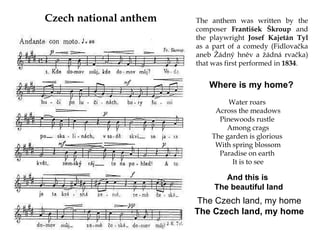
While many national anthems from the same period were written to celebrate military victories or monarchical figures, “Kde domov můj” focuses on the pastoral beauty of the Czech lands. The lyrics pose the question, “Where is my home?” and answer it through descriptions of bubbling springs, blooming orchards, and the rocky terrain of the Bohemian countryside. This focus on the land itself provided a unifying theme that resonated with the public, allowing the song to become a de facto national anthem long before it received official legal status.
Evolution of the Anthem in the 20th Century
Following the establishment of an independent Czechoslovak state in 1918, the song was formally codified as the first part of the national anthem. During the era of the unified state, the anthem consisted of two stanzas: the Czech portion, “Kde domov můj,” and the Slovak portion, “Nad Tatrou sa blýska.” The Government of the Czech Republic confirms that when the country split into the Czech Republic and Slovakia in 1993, the Czech Republic maintained the first stanza of the original hymn as its sole national anthem.
The transition from a two-part anthem to the singular Czech version was a pragmatic decision during the peaceful dissolution of Czechoslovakia. The decision ensured continuity for the Czech people while acknowledging the new status of the Slovak Republic, which adopted “Nad Tatrou sa blýska” as its own independent anthem. This historical shift underscores the importance of the anthem as a living document that has adapted alongside the political changes of Central Europe.
Cultural Significance and Modern Usage
Today, the anthem is protected and regulated by law. The Act No. 3/1993 Coll. on State Symbols of the Czech Republic mandates the respectful use of the anthem during official state ceremonies, national holidays, and international events. Its performance remains a moment of solemnity, reflecting the historical weight of the 19th-century movement that sought to preserve the Czech language and culture under imperial rule.
In contemporary settings, the anthem is most visible during international sporting matches. Fans and athletes alike adhere to the tradition of standing during the performance, a practice that serves as a modern expression of the same national sentiment that inspired Tyl and Škroup nearly two centuries ago. By linking the pastoral imagery of the 1834 play with current national pride, “Kde domov můj” continues to function as a bridge between the Czech Republic’s theatrical past and its modern global presence.
For those interested in the official protocols regarding the anthem, the Czech Ministry of the Interior provides comprehensive guidelines on the display and use of national symbols. The next major state commemoration involving the anthem is scheduled for October 28, the Independence Day of the Czech Republic, where the piece will be performed in accordance with national tradition. Readers are encouraged to share their thoughts on the cultural history of national anthems in the comments section below.
Worth a look