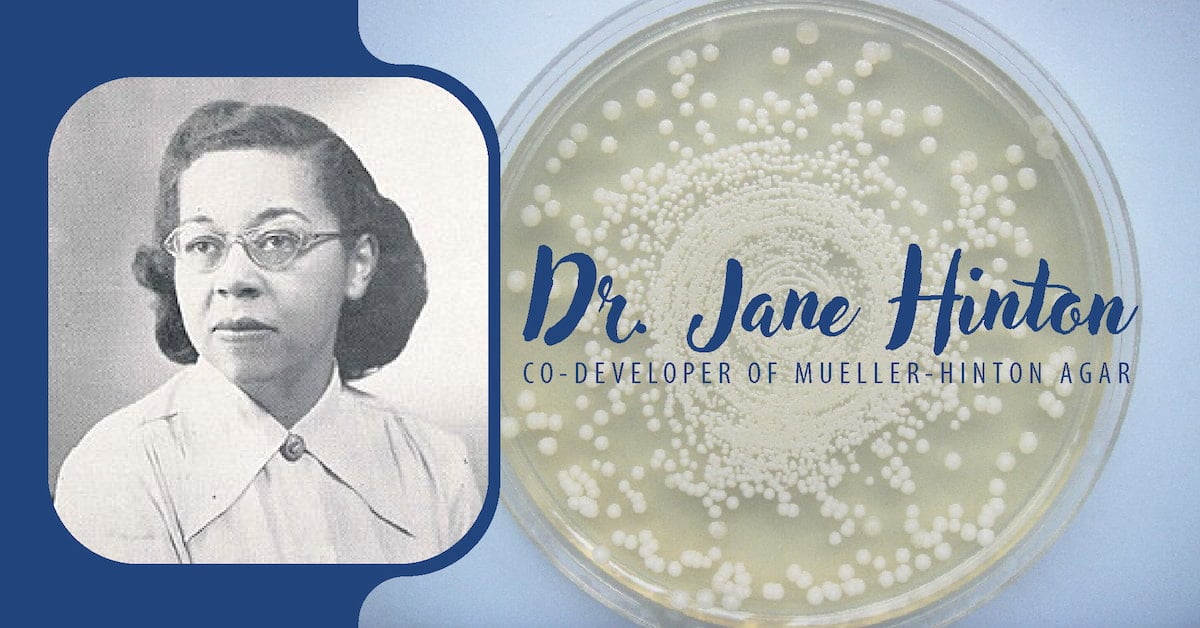
The fight against antibiotic resistance is a constant race, demanding innovation and vigilance. While much attention focuses on new drug development, the foundational tools that allow us to understand and combat bacterial threats often go unrecognized. One such critical, yet largely unsung, invention is Mueller-Hinton agar, a culture medium essential for determining the effectiveness of antibiotics. This seemingly simple substance owes its existence to the collaborative work of scientists, including a pioneering woman whose story deserves wider recognition: Dr. Jane Hinton.
Born in 1919, Dr. Hinton navigated a world rife with racial and gender barriers to become a groundbreaking figure in both microbiology and veterinary medicine. Her journey, deeply intertwined with that of her father, William Augustus Hinton – a renowned bacteriologist himself – exemplifies a commitment to scientific advancement and a determination to overcome systemic obstacles. Dr. Hinton’s legacy extends beyond the laboratory, embodying a spirit of perseverance and a dedication to improving both human and animal health.
Early Life and a Legacy of Scientific Pursuit
Jane Hinton’s upbringing was steeped in intellectual curiosity and a commitment to education. Her father, William Augustus Hinton, was a trailblazer in his own right. He was the first African American professor at Harvard University and a leading expert in the diagnosis and treatment of syphilis, developing crucial tests for the disease. As detailed in EOSCU, William Hinton faced significant racism that prevented him from securing a medical internship, leading him to pursue a career in laboratory medicine instead. This experience undoubtedly shaped his commitment to fostering opportunities for future generations of scientists.
Her mother, Ada Hawes, was also a dedicated educator, working as a Latin and English teacher at Tallahassee State College and as a social worker. This supportive and intellectually stimulating environment fostered Jane’s natural abilities. She and her sister, Anne, benefited from an education that included travel throughout Europe, broadening their perspectives and enriching their learning experiences. This early exposure to diverse cultures and ideas likely contributed to her later success and innovative thinking.
The Birth of Mueller-Hinton Agar
After completing her undergraduate degree at Simmons College in 1939, Dr. Hinton began working in the laboratories at Harvard University, where her father held a professorship. It was there, as an assistant to Dr. J. Howard Mueller at the New England Medical Center, that she played a pivotal role in developing Mueller-Hinton agar in 1941. According to her Wikipedia entry, this culture medium quickly became, and remains, a cornerstone of antibiotic susceptibility testing.
The significance of Mueller-Hinton agar lies in its specific properties. As explained by EOSCU, it is a nonselective, nondifferential medium, meaning it allows a wide range of pathogens to grow. The inclusion of starch absorbs toxins released by the bacteria, preventing interference with antibiotic testing. Its loose consistency allows for optimal diffusion of antibiotics, ensuring accurate results. These characteristics make it an ideal platform for determining which antibiotics are effective against specific bacterial strains.
Wartime Service and a Pioneering Veterinary Career
Dr. Hinton’s contributions extended beyond the laboratory during World War II. She worked as a civilian medical technician in the lab of Hildrus Augustus Poindexter, focusing on mitigating the impact of malaria and schistosomiasis on U.S. Servicemen. This work was crucial in protecting the health of troops deployed overseas, and Dr. Poindexter was recognized with a Bronze Star for his efforts.
Following her wartime service, Dr. Hinton pursued her passion for animal health, enrolling at the University of Pennsylvania’s School of Veterinary Medicine. In 1949, she and Dr. Alfreda Webb of Tuskegee University made history as the first African American women to earn Doctor of Veterinary Medicine degrees in the United States. They also became the first African American members of the Women’s Veterinary Medicine Association, breaking down barriers and paving the way for future generations of diverse veterinary professionals.
A Career of Service and Lasting Impact
After graduating, Dr. Hinton returned to Massachusetts, establishing a veterinary practice in Canton until 1955. She then transitioned to a career as a federal government inspector with the Department of Agriculture, stationed in Framington, MA. For decades, she investigated disease outbreaks in livestock, contributing to the health and safety of the nation’s food supply. She continued this work well into the 1980s, demonstrating a lifelong commitment to public service.
Dr. Hinton passed away in 2003, leaving behind a remarkable legacy. Her contributions to microbiology, veterinary medicine, and public health are a testament to her intelligence, dedication, and resilience. While her role in developing Mueller-Hinton agar is often overlooked, it remains a vital tool in the ongoing battle against antibiotic resistance, a challenge that continues to threaten global health security.
The Ongoing Threat of Antibiotic Resistance
The development of antibiotic resistance is a growing global health crisis. Bacteria evolve rapidly, and the overuse and misuse of antibiotics accelerate this process. As bacteria become resistant to more and more drugs, infections become harder to treat, leading to longer hospital stays, higher medical costs, and increased mortality rates. Tools like Mueller-Hinton agar are essential for monitoring resistance patterns and guiding appropriate antibiotic apply.
The work of Dr. Hinton and Dr. Mueller, continues to have a profound impact on modern medicine. By providing a reliable method for testing antibiotic susceptibility, Mueller-Hinton agar empowers healthcare professionals to make informed decisions about treatment, helping to slow the spread of resistance and protect vulnerable patients.
Looking ahead, continued research and development of new antibiotics, coupled with responsible antibiotic stewardship, are crucial to addressing this challenge. But it’s equally important to recognize and celebrate the foundational contributions of scientists like Dr. Jane Hinton, whose ingenuity and perseverance laid the groundwork for our current understanding of bacterial resistance and our ability to combat it.
The World Health Organization continues to monitor and report on the global spread of antimicrobial resistance. Their latest data and recommendations can be found on their website: https://www.who.int/antimicrobial-resistance. Further updates on research into new antibiotics and resistance mechanisms are regularly published in journals such as *The Lancet Infectious Diseases* and *The New England Journal of Medicine*.
What are your thoughts on the importance of recognizing the contributions of often-overlooked scientists? Share your comments below, and please share this article to help spread awareness of Dr. Jane Hinton’s remarkable story.
Related reading