
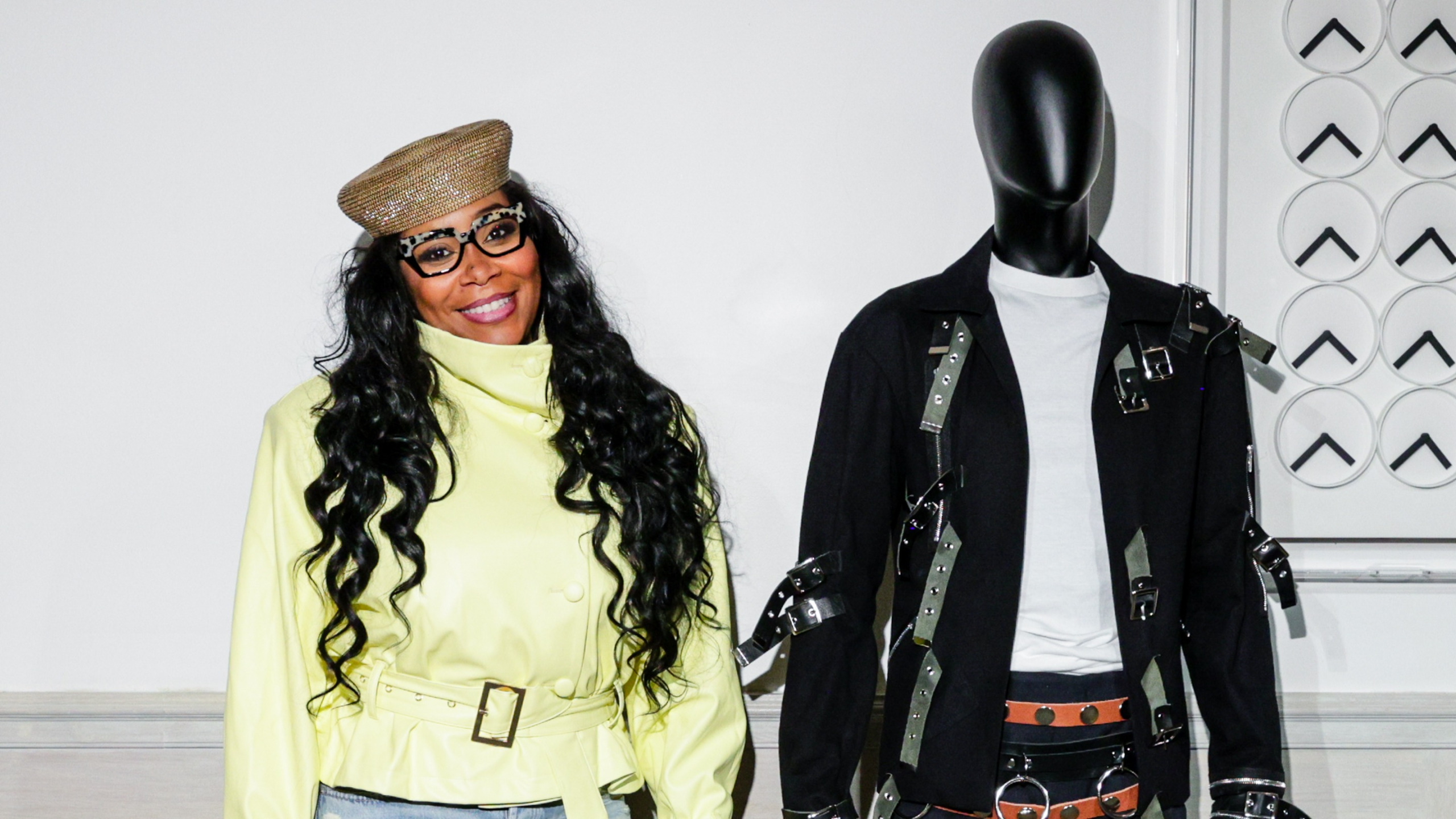
In the world of film and television, costume design is often seen as a supporting art—visible, but secondary to performance and direction. Yet when the subject is a cultural icon like Michael Jackson, the role of the costume designer shifts from mere clothing selection to historical stewardship. Every stitch, bead, and seam becomes an act of preservation, not just for the character on screen, but for the legacy of a global phenomenon whose image remains deeply embedded in collective memory.
This represents the space in which Marci Rodger operated as the costume designer behind the 2025 biopic Michael, a film that traces the life and career of the King of Pop from his early days with the Jackson 5 to his meteoric rise as a solo superstar. Rodger’s perform on the film did not begin with sketches or mood boards, but with years of immersive research rooted in personal history and cultural memory. Speaking at an advanced screening of the film in partnership with the Black in Fashion Council and Lionsgate, moderated by Asia Ware of The Cut, Rodger described her journey into the role as less a career move and more a calling.
“Do you really want to know the answer?” she said when asked how she landed the position. “It was God. And that’s the only answer.”
That sense of purpose permeated every phase of her process, from digging through vintage issues of Jet and EBONY magazines in her parents’ home to studying original garments in museums and private collections. Her preparation was not casual nostalgia—it was forensic.
“Before there were fittings, there was research. Not the kind you Google and call it a day, but the kind you inherit,” Rodger explained. “I grew up seeing Michael Jackson not as a distant icon, but as part of the cultural fabric—someone my family talked about, celebrated, and studied.”
That foundation led her to examine details others might overlook. One notable example was the Grammy Award jacket worn by Jackson in 1984, when he won a record-breaking eight awards in a single night. While many online sources described the jacket as covered in sequins, Rodger’s close examination of archival footage and surviving garments revealed a different truth: the shimmer came not from sequins, but from thousands of tiny, hand-sewn beads.
“I’m very proud of myself when it came to the devil in the details,” she said. “But it doesn’t read as ego. It reads as standard.”
That commitment to precision extended across every era of Jackson’s life depicted in the film. Rodger did not favor one period over another; instead, she viewed each phase as part of a continuous narrative of artistic evolution. Still, she returned repeatedly to the Jackson 5 era—not for sentimental reasons, but because it represented the foundation of Jackson’s discipline, work ethic, and stage presence.
“That Midwest energy. That early training. That’s where you see the raw material before it became a global phenomenon,” she said. “And I saw myself in that. A kid from the Midwest, learning to carry something bigger than myself.”
As the film progresses through different phases of Jackson’s life—from the Motown years to the Thriller era and beyond—Rodger tracked each shift with meticulous attention to costume evolution. She avoided improvisation or reinterpretation for the sake of personal flair. Instead, her goal was fidelity: to reflect what was worn, when, and why.
Of course, not every garment could be recreated exactly. Legal and intellectual property restrictions prevented direct replication of certain iconic looks, such as the Pepsi-colored jacket Jackson wore in a 1984 commercial that ended in a filming accident. In those cases, Rodger adopted a strategy of respectful approximation—getting as close as possible without infringing on protected designs.
“I definitely wanted to replicate it,” she said. “But that was beyond my control.”
This tension between authenticity and limitation, she noted, is where many costume projects falter. But for Rodger, it became a catalyst for deeper creativity—one rooted not in reinvention, but in reverence.
Perhaps the most profound aspect of her approach was her understanding that Jackson’s clothing was not mere decoration. It was functional, even essential, to his performance. To ensure authenticity, she worked closely with actor Jafar Jackson—Michael’s nephew, who portrays him in the film—to ensure the costumes could be worn not just on camera, but during rehearsals and movement breakdowns.
“If the clothes looked lived in, it’s because they were,” Rodger said. “Jafar needed them in rehearsal. He needed the weight of the jacket, the restriction of the layers, the way the shoes felt after hours of dancing. Those physical cues turn movement into memory.”
She adjusted shoes when his feet began to blister. She reworked seams to allow greater mobility. The goal was not comfort for its own sake, but to enable the actor to inhabit the role fully—so that when the moment came, the audience would see not an imitation, but an embodiment.
“That wasn’t Jafar,” she said, recalling a moment on set. “That was Michael.”
Such moments were not accidental. They were the result of a design philosophy that treated clothing as a form of method acting—where fabric, fit, and function all serve the truth of the character.
Rodger also understood that the responsibility extended beyond the lead actor. The film features hundreds of background performers, each dressed with the same level of intention as the principal cast. She treated extras not as fillers, but as essential components of the world being reconstructed—backup dancers, studio audiences, concertgoers, and family members whose presence helps ground the narrative in reality.
“It’s not just Michael that had to look right,” she explained. “His entire world had to feel accurate.”
This meant cross-referencing screenshots, comparing fan recordings with broadcast footage, and consulting with individuals who had been present at actual events. Her desktop became a digital archive, filled with references organized by year, venue, and outfit. Her team operated, she said, “like historians with sewing machines.”
The payoff came in quiet, unscripted moments. When a real-life member of Jackson’s band visited the set and paused in front of a background performer, then said, “I just saw myself,” Rodger recognized it as the highest form of validation.
“That wasn’t applause. That was recognition.”
Rodger’s own path into costume design began at Howard University, where she declared her intent to enter the field without a clear roadmap. A study abroad stint at Central Saint Martins in London expanded her technical skills, and a chance visit to a costume department led to a full-tuition offer that changed her trajectory.
“I manifested it,” she said. But she was quick to clarify that manifestation, in her case, was not passive wishing. It was paired with obsession—with a willingness to learn the difference between a bead and a sequin, and then to rebuild an entire jacket around that distinction.
When asked about her own legacy, she deflected grandeur. “My legacy is to be accurate,” she said. “To honor the greats who shaped our culture.”
In an industry that often rewards bold interpretation over meticulous documentation, Rodger’s approach stands as a quiet act of resistance. She chose not to reimagine, but to recall. Not to invent, but to preserve.
The film Michael premiered in select cities in late 2024 before a wider release in early 2025, distributed by Lionsgate. It has since been praised for its attention to detail, particularly in performance and production design. While critical responses have varied, audiences and fans have frequently pointed to the costumes as a standout element—one that feels less like Hollywood glamour and more like a reverent reconstruction of lived history.
As of now, We find no announced plans for a sequel or extended cut, though Lionsgate has confirmed that the film will be available for streaming on its platform later in 2025. No official date has been released, but the company typically rolls out new releases within four to six months of theatrical debut.
For those interested in the cultural impact of Michael Jackson’s style, institutions such as the Grammy Museum in Los Angeles and the Rock & Roll Hall of Fame in Cleveland have hosted exhibitions featuring original garments and accessories from his career. These displays often include detailed annotations about construction, materials, and historical context—offering a deeper look into the kind of work Rodger undertook.
Michael is more than a biopic. It’s an exercise in cultural memory, and its costumes are not just clothing—they are artifacts. And thanks to the precision, patience, and deep respect of designers like Marci Rodger, they serve as a reminder that legacy is not always loud. Sometimes, it is quiet. Sometimes, it is stitched into the seams.
What do you think about the role of costume design in preserving cultural history? Share your thoughts in the comments below, and consider sharing this article with anyone who appreciates the quiet artistry behind the scenes.