
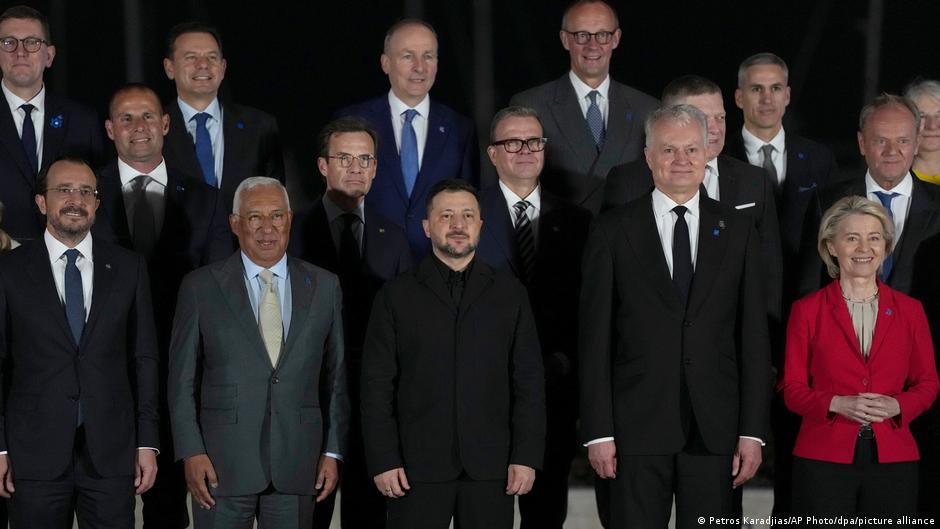
The European Union summit in Cyprus began on Thursday with a notable shift in tone, as leaders gathered without the presence of Hungarian Prime Minister Viktor Orbán, whose prolonged blocking of key EU initiatives has recently ended. According to verified reports, Orbán chose not to attend the summit following his party’s defeat in recent European Parliament elections, removing a major obstacle to EU unity on foreign policy and financial matters.
The absence of Orbán allowed the EU to move forward with a long-delayed €90 billion loan package for Ukraine, which had been blocked by Hungary for months. European Commission President Ursula von der Leyen welcomed the development, stating that the union is now “stronger and clearly more united.” The loan, intended to support Ukraine’s budget and reconstruction efforts, was formally approved during the summit’s opening session.
Although the resolution of the Orbán blockade brought relief on one front, the summit quickly turned to pressing security and economic concerns, particularly the ongoing Iran conflict and its ripple effects on global energy markets. Leaders acknowledged that despite a recent extension of the U.S.-Iran ceasefire, the situation remains fragile, with continued risks to shipping in the Strait of Hormuz.
EU High Representative for Foreign Affairs Kaja Kallas emphasized that the bloc remains committed to de-escalation but lacks the military or political capacity to directly influence the conflict. “The EU does not see itself as having either the political or military strength to exert influence in the Iran war,” she said, according to summit coverage. Instead, the focus has shifted to safeguarding maritime freedom, with Kallas announcing that the EU will expand its sanctions regime to include entities that impede freedom of navigation in critical waterways.
The summit also addressed growing anxiety over energy security, particularly the vulnerability of global fuel supplies to Middle Eastern instability. EU Energy Commissioner warned that declining strategic reserves and rising demand could exacerbate volatility in oil and aviation fuel markets. In response, the Commission unveiled the “AccelerateEU” contingency plan, designed to strengthen monitoring of energy flows, coordinate the release of strategic reserves, and accelerate investment in renewable alternatives.
Invited guests from across the Middle East — including leaders from Egypt, Jordan, Lebanon, Syria, and the Gulf Cooperation Council — participated in discussions aimed at reducing regional tensions. Officials noted that stabilizing the Israel-Lebanon ceasefire and ensuring freedom of navigation in the Hormuz Strait are central to preventing broader economic disruption, especially for European industries reliant on stable energy prices.
As the summit concluded, leaders reiterated that while the EU has regained internal cohesion on Ukraine, its ability to shape outcomes in the Iran conflict remains limited. The union’s strategy continues to focus on diplomatic support, economic resilience, and preparedness for potential escalations — all under the shadow of a conflict it cannot directly control but whose consequences it must mitigate.
For ongoing updates on EU foreign policy decisions and energy security measures, readers can consult the European Council’s official website and the European Commission’s policy portals.
We welcome your thoughts on how the EU is navigating these complex geopolitical challenges. Share your perspective in the comments below or join the conversation on our social media channels.