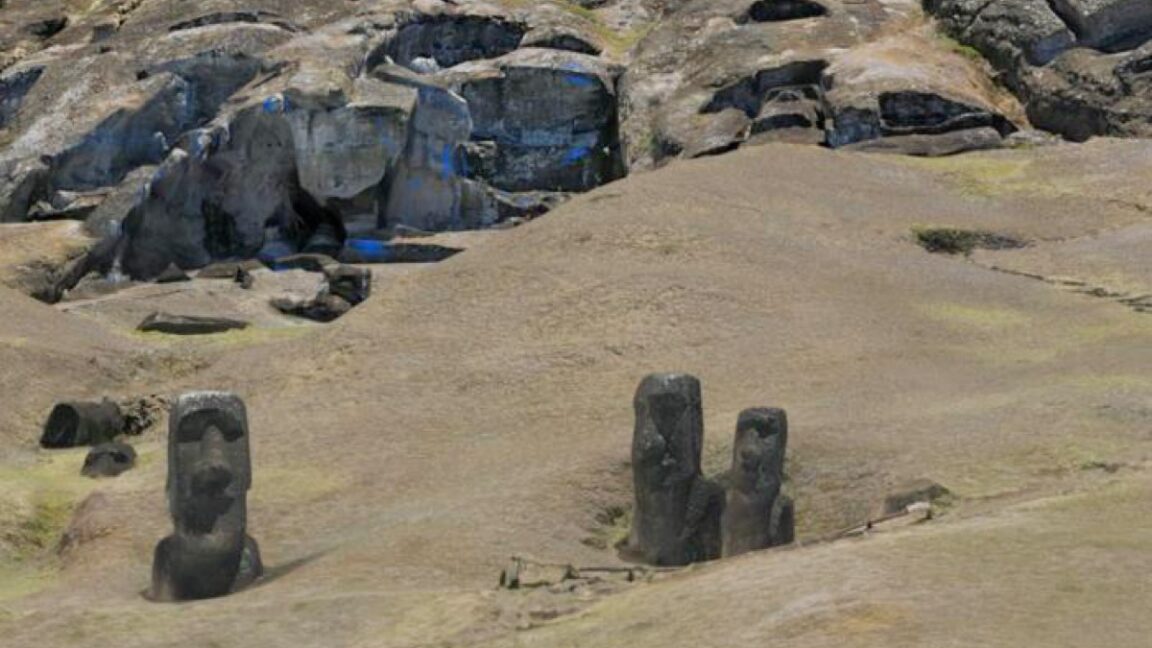
Unlocking the Secrets of Easter Island’s Moai: A New 3D perspective
Easter Island, or Rapa Nui, continues to captivate the world with its monumental moai statues. These iconic figures, carved roughly 800 years ago, stand as a testament to the ingenuity and cultural complexity of the Rapa Nui people. Now, a groundbreaking interactive 3D model of the Rano Raraku quarry – the birthplace of these colossal sculptures – is offering unprecedented insights into their creation and the society that built them.
Archaeologists are leveraging this technology to unravel long-held mysteries surrounding the moai. You can even explore the full interactive model yourself here. Recent research, published in PLoS ONE, suggests a surprising shift in our understanding of moai construction.
Beyond Centralized Control: The Role of Family Clans
For years,the prevailing theory posited a highly centralized system for moai production. However, the detailed 3D model reveals a different picture. It indicates that numerous autonomous groups, likely family clans, were responsible for carving the statues. This challenges the notion of a single, overarching authority directing the entire process.
“You can see details that are impractical to observe on the ground,” explains Carl Lipo, a leading expert on the moai from Binghamton University.”We’re documenting something comprehensively and making it accessible to everyone.” This level of detail allows researchers – and now, you – to virtually “fly around” the quarry and examine the unique carving styles of different groups.
Re-Evaluating How the Moai Moved
Lipo’s work extends beyond understanding how the moai were made; he’s also dedicated to understanding how they were moved. Previously, it was assumed a large population was needed to transport these massive statues.
In fact, our team recently reported on Lipo’s experimental confirmation of a “walking” method for moving the moai.This innovative technique involves tilting the statues and using ropes to essentially “walk” them across the island.
Here’s what the latest research reveals about this method:
* Reduced Workforce: Onyl 18 people are needed – four on each lateral rope and ten on a rear rope.
* Pendulum Dynamics: The method utilizes basic pendulum dynamics to minimize friction.
* Resonance Principles: it exploits the gradual build-up of amplitude, demonstrating a sophisticated understanding of physics.
* Efficiency: Workers can move a statue 100 meters in just 40 minutes using this technique.
This discovery significantly alters our understanding of the logistical capabilities of the Rapa Nui people. It suggests they possessed a remarkable understanding of engineering and physics, allowing them to accomplish feats previously thought impossible with limited resources.
A new Era of Rapa Nui Research
The combination of advanced 3D modeling and rigorous field testing is ushering in a new era of Rapa Nui research. these tools aren’t just providing answers; they’re raising new questions and challenging long-held assumptions.
ultimately, this research highlights the amazing resourcefulness and ingenuity of the Rapa Nui people. It’s a story of innovation, collaboration, and a deep connection to their environment – a story that continues to unfold with each new discovery.
Worth a look