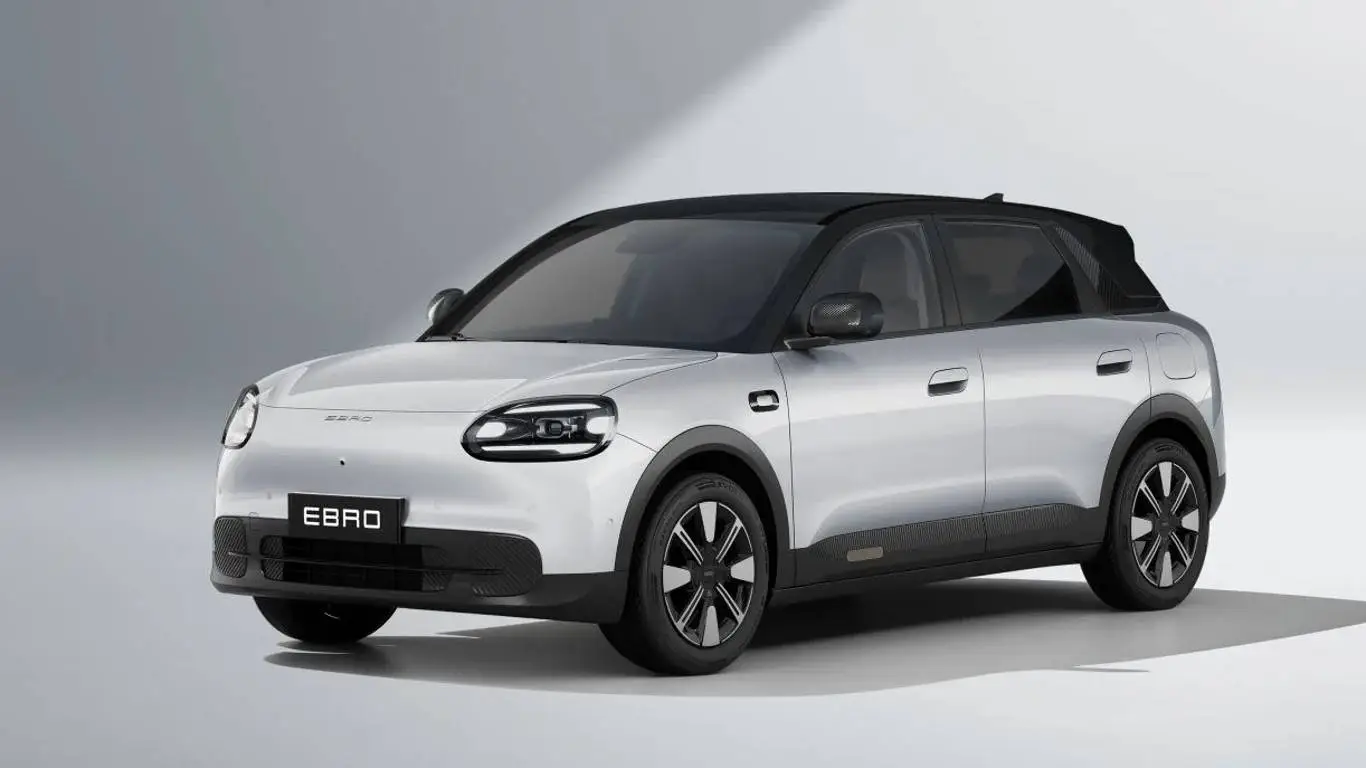
Spain’s EBRO to Launch Affordable Electric Vehicle in Winter 2026, Challenging Chinese Dominance
BARCELONA — In a bold move to reshape Europe’s electric vehicle (EV) market, Spanish automaker EBRO has announced plans to launch its first all-electric car in the winter of 2026. The compact crossover, built on a platform developed by Chinese automaker Chery, aims to offer a more affordable alternative to the flood of Chinese-made EVs entering the European market. With a targeted range of up to 400 kilometers (248 miles) and a focus on urban versatility, the yet-to-be-named model could mark a turning point for Spain’s automotive industry as it seeks to reclaim relevance in the global shift toward electrification.
Maria Petrova, reporting from Sofia, Bulgaria, examines how EBRO’s strategic pivot reflects broader trends in Europe’s automotive sector—where legacy brands are increasingly turning to Chinese technology to compete on price, performance, and speed to market. The launch comes at a critical juncture: the European Union has imposed tariffs on Chinese EVs to protect its domestic industry, while consumers grapple with high costs and limited options for budget-friendly electric cars. EBRO’s entry could offer a middle ground—European design and assembly with Chinese engineering under the hood.
“This isn’t just about launching another EV,” said an industry analyst familiar with EBRO’s strategy, who requested anonymity due to non-disclosure agreements. “It’s about proving that Europe can still produce competitive electric vehicles without relying solely on its own supply chains. The Chery partnership gives EBRO a shortcut to market, but the real test will be whether European buyers embrace a Spanish-Chinese hybrid.”
A Compact Crossover Built for European Cities
The new EBRO EV will be produced at the company’s factory in Barcelona’s free-trade zone, a strategic location that underscores Spain’s ambitions to become a hub for electric vehicle manufacturing. The facility, which has historically focused on commercial vehicles, is undergoing a €120 million ($130 million) modernization to accommodate EV production, according to a company press release from last year. The investment is part of a broader effort to revitalize Spain’s automotive sector, which employs over 300,000 people and accounts for 10% of the country’s GDP, per Spain’s National Association of Automobile and Truck Manufacturers (ANFAC).
The vehicle itself is a 5-door, 5-seater compact crossover with a length of 4.2 meters (13.8 feet) and a wheelbase of 2.7 meters (8.9 feet). EBRO has positioned it as a “versatile urban vehicle” capable of handling both city driving and suburban roads. While the exterior design has not been fully revealed, teasers suggest a modern, aerodynamic silhouette with LED lighting and a panoramic glass roof—features typically found in higher-end models.
Inside, the cabin prioritizes technology and practicality. The dashboard features an 8.88-inch digital instrument cluster and a 15.6-inch central touchscreen powered by a Qualcomm Snapdragon chip, a setup more commonly seen in premium EVs. Other notable features include:
- Dual-zone climate control
- 50W wireless charging pad
- Six airbags and 16 advanced driver-assistance systems (ADAS), including adaptive cruise control and lane-keeping assist
- Over-the-air (OTA) software updates
“This isn’t just a budget car with stripped-down features,” said EBRO’s head of product development, Carlos Mendez, in a recent interview with Automotive World. “We’re offering premium-level tech at a price point that makes EVs accessible to a broader audience.”
Performance and Pricing: The Chinese Connection
At the heart of EBRO’s new EV is its powertrain, developed in collaboration with Chery Automobile, one of China’s largest automakers. The vehicle will be equipped with a 122-horsepower rear-wheel-drive electric motor, capable of accelerating from 0 to 100 km/h (0 to 62 mph) in under 11 seconds. Two battery options will be available, both offering a maximum range of 400 km on the WLTP (Worldwide Harmonised Light Vehicle Test Procedure) cycle, a standard used in Europe to measure EV range.
Charging capabilities are designed for convenience. The vehicle supports 11 kW AC charging, which can fully recharge the battery in about 5-6 hours using a home or public charging station. For faster top-ups, DC prompt charging can replenish the battery from 30% to 80% in 20-30 minutes. These specifications align with the needs of urban and suburban drivers, who may lack access to overnight charging but can rely on public fast-charging networks.

The partnership with Chery is a strategic one. The Chinese automaker, which has been expanding aggressively into Europe, provides EBRO with a proven platform—the same one used in Chery’s QQ3 EV—while allowing the Spanish brand to focus on design, assembly, and local market adaptation. This approach mirrors a growing trend among European automakers, including Renault and Volkswagen, which have also partnered with Chinese firms to accelerate their EV development.
“The collaboration with Chery is a pragmatic solution,” said Felipe Muñoz, a global automotive analyst at JATO Dynamics, in a recent report. “European automakers are under immense pressure to electrify their lineups quickly and cost-effectively. By leveraging Chinese battery and platform technology, they can bring competitive products to market faster than if they developed everything in-house.”
Pricing details for the EBRO EV have not been officially disclosed, but industry insiders suggest the vehicle will be positioned as a budget-friendly option, likely starting below €30,000 ($32,500). This would place it in direct competition with popular Chinese models like the BYD Dolphin and MG4, as well as European offerings such as the Renault Twingo E-Tech and Volkswagen ID.3. EBRO’s ability to undercut these competitors could hinge on its local production in Spain, which may qualify the vehicle for EU subsidies and lower import tariffs.
Why This Launch Matters for Europe’s EV Market
EBRO’s entry into the EV market arrives at a pivotal moment for Europe. The continent is the world’s second-largest EV market after China, but its growth has slowed in recent months due to economic uncertainty, high interest rates, and concerns about charging infrastructure. According to data from the European Alternative Fuels Observatory (EAFO), EV sales in the EU grew by just 14% in 2025, down from 55% in 2023. Affordability remains a key barrier: the average price of a new EV in Europe is €55,000 ($59,500), nearly double the price of an average internal combustion engine (ICE) car.
The European Commission has taken steps to address this imbalance, including the imposition of provisional tariffs of up to 38.1% on Chinese-made EVs in July 2024. The move was intended to protect European automakers from what the EU described as “unfair competition” due to state subsidies in China. But, the tariffs have also raised concerns about higher prices for consumers and potential retaliation from Beijing, which could impact European automakers with operations in China, such as BMW and Mercedes-Benz.
EBRO’s strategy of combining Chinese technology with European assembly could facilitate navigate this complex landscape. By producing the vehicle in Spain, the company may avoid the highest tariffs while still benefiting from Chery’s cost-effective platform. This “best of both worlds” approach could serve as a blueprint for other European automakers looking to balance affordability with local production.
“EBRO is betting on a niche that hasn’t been fully exploited yet: the affordable, urban-focused EV,” said Muñoz. “If they can deliver on their promises of range, tech, and price, they could carve out a significant share of the market, especially among younger buyers and urban commuters.”
Challenges and Competition Ahead
Despite its potential, EBRO faces several hurdles. The company, which traces its roots back to the 1950s as a manufacturer of commercial vehicles, has limited experience in the passenger EV market. Its brand recognition in Europe is also modest compared to giants like Volkswagen, Renault, and Stellantis. To succeed, EBRO will demand to invest heavily in marketing and dealership networks to build trust with consumers.
Another challenge is the intensifying competition in the budget EV segment. Chinese automakers, including BYD, MG, and NIO, have been rapidly expanding their presence in Europe, offering vehicles with longer ranges and more advanced features at competitive prices. For example, BYD’s Dolphin, which starts at around €28,000 ($30,300), offers a range of up to 427 km (265 miles) and a 0-100 km/h time of 7.5 seconds—significantly quicker than EBRO’s offering.
European automakers are also stepping up their game. Renault’s Twingo E-Tech, set to launch later this year, promises a range of 250 km (155 miles) and a starting price of €20,000 ($21,600), while Volkswagen’s ID.3 is expected to receive a price cut in 2026 to make it more competitive. These developments suggest that EBRO’s window of opportunity may be narrow.
“The EV market is evolving at breakneck speed,” said Julia Poliscanova, senior director for vehicles and e-mobility at Transport & Environment, a Brussels-based NGO. “To succeed, EBRO will need to differentiate itself not just on price, but on factors like charging infrastructure partnerships, software updates, and customer service. The battle for Europe’s EV market is far from over.”
What’s Next for EBRO and Europe’s EV Future
EBRO’s first electric vehicle is expected to hit dealerships in late 2026, with pre-orders likely to open in the first half of the year. The company has not yet revealed the model’s official name, but teasers suggest it will be part of a new sub-brand focused on electric mobility. In the meantime, EBRO is ramping up production at its Barcelona factory and finalizing partnerships with suppliers and charging network providers.
For Europe, the success of EBRO’s EV could signal a new phase in the continent’s automotive industry—one where collaboration with Chinese partners becomes a necessity rather than an exception. As the EU continues to grapple with how to balance protectionism with innovation, models like EBRO’s could offer a glimpse of the future: a hybrid approach that leverages global supply chains while maintaining local production and jobs.
“This isn’t just about one car or one company,” said Mendez. “It’s about proving that Europe can still lead in the electric mobility revolution. We may be late to the game, but we’re bringing something unique to the table: a vehicle that’s designed for European cities, built in Europe, and priced for European consumers.”
Key Takeaways
- Launch Timeline: EBRO’s first electric vehicle is set to debut in the winter of 2026, with production taking place at the company’s Barcelona factory.
- Technical Specifications: The compact crossover will feature a 122-horsepower electric motor, a range of up to 400 km, and support for 11 kW AC charging and DC fast charging.
- Chinese Collaboration: The vehicle is built on Chery’s QQ3 platform, highlighting a growing trend of European automakers partnering with Chinese firms to accelerate EV development.
- Target Market: EBRO is positioning the EV as an affordable, urban-focused alternative to Chinese and European competitors, with an expected starting price below €30,000.
- Broader Implications: The launch reflects Europe’s struggle to balance affordability, innovation, and protectionism in the face of Chinese dominance in the EV market.
- Challenges: EBRO faces stiff competition from established Chinese and European brands, as well as the need to build brand recognition and dealership networks.
FAQ
1. What is EBRO?
EBRO is a Spanish automaker with roots dating back to the 1950s. Historically known for commercial vehicles, the company is now expanding into the passenger electric vehicle market with its first EV, set to launch in 2026.
2. Why is EBRO partnering with Chery?
EBRO is collaborating with Chery, a leading Chinese automaker, to leverage its proven EV platform and battery technology. This partnership allows EBRO to bring a competitive product to market faster and at a lower cost than if it developed the technology in-house.
3. How does the EBRO EV compare to Chinese competitors?
The EBRO EV is designed to compete with budget-friendly Chinese models like the BYD Dolphin and MG4. While it offers a similar range (400 km), it may differentiate itself through local European production, which could qualify it for subsidies and avoid high import tariffs.
4. Will the EBRO EV be eligible for EU subsidies?
Yes, the vehicle is expected to qualify for EU subsidies, including national incentives for electric vehicles, due to its local production in Spain. However, the exact subsidy amounts will depend on individual country policies.
5. What are the biggest challenges for EBRO?
EBRO faces several challenges, including building brand recognition in the competitive EV market, expanding its dealership network, and differentiating its product from established Chinese and European competitors. The company will also need to ensure reliable supply chains and customer support.
6. Where can I find updates on the EBRO EV?
Official updates can be found on EBRO’s website (ebro.eu) and through its social media channels. Industry publications like Automotive World and Reuters Automotive News are also likely to cover developments as the launch approaches.
As the countdown to EBRO’s EV launch begins, all eyes will be on how the Spanish automaker navigates the challenges ahead. The next major milestone will be the official unveiling of the vehicle’s name and final specifications, expected in early 2026. For now, Europe’s EV market remains a battleground—one where affordability, innovation, and geopolitics intersect in ways that could shape the future of transportation for decades to come.
What do you think about EBRO’s strategy to challenge Chinese EV dominance? Will European consumers embrace a Spanish-Chinese hybrid vehicle? Share your thoughts in the comments below and join the conversation on social media.