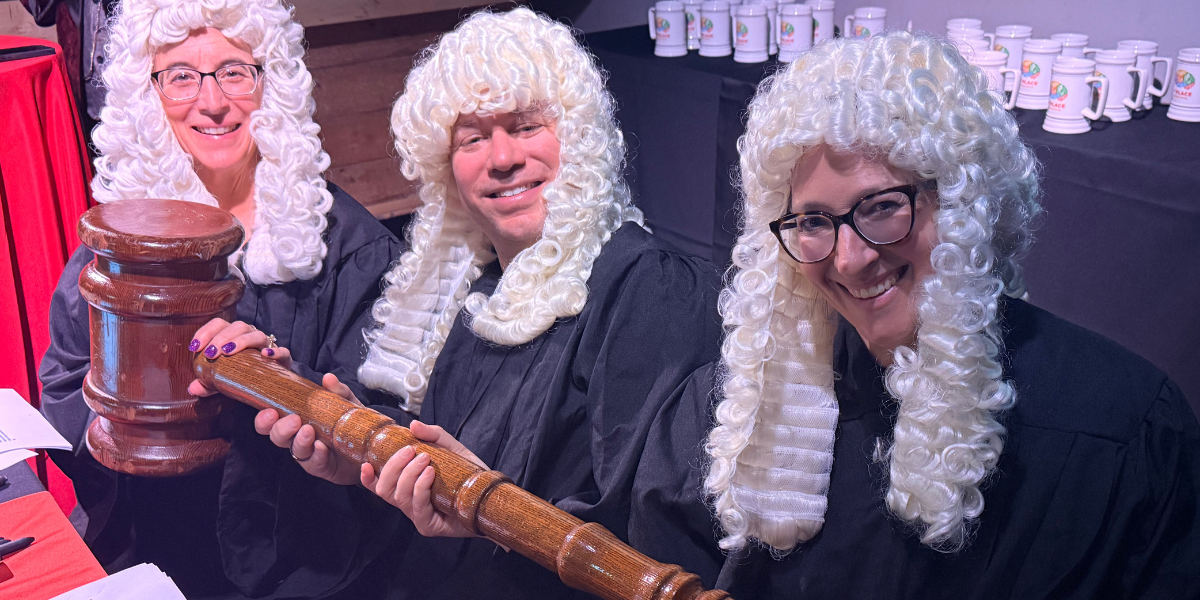
The 18th Annual Cyberlaw Trivia Night brought together legal professionals and digital rights advocates in San Francisco on June 4, 2026, for a competitive evening centered on the evolving landscape of privacy, free speech, and intellectual property law. Held at the Public Works venue, the event served as both a test of technical legal knowledge and a fundraiser supporting the Electronic Frontier Foundation (EFF) legal intern program.
The competition, which drew teams from various law firms and organizations, featured six rounds of questions curated by Quizmaster Kurt Opsahl. Topics ranged from the history of the SOPA/PIPA internet blackout and Section 230 to contemporary challenges involving artificial intelligence, such as copyright disputes and geofence warrants. The event’s 2026 iteration was particularly notable for the presence of a three-judge panel featuring outgoing EFF Executive Director Cindy Cohn, incoming Executive Director Nicole Ozer, and Techdirt founder Mike Masnick, a 2020 recipient of an EFF Award.
The intensity of the trivia was matched by the social atmosphere, with teams including Shady Docket, Byte Club, Flock U, This Is Why We Can’t Have Nice Precedent, Nicky’s Angels, and the Betamaxxers vying for the top spot. A moment of levity occurred during a round concerning Afroman’s legal dispute with Ohio sheriff’s deputies, when members of the Byte Club team attempted to perform a musical rendition of “Lemon Pound Cake” for the judges. The request was politely declined by the judiciary.
Competition remained exceptionally tight throughout the evening. For the first time in the event’s 18-year history, three teams ended regulation play in a tie for first place, requiring two tiebreaker questions to determine the winner. The final question shifted focus to government transparency, asking teams to estimate the number of government information requests received by OpenAI in the first half of 2025, compared to the more than 287,000 requests received by Google during the same period. While all teams overestimated the figure, the team Shady Docket secured the victory by providing the lowest estimate of 260. The actual number of requests received by OpenAI during that period was 146.
Understanding the Stakes: Cyberlaw and Digital Rights
The trivia rounds were designed to reflect the real-world complexities of digital rights litigation. Beyond the standard intellectual property questions, which included details regarding the server test, the competition covered news-adjacent topics such as the development of anti-ICE applications and recent defamation litigation involving the sitting president. These questions underscored the event’s broader mission: to foster a legal community capable of defending privacy and free expression in an era of rapid technological advancement.
Following their win, Shady Docket team member Erin Simon remarked on the competitive spirit of the night, noting, “As much as we love EFF, what we love even more is crushing other trivia teams.” The podium was rounded out by Nicky’s Angels in second place and the Betamaxxers in third, the latter of whom gained an early lead by answering every question correctly during the Free Speech round.
Supporting the Next Generation of Legal Advocates
The event serves as a critical support mechanism for the EFF’s legal intern program. Sponsors for this year’s gathering included Morrison Foerster, Fenwick, Wilson Sonsini, and Public Resource. By bringing together established attorneys and those new to the field, the trivia night functions as a networking hub for the Cooperating Attorneys list—a network that connects individuals to legal assistance when the organization cannot provide direct representation.
For those interested in the intersection of law and technology, the EFF continues to provide resources on digital privacy and civil liberties. The organization encourages attorneys and supporters to stay engaged with upcoming legal challenges. Further information regarding support for the movement for digital privacy, free speech, and innovation can be found through the official EFF website or by contacting their outreach coordinators.
This event serves as an annual checkpoint for the intersection of technology and the law. As the legal community continues to address the implications of emerging surveillance technologies and government information requests, the EFF remains active in its advocacy before legislative bodies, including recent testimony provided to the House Homeland Security Subcommittee on Cybersecurity and Infrastructure Protection regarding the protection of Constitutional rights from government AI.
Worth a look