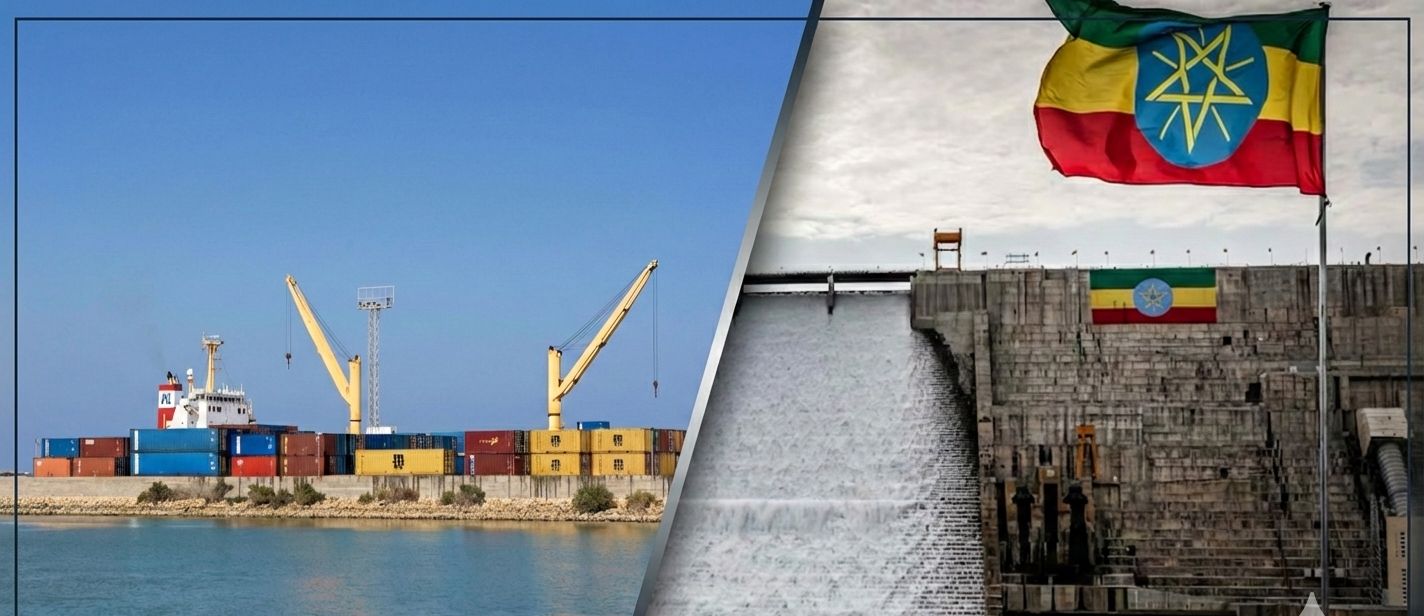
Cairo – Egypt has firmly dismissed reports suggesting a potential trade-off involving Red Sea access for Ethiopia in exchange for concessions regarding the Grand Ethiopian Renaissance Dam (GERD). The denial, issued by an official source cited by the Middle East News Agency (MENA), underscores Egypt’s unwavering stance on its water security and regional sovereignty. This comes amid ongoing tensions surrounding the GERD, a massive hydroelectric dam built on the Blue Nile, which Egypt fears will significantly reduce its share of Nile water.
The controversy surrounding the GERD has been a major point of contention between Egypt, Ethiopia, and Sudan for over a decade. Egypt, heavily reliant on the Nile for its water supply, views the dam as an existential threat. Ethiopia maintains the dam is crucial for its economic development and power generation, while Sudan has expressed concerns about its own water security and dam safety. Negotiations, often mediated by the African Union, have stalled repeatedly, leaving the situation in a prolonged state of uncertainty. The core issue revolves around the filling and operation of the dam, and establishing a legally binding agreement that guarantees the water rights of all three nations. The potential for escalating tensions remains high, particularly as Ethiopia continues to fill the reservoir.
Egypt Rejects Claims of Red Sea Access Deal
The official source, as reported by MENA, categorically rejected the circulating reports as “unfounded” and lacking any factual basis. The source emphasized that Egypt’s position on its water security and the GERD remains “steadfast, and unchanged.” This position is built upon several key principles: strict adherence to international law, a firm rejection of unilateral measures, the imperative of preventing any harm to Egypt’s established water share, and the protection of the comprehensive rights of downstream nations, in accordance with international legal frameworks. This strong denial appears to be a direct response to a report published by The National News on February 23, 2026, which suggested Egypt might be open to supporting Ethiopia’s access to the Red Sea if the water dispute softened. The National News report detailed speculation about a potential quid pro quo, but Egyptian officials now assert this is entirely inaccurate.
The denial is particularly significant given Ethiopia’s long-standing desire for access to a seaport. Landlocked since Eritrea’s independence in 1993, Ethiopia has relied on neighboring Djibouti for its maritime trade, a situation that has presented logistical challenges and economic vulnerabilities. Ethiopia has explored various options for securing direct access to the Red Sea, including potential agreements with neighboring countries. In recent years, there has been increased discussion about the possibility of Ethiopia leasing a port in Somaliland, a self-declared independent region of Somalia, though this has similarly been met with regional opposition. The suggestion that Egypt might facilitate this access in exchange for concessions on the GERD therefore raised eyebrows and prompted the swift denial from Cairo.
Red Sea Sovereignty and Regional Security
Beyond the GERD dispute, the Egyptian source underscored the importance of maintaining the sovereignty and security of the Red Sea. The statement emphasized that the governance and security of this vital waterway are the “exclusive domain of its littoral states” – those countries with coastlines on the Red Sea. This includes Egypt, Saudi Arabia, Yemen, Djibouti, Eritrea, and Sudan. The source maintained that no external parties should engage in any arrangements or regional security architectures concerning the Red Sea, highlighting its strategic importance and the national security interests of the coastal nations.
The Red Sea is one of the world’s most important shipping lanes, connecting the Mediterranean Sea to the Indian Ocean via the Suez Canal. Approximately 12% of global trade passes through the Red Sea annually, making it a critical artery for international commerce. Recent geopolitical events, including the Houthi attacks on commercial vessels in the Bab-el-Mandeb Strait, have underscored the vulnerability of this waterway and the necessitate for enhanced security cooperation among the littoral states. The United States and other international powers have increased their naval presence in the region to protect shipping lanes and deter further attacks. The Grand Ethiopian Renaissance Dam, located on the Blue Nile, which feeds into the Nile River and ultimately impacts the Mediterranean Sea, is geographically distinct from the Red Sea, but the interconnectedness of regional water and security issues is evident.
The GERD: A Timeline of Development
Construction of the Grand Ethiopian Renaissance Dam began in April 2011, with initial projections estimating completion within five to seven years. However, the project faced numerous delays due to technical challenges, funding issues, and political disagreements. The dam officially opened in July 2020, but full operation and reservoir filling have been subject to ongoing negotiations. The dam is a gravity dam, utilizing roller-compacted concrete, and stands at 145 meters (476 feet) high, with a length of 1,780 meters (5,840 feet). Its reservoir, Nigat Lake, has a total capacity of 74 billion cubic meters (60,000 million acre-feet). The power station, commissioned in February 2022 and fully operational by August 2024, boasts an installed capacity of 5.15 GW, generated by 11 x 400 MW and 2 x 375 MW Francis turbines.
Egypt’s Water Concerns and International Law
Egypt’s concerns regarding the GERD stem from its historical water rights under treaties dating back to 1929 and 1959. These agreements allocated Egypt a significant share of the Nile’s water, and Cairo argues that the GERD’s construction and operation could jeopardize this allocation. Egypt maintains that any unilateral action by Ethiopia to alter the natural flow of the Nile violates international law, specifically the principle of equitable and reasonable utilization of shared water resources. This principle, enshrined in the 1997 UN Watercourses Convention, requires states to use transboundary water resources in a manner that does not cause significant harm to other riparian states. However, Ethiopia is not a signatory to this convention, adding to the complexity of the dispute.
The potential impact of the GERD on Egypt’s water supply is a serious concern, particularly given the country’s growing population and increasing water scarcity. Egypt already faces significant water stress, and a substantial reduction in Nile flow could have devastating consequences for agriculture, industry, and domestic water consumption. The Egyptian government has repeatedly called for a legally binding agreement with Ethiopia that guarantees its water rights and ensures the sustainable management of the Nile River basin. The African Union has played a mediating role in the negotiations, but a breakthrough remains elusive.
Looking Ahead
The Egyptian denial of a potential Red Sea access trade-off underscores the deep-seated mistrust and unresolved issues surrounding the GERD. While Egypt maintains its commitment to finding a peaceful resolution through negotiation, it remains firm in its defense of its water security and regional interests. The future of the GERD and the stability of the Nile River basin will depend on the willingness of all three countries – Egypt, Ethiopia, and Sudan – to compromise and reach a mutually acceptable agreement. The next scheduled meeting between the foreign ministers of the three countries, facilitated by the African Union, is slated for March 15, 2026, in Addis Ababa. Further updates on the negotiations and any potential breakthroughs will be closely monitored by regional and international observers.
The situation remains fluid and requires continued diplomatic engagement to prevent further escalation. Readers interested in following developments can uncover updates on the African Union’s website and through reports from international news agencies such as Reuters and the Associated Press. We encourage readers to share their thoughts and perspectives on this critical issue in the comments section below.