
An annual celebration of contemporary art within sacred spaces returns to Rouen this spring, featuring the operate of painter Emmanuel Brocart at the historic Abbatiale Saint-Ouen. The 21st edition of Festival Courant d’Art runs from April 10 to May 10, 2026, transforming three Norman churches into venues for modern artistic expression. Brocart’s exhibition titled “Apparitions” will be on display in the abbey church, continuing a tradition that invites dialogue between religious heritage and contemporary creation.
Organized by the Art & Culture association of the Rouen diocese, the festival emphasizes accessibility and spiritual reflection through art. Visitors can view Brocart’s paintings daily from 10 a.m. To 12 p.m. And 2 p.m. To 5 p.m., except on Mondays and Fridays when the abbatiale is closed. The initiative aims to offer free access to meaningful works that convey beauty, hope, and fraternal communion, aligning with the festival’s broader mission to animate sacred spaces with today’s artistic voices.
Emmanuel Brocart, a graduate of the École nationale supérieure des Arts Décoratifs, presents a body of work described as exploring themes of visibility and presence within architectural and spiritual contexts. His participation follows previous editions where artists like Sylvia Neulichedl at Rouen Cathedral and Grégoire Rodet at Chapelle Sainte-Catherine have contributed site-specific installations. This year’s trio of exhibitions maintains the festival’s core principle: one artist, one place, fostering intimate encounters between artwork and architectural setting.
Festival Courant d’Art: Bridging Sacred Heritage and Contemporary Practice
Now in its 21st year, Festival Courant d’Art has become a recurring cultural event tied to the Easter season in Rouen. According to Rouen.fr, the festival was developed by the diocesan Art & Culture association to promote contemporary artistic expression while highlighting the city’s religious patrimony. Each edition follows a consistent format: placing a single artist’s work within a designated sacred space for approximately one month, creating what organizers describe as a “dialogue audacieux entre le sacré et la création contemporaine.”
The 2026 iteration extends this model across three locations: the Abbatiale Saint-Ouen for Emmanuel Brocart’s paintings, the Cathédrale Notre-Dame de l’Assomption for Sylvia Neulichedl’s “Fragments,” and the Chapelle Sainte-Catherine for Grégoire Rodet’s “Lumières urbaines.” All exhibitions are free to the public, reinforcing the festival’s commitment to democratizing access to art in unconventional venues. The program as well includes musical performances, lectures, and other cultural propositions spread throughout the duration of the event.
Festival Courant d’Art distinguishes itself by situating art not as an intrusion but as a continuation of the sacred spaces’ historical role as centers of reflection and community gathering. By inviting contemporary creators into these environments, the festival seeks to reactivate their cultural function beyond liturgical use, offering residents and visitors alike a renewed perspective on familiar landmarks.
Emmanuel Brocart: Artist Profile and Artistic Approach
Emmanuel Brocart’s participation in Festival Courant d’Art marks his contribution to a lineage of artists invited to engage with Normandy’s ecclesiastical architecture through the diocesan initiative. A graduate of the École nationale supérieure des Arts Décoratifs in Paris, Brocart has developed a practice centered on painting, often exploring the interplay between light, surface, and perception. While specific details about his “Apparitions” series for the Abbatiale Saint-Ouen are not detailed in verified sources, his artistic background suggests a focus on abstract or semi-figurative forms that interact with architectural space.
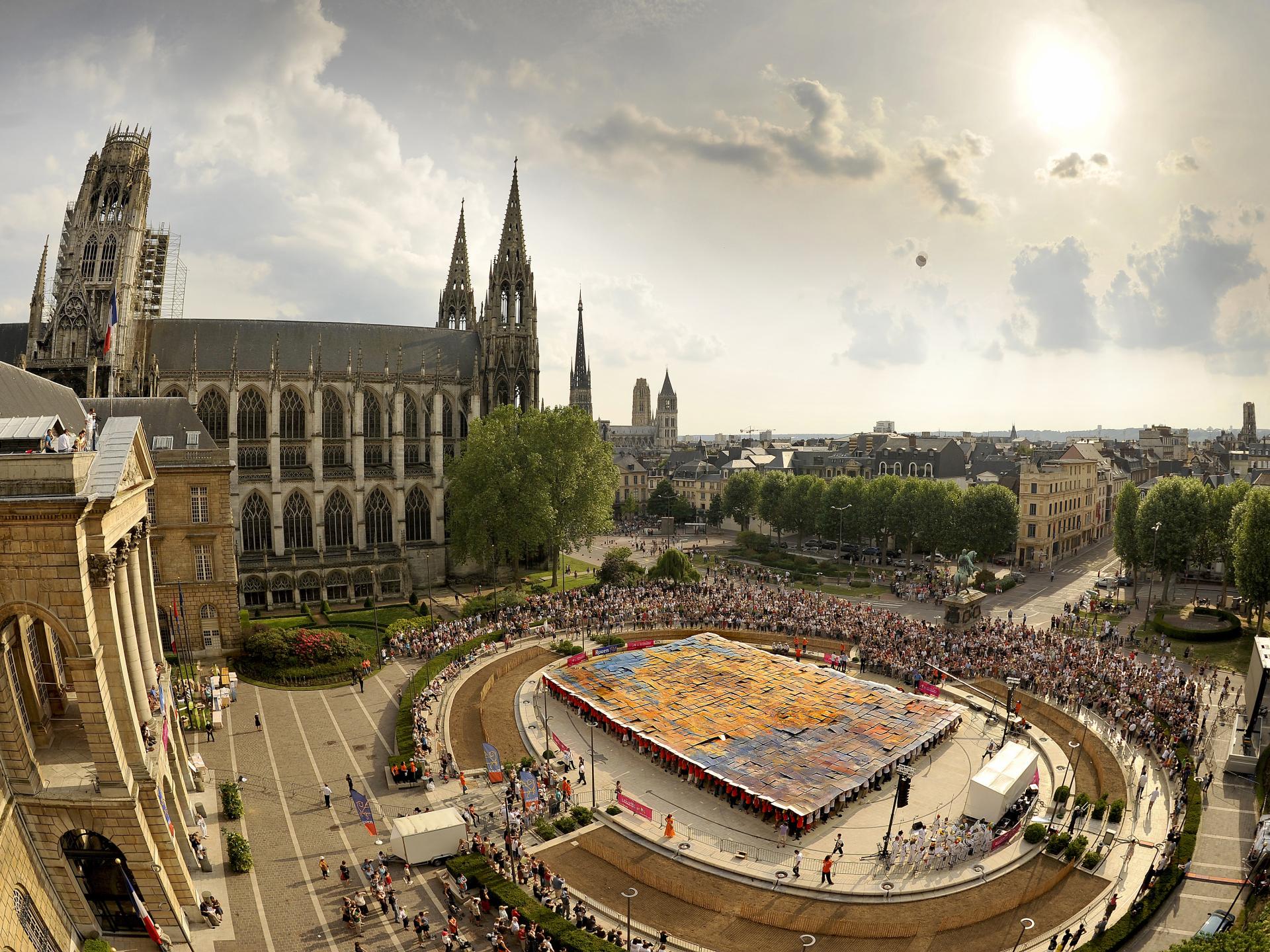
The Abbatiale Saint-Ouen, a former Benedictine abbey church located in the heart of Rouen, provides a significant historical backdrop for Brocart’s work. Dating back to the medieval period, the structure combines Romanesque and Gothic architectural elements and has long served as a religious and cultural landmark in Normandy. Its vast interior, characterized by elevated vaults and expansive nave, offers a distinctive environment for the display of large-scale paintings, potentially allowing Brocart’s work to engage with scale, perspective, and spatial dynamics inherent to the building.
Artists selected for Festival Courant d’Art are typically invited to create or present work that responds to the unique characteristics of their assigned venue. In past editions, participants have adapted their practices to considerations such as natural light patterns, acoustics, and the spiritual atmosphere of the space. Brocart’s exhibition will be accessible during the abbatiale’s regular visiting hours, allowing audiences to experience the paintings under varying daylight conditions throughout the spring months.
Public Access and Cultural Programming
Festival Courant d’Art operates on a model of free admission, ensuring that all exhibitions and most accompanying events are open to the public without cost. For the Abbatiale Saint-Ouen, visiting hours are set from 10 a.m. To 12 p.m. And 2 p.m. To 5 p.m., with closures on Mondays and Fridays. This schedule allows for consistent access while accommodating the abbatiale’s possible use for other religious or community functions. Visitors are encouraged to verify any potential schedule changes directly with the venue or festival organizers closer to their planned visit.
Beyond the visual art exhibitions, the 2026 festival includes a range of musical and intellectual events. Notable performances include a recital by Clément Bernard featuring “Portraits d’Andalousie” at Chapelle Sainte-Catherine on May 9 at 3:30 p.m., and a piano recital by Paul Beynet titled “Une heure avec Chopin” at Église Notre-Dame de Miséricorde on May 6 at 8 p.m. These events are listed as having either free or participation-based admission, with some offering reduced tariffs for specific groups such as young adults or seniors.
The festival also features a conference titled “Saint-François-d’Assise aux couleurs de Giotto” by Iliana Kasarska, scheduled to take place at a location associated with the ICP institute in Rouen. Additional cultural propositions may be announced as the event progresses, though all supplementary programming remains subject to confirmation by the organizing association. Attendees seeking the most current information are advised to consult the official Rouen.fr events page or the diocesan website for updates.
Context and Significance of the Initiative
Festival Courant d’Art reflects a broader trend in cultural programming that seeks to revitalize underutilized or historically significant buildings through temporary artistic interventions. By placing contemporary art within active or conserved religious sites, the festival contributes to ongoing conversations about the adaptive reuse of heritage spaces. Such initiatives often aim to attract new audiences to historic buildings while providing artists with unique environments that challenge conventional gallery contexts.

In Rouen, a city renowned for its Gothic architecture and historical ties to figures like Joan of Arc, the festival adds a layer of modern cultural engagement to its established identity. The collaboration between the diocesan association and living artists underscores a willingness to interpret sacred spaces as evolving sites of meaning rather than static monuments. This approach aligns with similar efforts in other European cities where churches, chapels, and abbeys have hosted exhibitions, residencies, and performances that bridge historical preservation with contemporary creativity.
The timing of the festival—coinciding with the spring season and the Easter period—may also carry symbolic resonance, inviting reflection on themes of renewal, presence, and transcendence. While the organizers do not prescribe specific interpretations, the juxtaposition of modern artistic expressions within centuries-old architecture naturally prompts questions about continuity, memory, and the role of art in spiritual life.
Practical Information for Visitors
Those planning to attend Festival Courant d’Art in 2026 should note the following verified details based on official sources:
- Emmanuel Brocart’s exhibition “Apparitions” is on display at the Abbatiale Saint-Ouen from April 10 to May 10, 2026.
- Visiting hours: 10 a.m. To 12 p.m. And 2 p.m. To 5 p.m., closed Mondays and Fridays.
- Admission to all exhibitions is free of charge.
- The festival concludes on May 10, 2026, with select musical events extending slightly beyond this date.
- Additional venues include Cathédrale Notre-Dame de l’Assomption (Sylvia Neulichedl) and Chapelle Sainte-Catherine (Grégoire Rodet).
- Musical events such as Clément Bernard’s guitar recital (May 9) and Paul Beynet’s piano performance (May 6) are part of the official program.
Information regarding accessibility, guided tours, or special accommodations is not specified in currently available verified sources. Visitors with specific needs are encouraged to contact the Abbatiale Saint-Ouen or the Rouen diocesan offices directly for the most accurate and up-to-date details. As the festival approaches, any updates to scheduling, artist talks, or health-related guidelines will be disseminated through official channels associated with the Art & Culture association and the city of Rouen.
Festival Courant d’Art continues to serve as a distinctive platform for encountering art in unexpected places, reinforcing the idea that creativity can flourish at the intersection of history and modernity. By welcoming Emmanuel Brocart and other contemporary artists into Normandy’s sacred spaces, the 2026 edition invites audiences to experience familiar landmarks through a renewed artistic lens—one that values dialogue, accessibility, and the enduring human impulse to seek beauty in shared spaces.
To stay informed about Festival Courant d’Art and similar cultural initiatives in Normandy, readers are encouraged to follow official announcements from the Rouen diocese and cultural departments. Share your thoughts on the role of contemporary art in historic settings, and join the conversation about how communities can reimagine their heritage through creative engagement.
Related reading