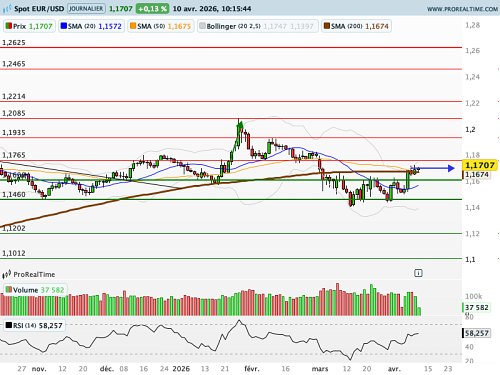
The EUR/USD exchange rate is currently navigating a period of heightened volatility, reflecting what market analysts describe as the pendulum movements of risk assets. As of April 11, 2026, at 2:06 AM UTC, the Euro was trading at 1.1727 against the US Dollar, according to data from Google Finance.
This recent uptick follows a series of sharp fluctuations driven by a complex mix of geopolitical rumors and looming economic data. The currency pair has seen a tug-of-war between bullish momentum sparked by potential diplomatic breakthroughs and bearish pressure stemming from anticipated US inflation reports.
For global investors and businesses, these shifts highlight the sensitivity of the Euro to external shocks. Whereas the pair has recently jumped back above the 1.1700 threshold, the market remains on edge, balancing the hope of peace deals in Eastern Europe and the Middle East against the hard reality of macroeconomic indicators.
Current Market Valuation and Exchange Rates
Real-time data indicates a tight clustering of values across major currency tracking platforms, though slight variations exist based on the timing of the mid-market rates. While Google Finance reports the rate at 1.1727, Xe listed the mid-market rate at 1.17250982 USD as of 22:46 UTC on April 10, 2026. Conversion tools from UnitConverters have cited a rate of 1.1730494241 USD.
These figures represent the baseline for international trade and currency conversion. For instance, based on the mid-market rate provided by Xe, 1,000 EUR is equivalent to 1,172.51 USD, while 10,000 EUR converts to 11,725.1 USD.
| Source | Exchange Rate (1 EUR to USD) | Timestamp/Date |
|---|---|---|
| Google Finance | 1.1727 | April 11, 2:06 AM UTC |
| Xe | 1.1725 | April 10, 22:46 UTC |
| UnitConverters | 1.1730 | April 11, 2026 |
Geopolitical Catalysts: Ukraine and Iran
The recent surge in the Euro’s value is closely tied to geopolitical developments. Market reports indicate that the EUR/USD pair jumped back above the 1.1700 level amid rumors of a potential peace deal in Ukraine, as reported by FXStreet. Such developments typically increase investor appetite for risk assets, benefiting the Euro relative to the safe-haven status of the US Dollar.
Simultaneously, signals from the United States regarding diplomacy in the Middle East have played a role. Forex.com has noted that the Euro surged as Donald Trump signaled a potential deal with Iran. These geopolitical “pendulum swings”—moving from tension to potential resolution—create rapid shifts in currency valuation as traders speculate on the long-term stability of European markets.
Economic Headwinds and Market Sentiment
Despite the optimistic rumors regarding peace deals, the EUR/USD exchange rate faces significant downward pressure from upcoming economic data. Traders are currently bracing for the release of US Consumer Price Index (CPI) data, a key inflation metric that often dictates the Federal Reserve’s interest rate trajectory. FXStreet reports that the pair had previously weakened below 1.1700 as the market prepared for this data release.
Beyond inflation data, European markets are facing their own set of challenges. According to Seeking Alpha, European markets have remained subdued as a surge in oil prices clouds the economic outlook. The interplay between rising energy costs in Europe and inflation expectations in the United States continues to create a volatile environment for the EUR/USD pair.
What Which means for the Eurozone
The Euro serves as the official currency for 21 of the 27 member states of the European Union, a group officially known as the eurozone. Because the currency is used by such a vast economic bloc—including four European microstates and various EU institutions—its value is a primary indicator of the collective economic health of the region. When risk assets fluctuate, the Euro often acts as a barometer for global confidence in European fiscal stability.
Key Takeaways for Investors
- Current Position: The EUR/USD is hovering around the 1.1727 mark, showing a recent recovery above 1.1700.
- Bullish Drivers: Rumors of a peace deal in Ukraine and potential US-Iran diplomatic signals are driving the Euro higher.
- Bearish Risks: Anticipation of US CPI data and a surge in oil prices are creating headwinds for European markets.
- Volatility Source: The “pendulum” movement is characterized by rapid shifts between geopolitical optimism and macroeconomic caution.
The next critical checkpoint for the markets will be the release of the US CPI data, which is expected to provide a clearer direction for the US Dollar’s strength and, the Euro’s trajectory. Investors are advised to monitor official government releases for inflation figures and verified diplomatic statements regarding Ukraine and Iran.
Do you believe geopolitical rumors are currently outweighing economic fundamentals in the forex market? Share your thoughts in the comments below or share this analysis with your professional network.
Related reading