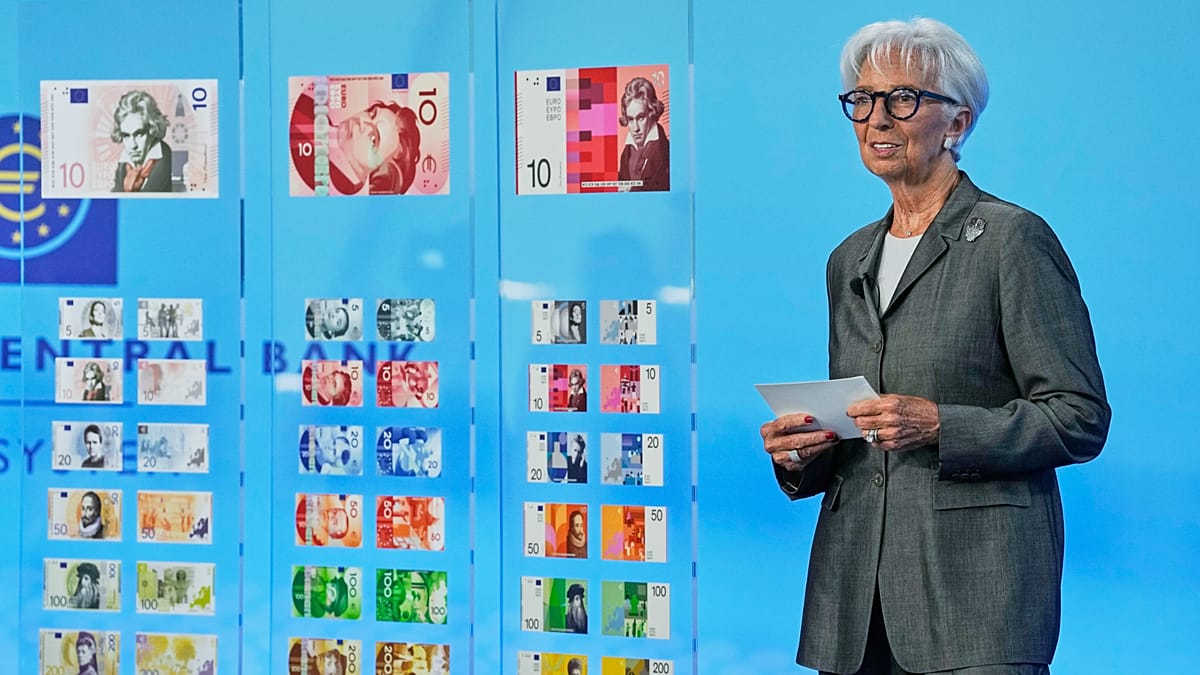
For the first time since 2002, the European Central Bank is overhauling euro bank note designs. European Central Bank President Christine Lagarde unveiled ten finalist concepts split between European cultural icons and regional wildlife themes, launching a public survey to shape the final currency appearance ahead of a planned 2026 rollout.
Your wallet’s contents are getting a makeover. Rather than keeping design decisions behind closed doors in Frankfurt, officials have opened the selection process to the public, allowing citizens across the continent to vote on how their physical currency will look.
The current selection represents a rigorous filtration of more than 1.200 proposals submitted during earlier consultation phases. Out of that extensive pool, planners narrowed the vision down to two distinct, competing philosophies that celebrate either human achievement or the natural environment.
Ten Finalist Designs Unveiled by Christine Lagarde
European Central Bank President Christine Lagarde introduced the ten shortlisted design concepts, urging citizens to take part in the digital balloting process. Each of the two overarching themes features five distinct variations per denomination, ranging from modern minimalist aesthetics to more traditional artistic representations.
The first primary direction, dubbed European culture, leans heavily on history, philosophy, and the arts. If this theme wins the public mandate, each bank note denomination will honor a towering figure who shaped European civilization.
- 5 euro note: Greek-American soprano Maria Callas
- 10 euro note: German composer Ludwig van Beethoven
- 20 euro note: Nobel-winning physicist and chemist Marie Curie
- 50 euro note: Miguel de Cervantes, author of Don Quixote
- 100 euro note: Polymath Leonardo da Vinci
- 200 euro note: Nobel Peace Prize laureate Bertha von Suttner
Rivers, Birds, and European Institutions
The alternative design path shifts away from human history and focuses entirely on the continent’s natural wealth and governance structures. This ecological theme pairs regional rivers and migratory bird species on the front of each note with major European Union institutions on the reverse side.
The wildlife selections intentionally link specific birds to the political bodies that anchor the European Union. According to the structural breakdown released by financial authorities, the Eurasian nuthatch represents the European Parliament, while the kingfisher corresponds to the European Commission. The bee-eater aligns with the European Central Bank itself, the white stork pairs with the European Court of Justice, the pied avocet represents both the Council of Europe and the Council of the European Union, and the northern gannet links to the European Court of Auditors.
Public Voting and the Road to Circulation
The public consultation is hosted directly on the central bank’s online portal, where residents can review the artwork and submit their preferences. While the public polling is not a binding referendum, public feedback serves as a core pillar in shaping the ultimate design decisions.
Once the voting window closes and a winning aesthetic is formally selected, the institution will shift gears into technical production preparation.
Worth a look