
Environmental groups and former space officials have filed a new petition demanding that the Federal Communications Commission (FCC) conduct an environmental review of proposed orbital data centers, according to Newser. Tech companies including SpaceX, Jeff Bezos’s Blue Origin, and others have collectively proposed launching millions of space-based data center satellites, according to Theguardian.
Experts Petition FCC for Environmental Review of Orbital Data Centers
The 28-page petition argues that the proposed projects violate federal law by skipping required environmental reviews, Newser reports. Petitioning organizations include Public Employees for Environmental Responsibility, Earthjustice, and DarkSky International, as noted by Newser.
Atmospheric Concerns and Stratospheric Pollution
Space industry experts and environmental groups warn that the proposed space data centers would release staggering levels of pollution likely to alter the Earth’s atmosphere in ways that could be catastrophic for the planet, according to Theguardian. Rocket launches emit black carbon, nitrogen oxides, carbon monoxide, aluminum oxide, chlorine gases, and mercury once in orbit, while decommissioned satellites release metals when they vaporize five to fifteen years later.
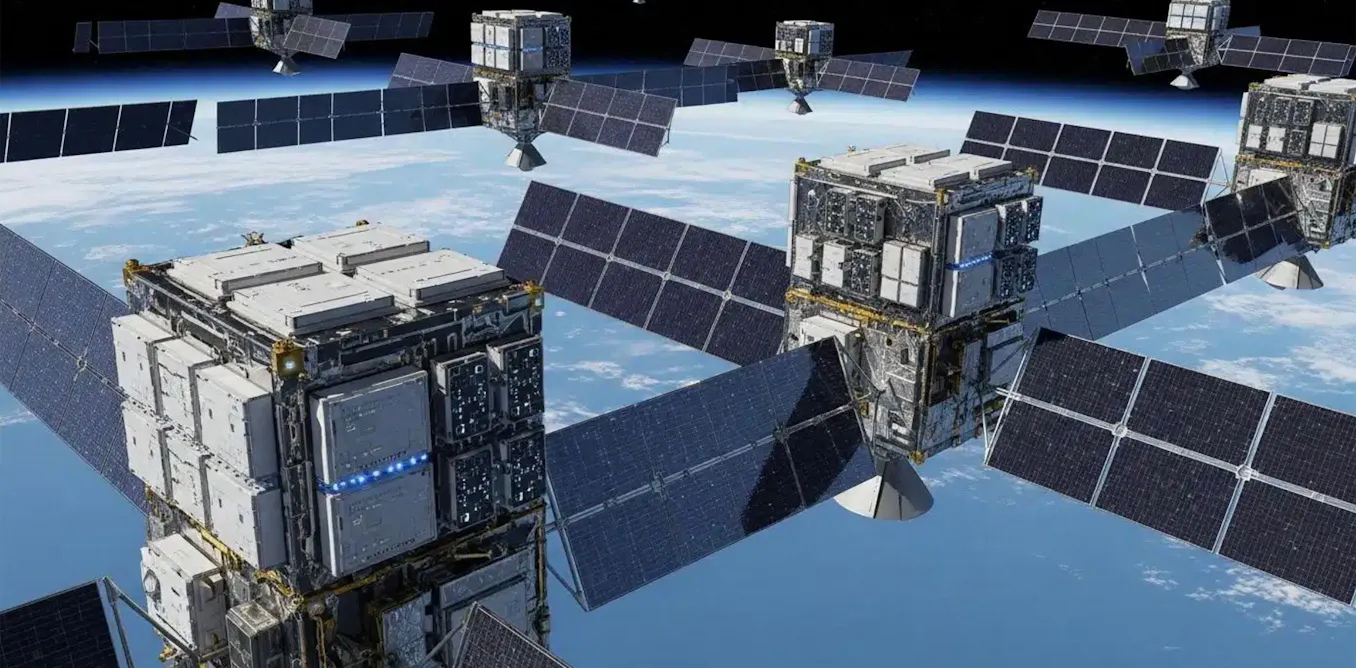
Scientists fear that this accumulating pollution in the stratosphere could destroy the ozone layer, expose people to higher levels of ultraviolet radiation, and destabilize the planet during the climate crisis. Furthermore, spaceport deluge systems release around 2 million litres of water per launch to capture toxic dust and protect launch pads from heat damage, and every heavy-lift Starship launch burns over 1,000 tonnes of liquid methane to release approximately 80,000 tonnes of CO₂.
Artificial Saturn’s Ring and Light Pollution
Astronomers warn that the massive influx of spacecraft could form an artificial “Saturn’s ring” of satellites circling the night sky, outshining every star and planet while remaining visible from every spot on Earth. According to Hugh Lewis, a professor of astronautics at the University of Birmingham in the U.K., accommodating these proposed constellations requires stacking them in an orbital plane following the terminator line between day and night to maintain constant 24-hour sunlight.

University of Regina astronomer Samantha Lawler and colleagues used computer modeling to visualize fleets such as SpaceX’s Starmind, Blue Origin’s Project Sunrise, and Cowboy Space’s Stampede constellation, finding that visible satellites would outnumber and outshine visible stars. Ruskin Hartley, executive director of DarkSky International, stated that these projects could permanently alter the night sky, while light pollution contributes to insect die-offs among fireflies and other species.
Engineering Challenges and Orbital Risks
Technical hurdles also face the expansion of space-based data operations. Space keeps things hot like a Thermos flask due to a lack of air or water for cooling, requiring massive ammonia-filled radiators that let heat escape as infrared radiation. Microchips in orbit are also vulnerable to high-energy particles causing “bit flipping,” which randomly changes stored data from 1 to 0.
Additionally, scientists point to Kessler Syndrome risks, where untethered satellites colliding could generate cascading debris fields that threaten future space activities. As noted in the petition cited by Newser, project proponents describe their plans in grandiose terms but have refused to embrace inquiries into their environmental, scientific, or economic impacts.