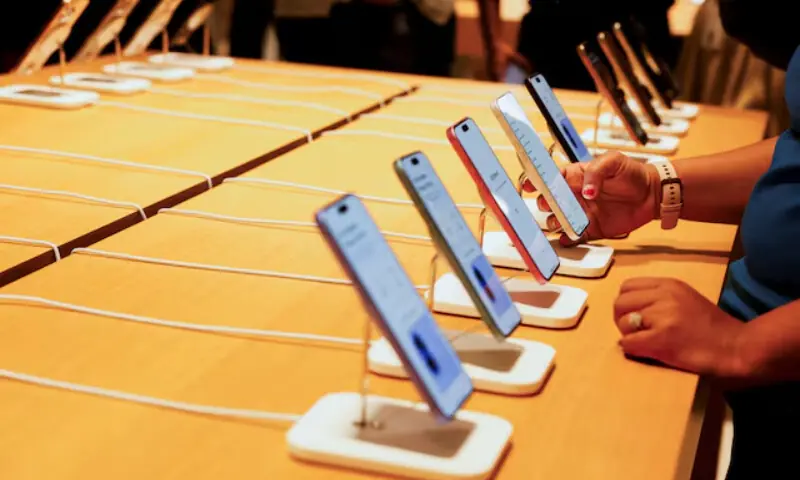
Islamabad – Pakistan’s Federal Board of Revenue (FBR) has updated customs valuations for 62 models of used and older mobile phones, marking a significant shift in how duties and taxes are assessed on imported handsets. The revision, formalised through Valuation Ruling No. 2070 of 2026, replaces the earlier ruling from January 2026 and aims to align assessed values with current market rates for second-hand devices. The move comes amid a sharp rise in smartphone imports, which grew by 27.84 per cent to $1.444 billion during the first nine months of the fiscal year, compared to $1.129 billion in the same period last year, according to FBR trade data.
The updated ruling applies specifically to imports of used and older mobile phones in commercial quantities without original packaging or accessories. It maintains the existing framework for six-month activation periods, declared value thresholds, and freight adjustments, but recalibrates the benchmark values used to calculate duties and taxes. FBR officials stated the adjustment was necessary to prevent under-invoicing and ensure fair revenue collection, particularly as the market for refurbished and second-hand smartphones continues to expand in Pakistan.
The revision follows assurances given by senior FBR officials to a National Assembly parliamentary committee just days earlier, in which they indicated that mobile phone import costs might be reduced in the upcoming federal budget. That contrast has drawn attention from traders and importers, who now face higher immediate costs despite earlier signals of potential relief. The FBR has not yet clarified whether the new valuation will be adjusted in the budget, but officials confirmed the ruling is effective immediately for customs clearance purposes.
According to the FBR’s published comparison between the old and new rulings, the most substantial increases were recorded for older Google Pixel and Samsung models, while changes for Apple iPhones were more moderate, particularly for newer flagship variants. The Google Pixel 6, for example, saw its customs value rise from $32 to $94 – an increase of 193.75 per cent – while the Pixel 6A jumped from $28 to $82, a rise of 192.86 per cent. Even steeper increases were seen in the Pixel 5 and Pixel 5A 5G models, which rose from $18 to $47 each, representing a 161.11 per cent increase.
Samsung devices also experienced sharp upward revisions, especially in mid-range and older flagship models. The Galaxy S22+ 5G saw its value jump from $75 to $180 – a 140 per cent increase – while the S21+ 5G rose from $69 to $150 (117.39 per cent) and the S21 5G from $50 to $110 (120 per cent). Older models like the S10+ and S10 saw increases of 140 per cent and 116 per cent respectively. In contrast, the Galaxy S23 Ultra, a more recent flagship, saw a more modest rise from $255 to $305, or 19.61 per cent, suggesting the earlier ruling had already valued newer models closer to market rates.
Apple iPhone valuations increased across most models, but with greater variation. The iPhone 15 Pro Max rose from $460 to $505 (9.78 per cent), while the iPhone 14 jumped from $210 to $275 (30.95 per cent). Older models saw sharper increases: the iPhone 8 Plus rose from $47 to $78 (65.96 per cent), and the iPhone 7 Plus from $26 to $47 (80.77 per cent). The most dramatic increase among Apple devices was for the iPhone SE 2, which rose from $25 to $52 – a 108 per cent jump. Notably, the iPhone XS Max and iPhone SE 3 showed no change in valuation, remaining at $95 and $73 respectively in both rulings.
OnePlus devices also saw varied adjustments. The OnePlus 12 increased modestly from $184 to $211 (14.67 per cent), while the OnePlus 12R rose sharply from $105 to $176 (67.62 per cent) and the OnePlus 10 Pro from $65 to $113 (73.85 per cent). The OnePlus 10T increased from $60 to $90, a 50 per cent rise.
The FBR confirmed that the valuation rulings are issued under Section 25A of the Customs Act, 1969, which allows authorities to establish benchmark values when declared transaction values are deemed unreliable for uniform assessment. These rulings serve as reference points for customs officials to assess duties and taxes, reduce disputes at clearance points, and ensure consistency across collectorates. The agency emphasized that the updated values reflect prevailing prices in the international secondary market for used smartphones, particularly in regions where such devices are refurbished and re-exported.
Industry analysts note that the revision will likely increase costs for importers specialising in refurbished or older-model smartphones, particularly those sourcing from markets in Europe, the UAE, or Southeast Asia where used devices are graded and resold. Retailers dealing in mid-range and older flagship models may necessitate to adjust pricing strategies, while those focused on newer Apple or Samsung flagships may spot relatively smaller impacts. The change could also influence consumer prices in the local market, where demand for affordable used smartphones remains strong, especially among students and budget-conscious buyers.
The FBR has not released an official estimate of how much additional revenue the revised valuations are expected to generate, but officials acknowledged that the adjustment will increase the tax base across the board. Traders have been advised to consult the FBR’s official valuation rulings page or contact their regional collectorate for clarification on how the changes apply to specific models and shipment types. The next scheduled review of mobile phone valuation rulings has not been publicly announced, though such updates typically occur biannually or in response to significant market shifts.
For the latest updates on customs valuations, tariff schedules, and trade regulations, importers and stakeholders can refer to the Federal Board of Revenue’s official website or subscribe to its trade notices portal. The FBR also holds periodic consultations with trade bodies, and interested parties are encouraged to participate in upcoming stakeholder forums to provide feedback on valuation methodologies.
As Pakistan continues to regulate the influx of used electronics amid growing environmental and economic concerns, the adjustment underscores the authorities’ focus on aligning fiscal policy with real-time market dynamics. While the move aims to strengthen revenue collection and prevent valuation discrepancies, its broader impact on affordability, retail pricing, and the second-hand device market will unfold over the coming months.
Stay informed about changes to import regulations and trade policies by following official updates from the Federal Board of Revenue. Share your thoughts on how these changes might affect the mobile phone market in Pakistan in the comments below.