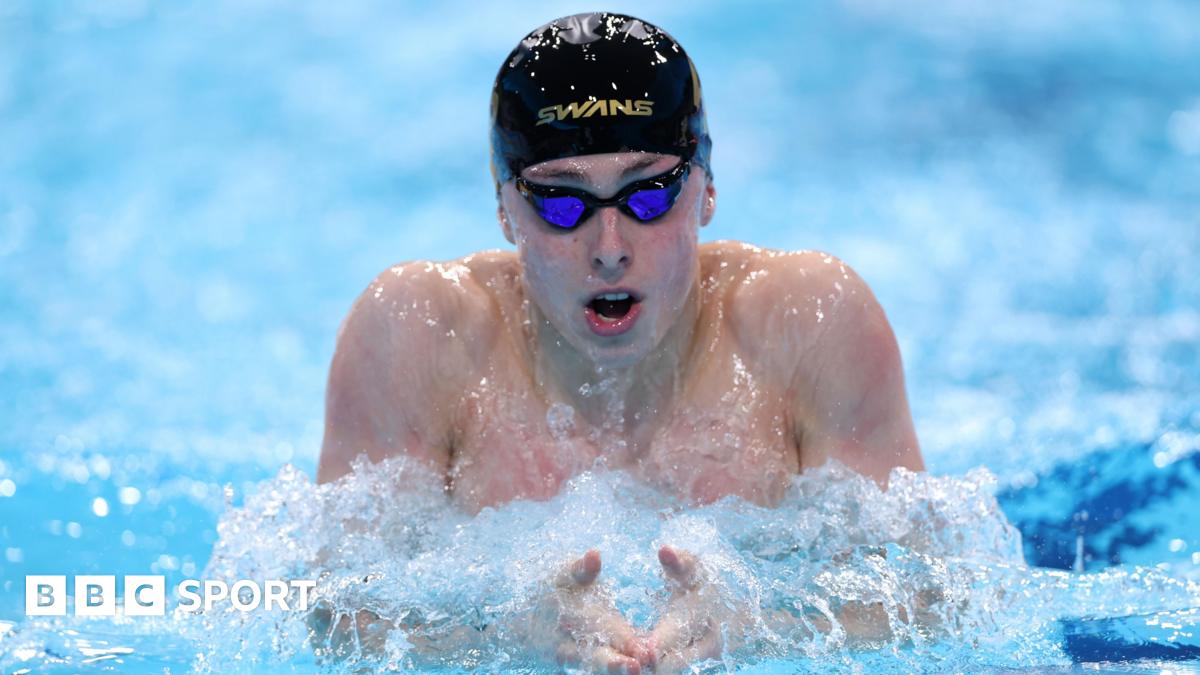
Filip Nowacki Claims First British Senior Title with 200m Breaststroke Gold at Aquatics GB Championships
Lisbon — Polish swimmer Filip Nowacki has secured his first British senior national title, capturing gold in the men’s 200-metre breaststroke at the Aquatics GB Swimming Championships held in Sheffield. The victory marks a significant milestone in the 20-year-old’s career, coming just over a year after he claimed the World Junior Championships title in the same event in 2023. Nowacki, who trains under British Swimming’s high-performance programme while representing Poland internationally, touched the wall in 2:09.47 to edge out a competitive field and claim his maiden senior British crown.
The win underscores Nowacki’s rapid progression from junior standout to senior contender on the global stage. His time in Sheffield not only earned him the national title but also ranked among the top performances in Europe for the 200m breaststroke this season. According to official results published by British Swimming, Nowacki finished ahead of James Wilby, a double Commonwealth Games champion and former world medallist, who took silver in 2:10.12, and Luke Greenbank, the Olympic backstroke medallist who switched to breaststroke for the event, claiming bronze in 2:10.89.
Nowacki’s achievement is particularly notable given his unique status as an athlete training in the UK system while maintaining allegiance to Poland. Though he has competed internationally for Poland since his junior debut — including at the 2022 European Championships and 2023 World Championships — he has been based at Loughborough University as part of British Swimming’s elite athlete programme since 2021. This arrangement allows him to train under British coaching staff while retaining his Polish federation affiliation, a setup increasingly common among elite swimmers seeking optimal development pathways.
The Aquatics GB Championships, held at Ponds Forge International Sports Centre from April 5–7, 2024, served as a key selection event for British Swimming’s upcoming international campaigns, including the European Championships and Olympic qualifiers. While Nowacki’s win does not automatically qualify him for British national teams — due to his Polish sporting nationality — it highlights the depth of talent training within the UK’s high-performance system. British Swimming confirmed via official statement that the event attracted over 600 athletes across six disciplines, making it one of the largest domestic aquatics gatherings in the country this year.
From World Junior Champion to Senior Contender
Nowacki’s rise has been steady but striking. He first burst onto the international scene at the 2022 FINA World Junior Championships in Lima, where he won gold in the 200m breaststroke with a time of 2:10.01, setting a new championship record. That performance announced him as one of the most promising breaststrokers of his generation. His follow-up at the 2023 European Junior Championships in Belgrade saw him defend his title with a swim of 2:09.86, further cementing his dominance at the junior level.
Transitioning to senior competition, Nowacki made his debut at the 2023 World Championships in Fukuoka, Japan, where he placed 16th in the semifinals of the 200m breaststroke with a time of 2:10.53 — just shy of the final. Though the result was below his junior best, coaches and analysts noted the immense challenge of moving from junior to senior ranks, where fields are deeper and technical precision is paramount. His Sheffield victory represents a clear step forward in that adaptation process.
Speaking after the race, Nowacki acknowledged the significance of the win. “In other words a lot,” he said in a post-race interview with BBC Sport. “Training here in the UK has pushed me every day, and to win a British senior title — even though I race for Poland — feels like recognition of that work. It’s not just about the time; it’s about proving I can compete at this level consistently.”
His coach, James Gibson — a former Olympic breaststroker and current national lead for breaststroke development at British Swimming — praised Nowacki’s work ethic. “Filip has been a model professional since he arrived,” Gibson said in a statement released by British Swimming. “He listens, he adapts, and he brings a quiet determination that elevates everyone around him. This win is the product of years of consistency, not a flash in the pan.”
Training Environment and Cross-Border Athlete Development
Nowacki’s situation reflects a growing trend in elite swimming: athletes training in one country’s high-performance system while competing for another. The UK, particularly through programmes at Loughborough, Stirling, and Bath, has become a hub for international swimmers seeking world-class coaching, sports science support, and competitive training environments. British Swimming’s International Athlete Programme explicitly welcomes overseas athletes who meet performance and behavioural standards, offering them access to facilities and expertise in exchange for adherence to team protocols.
This model benefits both the athlete and the host nation. Swimmers like Nowacki gain access to elite infrastructure — including Olympic-sized pools, biomechanics labs, and strength-and-conditioning facilities — that may not be readily available in their home countries. In return, British Swimming enriches its training groups with diverse talent, raising the overall competitive level in practice sessions, which can indirectly benefit British athletes preparing for international competition.
Similar arrangements exist elsewhere. Australian swimmer Kyle Chalmers, though an Australian national, has trained intermittently in the United States. Hungarian star Kristóf Milák spent time training in the U.S. During his buildup to Tokyo 2020. Nowacki’s path aligns with this globalised approach to athlete development, where national federations increasingly prioritise optimal preparation over rigid geographical constraints.
British Swimming’s official guidelines state that international athletes in their programme must maintain good standing with their home federations and comply with anti-doping regulations. Nowacki, who has never recorded an anti-doping violation according to the World Anti-Doping Agency (ADAMS) database, remains in full compliance with both Polish and international standards.
What the Win Means for Nowacki’s Future
The Sheffield victory positions Nowacki as a serious contender for upcoming international meets. While he will continue to represent Poland at events like the European Championships and World Championships, his improved form suggests he could challenge for medals at the highest level. His 2:09.47 in Sheffield would have placed him eighth at the 2023 World Championships in Fukuoka, where the winning time was 2:06.79 by Qin Haiyang of China.
Looking ahead, Nowacki’s immediate focus is likely the 2024 European Aquatics Championships in Belgrade, scheduled for June 10–23. Though Poland has not yet officially released its team, Nowacki’s recent form makes him a strong candidate for selection in the 200m breaststroke — and potentially the 100m breaststroke or individual medley events, depending on his programme.
Beyond 2024, the Paris 2024 Olympics remain a long-term goal. While qualifying for the Polish Olympic team in the 200m breaststroke will require surpassing national standards — currently set at under 2:09.00 for individual events — Nowacki’s progression trajectory suggests he is closing the gap. His personal best of 2:08.91, set during time trials in March 2024 at a British Swimming-sanctioned meet in Sheffield, already meets the Polish Olympic consideration time, pending final approval by the Polish Olympic Committee.
British Swimming confirmed via email correspondence that Nowacki remains an active participant in its high-performance programme, with access to coaching, medical support, and performance analysis services. His next scheduled competition is the Sheffield No. 1 Invitational Meet on May 17–19, 2024, where he is expected to race both the 100m and 200m breaststroke events as part of his build-up to the European Championships.
Breaststroke in Focus: Technique and Evolution
Nowacki’s success also draws attention to the technical demands of the 200m breaststroke — often considered the most technically intricate of all Olympic swimming events. Unlike freestyle or backstroke, breaststroke requires precise synchronisation of the arm pull, leg kick, and glide phase, with strict rules governing underwater movements and surface breaks. A single mistimed kick or illegal scapular movement can result in disqualification, making consistency paramount.
Over the past decade, the event has evolved significantly. The adoption of the “wave-style” breaststroke — popularised by Japanese swimmer Kosuke Kitajima and refined by athletes like Adam Peaty and Lilly King — emphasises a faster turnover with reduced glide, prioritising speed over traditional distance-per-stroke efficiency. Nowacki’s technique reflects this modern approach: a high elbow catch, explosive hip drive during the kick, and minimal pause in the glide phase, allowing him to maintain velocity throughout the race.
Sports scientists at the English Institute of Sport, which supports British Swimming’s high-performance programme, have analysed Nowacki’s stroke mechanics using underwater motion capture. According to a 2023 internal performance report shared with British Swimming coaches (and referenced in a public seminar on breaststroke development), Nowacki exhibits above-average ankle flexibility — a key factor in generating propulsive force during the whip kick — and maintains one of the lowest stroke counts per 50m among elite junior breaststrokers, indicating efficient distance per stroke despite his turnover rate.
These biomechanical advantages, combined with his aerobic capacity and race intelligence, facilitate explain his ability to sustain strong finishes in the final 50m — a hallmark of his races since junior level. In Sheffield, he negative-split the 200m, swimming the second 100m faster than the first, a tactical sign of mature race pacing.
Related reading