The landscape of English professional rugby has undergone significant transformation since the dawn of the professional era in 1995. As the Premiership Rugby competition has evolved into a premier global tournament, the financial and structural demands placed on its member clubs have proven unforgiving. For many storied institutions, the dream of top-flight dominance has been curtailed by insolvency, mergers, or administrative restructuring, leaving a trail of “likely lads” who once competed at the highest level but have since vanished from the Premiership map.
Understanding the history of these disappeared Premiership rugby teams requires looking beyond the pitch to the economic realities of elite sport. From the early days of the Courage League to the modern Gallagher Premiership, the rise and fall of clubs often mirror the broader shifts in how professional sports are managed and financed. For fans, these departures represent more than just a change in the league table; they mark the loss of local identities and the fading of intense, long-standing rivalries.
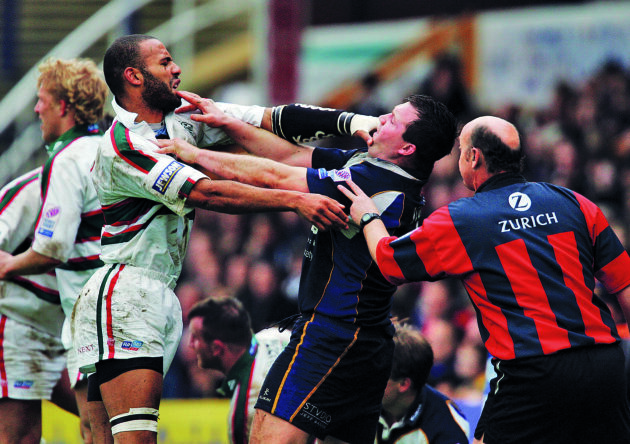
Leicester’s Leon Lloyd and Mark Regan of Leeds tangle during the Zurich Premiership match (Photo by Alex Livesey/Getty Images)
The Impact of Financial Volatility on Elite Clubs
The Premiership has seen several clubs exit the top flight due to financial instability. One of the most notable cases in recent history involved London Irish, which was suspended from the Gallagher Premiership in June 2023 after failing to meet the requirements of the Rugby Football Union (RFU) for continued participation. The club’s inability to secure a takeover or provide proof of funding led to their eventual withdrawal from professional competition, as detailed in the official statement issued by the Rugby Football Union.

Similarly, the collapse of Worcester Warriors and Wasps in late 2022 sent shockwaves through the sport. Both clubs entered administration, a process that effectively ended their tenure in the top flight. The BBC reported that Wasps were removed from the Premiership after failing to prove they had the funds to pay players and staff, underscoring the precarious nature of club ownership in a high-cost environment. These events prompted a wider discussion regarding the sustainability of the current club model, with governing bodies implementing stricter financial monitoring to prevent further losses to the league structure.
Clubs That Have Changed or Merged
Not all disappearances from the top flight were the result of insolvency. Some clubs sought survival through consolidation. Leeds Tykes, once a fixture of the Premiership in the early 2000s, underwent various iterations, including rebranding and drops to lower tiers of the English rugby pyramid. The evolution of Leeds, which often battled against the financial might of larger clubs, serves as a case study for the difficulty of maintaining competitiveness in a league where salary caps and infrastructure requirements are constantly rising.

Richmond FC and London Scottish, both of which competed in the early years of the professional Premiership, also saw their top-flight ambitions curtailed. Unlike modern clubs that often collapse due to debt, these sides faced the harsh reality of the transition to professionalization. Many clubs from that era struggled to adapt their business models to the demands of full-time professional squads, leading to relegation and subsequent financial restructuring that kept them out of the upper echelons of the sport for decades.
Why History Matters for the Modern Game
The disappearance of these teams highlights the “what it means” aspect of professional rugby: the sport is a fragile ecosystem. When a club like Wasps or London Irish ceases to function at the elite level, the impact is felt by the entire community—from the academy players who lose their development pathway to the supporters who lose their weekly connection to their hometown team. The Gallagher Premiership continues to implement reforms aimed at long-term financial viability, ensuring that the remaining clubs can weather the storms that claimed their predecessors.
For the modern fan, the history of these clubs serves as a reminder that participation in the top flight is a privilege, not a guarantee. The current administrative focus on “financial viability” is a direct response to the lessons learned from the clubs that could not sustain their operations. Moving forward, the league’s focus remains on stabilizing the existing structure, with stakeholders closely monitoring the financial health of the current roster of teams to avoid repeating the crises of 2022 and 2023.
Key Takeaways for Rugby Enthusiasts
- Sustainability: Financial solvency is now the primary metric for Premiership participation, with the RFU enforcing strict oversight.
- Administrative Change: The shift from traditional club models to investor-led ownership has increased both potential resources and the risk of catastrophic failure.
- The Pyramid: Clubs that drop out of the Premiership often face a long, difficult path to return, if they manage to survive at all.
- Fan Engagement: The loss of historic clubs has galvanized efforts to protect the heritage and community roots of the remaining teams.
As the sport looks toward the next season, the focus remains on the upcoming annual general meeting of the Premiership clubs and the Rugby Football Union, where updates on the league’s financial health and regulatory framework are expected to be discussed. We invite our readers to share their memories of these clubs in the comments below. Which team do you miss the most from the Premiership’s golden era? Join the conversation and let us know your thoughts on the future of the English game.

Related reading