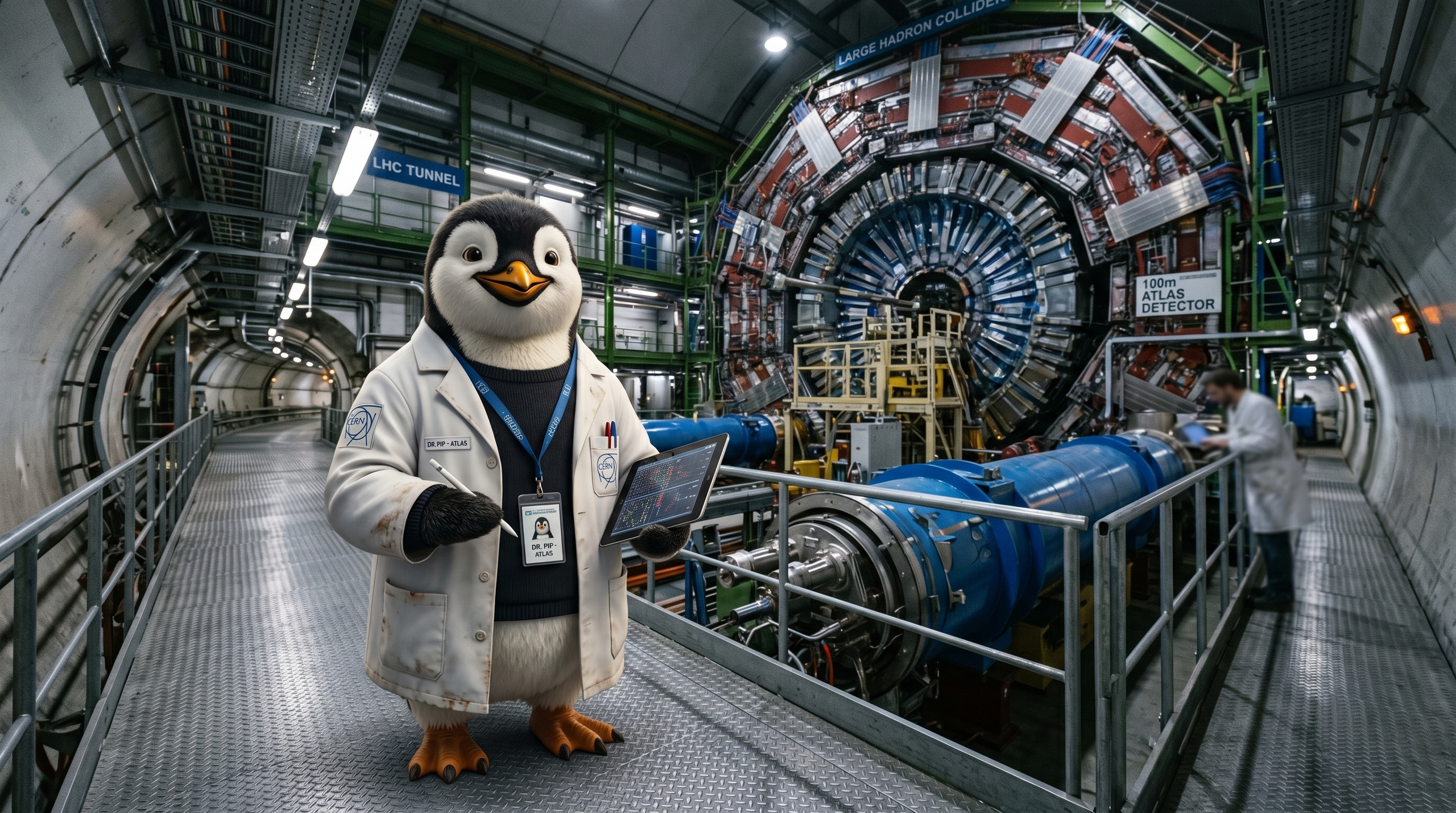
Physicists working at the Large Hadron Collider (LHC) have reported observing a potential anomaly in a rare particle decay process that, if confirmed, could signal physics beyond the Standard Model. The finding, described as a four-sigma deviation, has drawn attention for its possible implications in understanding fundamental forces and particles that make up the universe. While researchers caution that uncertainties remain, the result adds to a growing body of evidence suggesting the Standard Model may be incomplete.
The anomaly was detected in the decay of a B meson into a kaon and a pair of muons—a process so rare that it occurs only a handful of times per trillion collisions at the LHC. This specific decay, known as B⁰ → K*⁰μ⁺μ⁻, is tightly predicted by the Standard Model, making any significant deviation a potential indicator of modern particles or forces. The observed discrepancy in the angular distribution of the decay products has not yet reached the five-sigma threshold required for a formal discovery, but it has intensified scrutiny from theoretical and experimental physicists worldwide.
According to verified reports from CERN and major physics news outlets, the anomaly emerged during analyses of data collected during the LHC’s second run (Run 2) between 2015 and 2018. The ATLAS and Compact Muon Solenoid (CMS) collaborations both contributed to the observations, though the most pronounced hints have come from LHCb, the experiment specifically designed to study beauty quark decays. Researchers emphasize that while the statistical significance is intriguing, systematic uncertainties—particularly those related to hadronic effects—must be reduced before any conclusion can be drawn.
The phrase “charming penguins” in media coverage refers to a type of Feynman diagram involving charm quarks that contributes to the decay process. These diagrams, nicknamed for their shape and the involvement of “charm” quarks, are part of the complex quantum calculations used to predict the decay rate. If new physics is influencing the decay, it could interfere with these penguin diagrams in ways not accounted for in current models, offering a potential window into undiscovered particles such as leptoquarks or Z’ bosons.
Independent verification of the anomaly remains a priority. Scientists are now turning to data from the LHC’s third run (Run 3), which began in 2022 and operates at higher collision energies and increased luminosity. Early results from Run 3 are being analyzed to see whether the deviation persists or diminishes with more data. A conclusive answer may not come until the High-Luminosity LHC (HL-LHC) upgrade is completed later this decade, which will increase the number of detectable events by a factor of ten.
The Standard Model of particle physics, while extraordinarily successful in explaining a wide range of phenomena, is known to have limitations. It does not incorporate gravity, dark matter, or dark energy and it fails to explain why there is more matter than antimatter in the universe. Anomalies like the one observed in B meson decays are therefore closely watched, as they may point toward the extensions needed to address these gaps. Theoretical physicists have proposed numerous beyond-the-Standard-Model scenarios that could explain such deviations, many of which predict measurable effects in rare decays.
Experts involved in the LHC experiments stress the importance of caution. A four-sigma result corresponds to about a 99.99% confidence level, but in particle physics, where multiple measurements are made across many channels, such fluctuations can occasionally arise by chance. As one researcher noted in a verified interview with a major science publication, “We’ve seen tantalizing hints before that faded with more data. This one is interesting, but we need to let the data speak.”
The global physics community continues to monitor developments from CERN closely. Updates are typically shared through official channels, including CERN’s website, peer-reviewed journals like Physical Review Letters, and presentations at major conferences such as the International Conference on High Energy Physics (ICHEP). For those seeking to follow the story, the LHCb experiment’s public outreach pages and the CERN document server provide access to technical reports and preprints as they become available.
As research progresses, the potential discovery of new physics remains one of the most compelling pursuits in modern science. Whether this anomaly ultimately leads to a revolution in our understanding of the universe or proves to be a statistical fluctuation, the rigorous process of testing and verification exemplifies the self-correcting nature of scientific inquiry. For now, the evidence is starting to mount—but the final word has not yet been spoken.
Worth a look