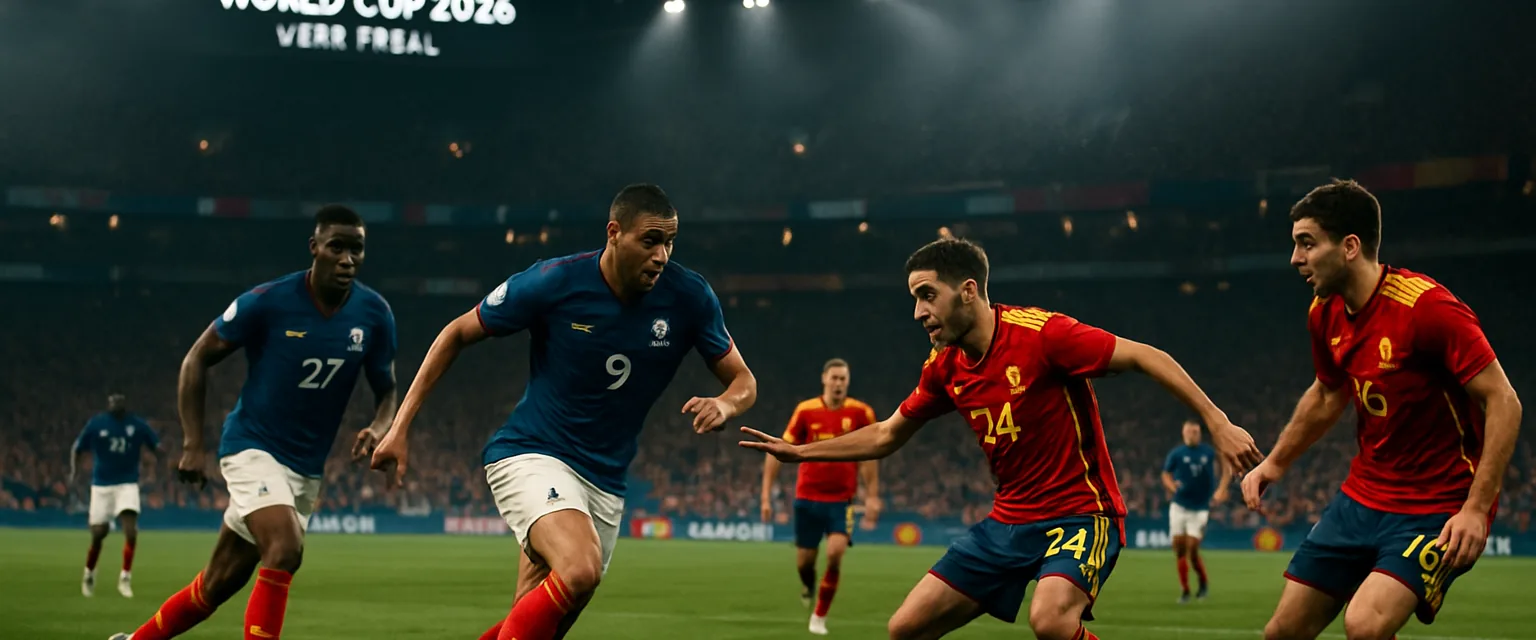
The football rivalry between France and Spain, often defined by tactical shifts and generational shifts in talent, reaches a new peak as the two nations collide in the 2026 World Cup semifinals. From the legendary encounters of the Michel Platini era to the emergence of modern sensations like Lamine Yamal, the fixture has evolved into one of European football’s most compelling narratives. As France prepares for this latest chapter, the focus remains on how Didier Deschamps will manage a squad facing an Spain side that many observers, including the French manager himself, have labeled the tournament favorites.
This match represents more than a path to a World Cup final; it is a confrontation between two distinct footballing philosophies that have traded dominance for decades. The anticipation surrounding this semifinal is underscored by the high stakes of the 2026 tournament, where both nations look to cement their standing in global football history.
Tactical Battles and the Evolution of the France-Spain Rivalry
The rivalry is historically anchored in high-profile tournament matches that often serve as turning points for both programs. Throughout the decades, the tactical evolution of the “Bleus” and “La Roja” has mirrored the broader changes in international football. Analysts point to three specific zones on the pitch—the central midfield battle, the defensive transition against rapid wing play, and the management of high-pressing systems—as the critical areas that will determine the outcome of the 2026 semifinal. The ability of the French midfield to disrupt the rhythmic passing of the Spanish side remains a key talking point in pre-match assessments.

Didier Deschamps faces significant pressure to finalize his starting XI, with critics and supporters alike debating whether to maintain a conservative defensive posture or to lean into a more aggressive attacking formation. The decision is complicated by the individual brilliance of young Spanish talents, whose ability to exploit space has been a recurring theme in the 2026 competition. Spain’s reliance on technical precision, contrasted with France’s history of physical and tactical pragmatism, ensures that the match is viewed as a definitive clash of styles.
The Mbappé Factor and Spanish Media Perspectives
In the lead-up to the match, the Spanish press has highlighted the threat posed by Kylian Mbappé, frequently using descriptive language to characterize his influence on the game. One prominent metaphor, referring to the difficulty of containing the French forward, has drawn comparisons to the daunting nature of the Tourmalet pass in cycling, emphasizing the physical and psychological toll he exerts on opposing defenses. This focus on individual star power highlights the tactical “pressentiment” or anticipation among Spanish observers regarding how their defense will handle the French transition game.

While the focus is often on the stars, the match will likely be decided by the collective discipline of both squads. Didier Deschamps has repeatedly emphasized in press briefings that Spain enters the match as the favorite, a strategic attempt to shift the psychological burden onto the opposition. However, the French squad’s experience in navigating deep tournament runs provides a counter-narrative, suggesting that their familiarity with high-pressure scenarios remains a significant asset.
Historical Context: From Platini to the Present
The historical backdrop of this fixture is defined by landmark matches that have shaped the identities of both teams. The era of Michel Platini in the 1980s set a precedent for the intensity of the rivalry, with subsequent generations continuing to add layers of complexity to the matchup. Whether it is a knockout match in a European Championship or a high-stakes World Cup encounter, the history between these two nations is marked by narrow margins and moments of individual brilliance that have defined careers and legacies.
As the 2026 World Cup progresses, the performance of younger players like Lamine Yamal has introduced a new dimension to the rivalry. The integration of such talents into the Spanish system has forced opponents, including France, to recalibrate their scouting and defensive preparations. This blend of seasoned veteran leadership and emerging youth talent is what makes the current iteration of this rivalry particularly unpredictable.
Next Steps in the 2026 World Cup
The semifinal match is scheduled to determine which nation will progress to the final at the 2026 World Cup. Following the conclusion of this fixture, the winner will prepare for the championship match, while the loser will compete in the third-place play-off. Official updates, including confirmed lineups and referee assignments, will be provided by FIFA through their official tournament portal as the kickoff time approaches. We invite our readers to share their predictions and analysis of this historic rivalry in the comments section below.
