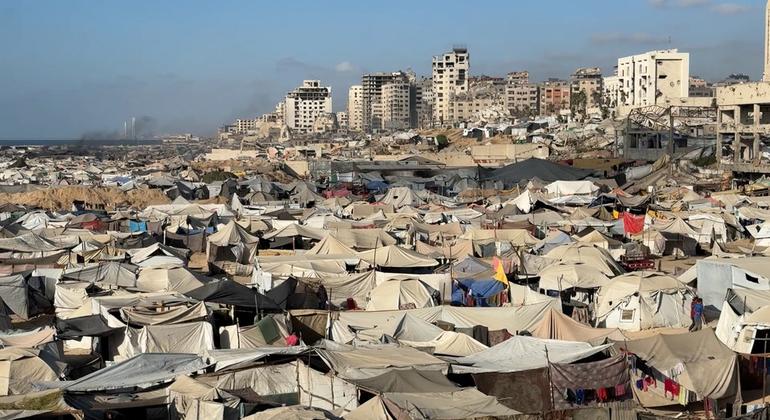
Gaza‘s displacement Crisis Deepens: Families Forced to flee again, Facing Financial Ruin and Uncertainty
The ongoing conflict in Gaza is creating a spiraling humanitarian crisis, forcing already displaced families to uproot their lives again. Residents of Gaza City, notably in neighborhoods like Sheikh Radwan, are facing impossible choices - stay amidst the rubble and risk further danger, or attempt to relocate with dwindling resources and no guarantee of safety.This article delves into the realities faced by Gazans, highlighting the financial burdens, desperation, and uncertainty that define their current plight.
A Cycle of displacement & Financial Strain
Many families have already been displaced multiple times throughout the conflict. Now, even those who managed to salvage some semblance of stability are being forced to move once more. Abu Amer, a resident of Gaza City, explains the crushing financial weight of each displacement.
Transportation costs are exorbitant.
Rent for even basic shelter is prohibitively expensive, frequently enough costing families thousands of dollars. Crucially, there is no financial assistance from authorities, leaving people entirely reliant on their own rapidly depleting resources.
“There are no salaries from the authorities and people have no income,” Abu Amer stated, emphasizing the complete lack of support. “Families are required to pay thousands of dollars for the places they move to, in addition to transportation costs. On top of that, our property is damaged.”
Living Amidst the Rubble: A Desperate Struggle for Survival
The situation is so dire that some are literally living amongst the ruins of their homes. Hossam madi, also from Sheikh Radwan, is breaking up furniture to sell as firewood just to afford basic necessities.
He bluntly stated, “We don’t have enough money to move to the southern Gaza Strip.”
This illustrates a heartbreaking reality: even the option of moving to what is considered a “safer” area is financially out of reach for many. He is forced to sell what little remains of his possessions to survive. “I break wood to sell it to buy a kilo of flour for breakfast or lunch. We have nothing. Look at our house, look what happened to it. I am living on the rubble, and now I will take my things and move to western Gaza.”
Uncertainty and the Illusion of “Safe Areas”
The lack of clear guidance and the constant shifting of conflict zones contribute to the overwhelming sense of chaos. Saqr Abu Sultan is preparing to evacuate with his family,but doesn’t know where they will go.
“The situation is chaotic now,” he said. “We’re trying to evacuate, but we don’t know where to go, despite the constant talk of safe areas.”
This highlights a critical issue: the designation of “safe areas” often feels illusory, offering little real security or long-term solutions for displaced families.You can understand the desperation when even the promise of safety is met with skepticism.
The Human Cost: A Growing Crisis
These individual stories represent a much larger, unfolding tragedy. The repeated displacement, coupled with the lack of financial support and the destruction of homes, is pushing Gazans to the brink.
Increased vulnerability: Displaced populations are more susceptible to disease, malnutrition, and exploitation.
Psychological trauma: the constant upheaval and loss are taking a severe toll on mental health.
Erosion of community: Displacement disrupts social networks and support systems, further isolating individuals and families.
What Does This Mean for You?
Understanding the depth of this crisis is crucial. If you are looking for ways to help, consider supporting reputable humanitarian organizations working on the ground in Gaza. Staying informed and advocating for increased aid and a lasting resolution to the conflict are also vital steps. the situation demands urgent attention and a sustained commitment to alleviating the suffering of the Palestinian people.
Image Captions (as provided in the original text):
Hossam Madi,a resident of Sheikh Radwan in northern Gaza City removes some of his belongings from his destroyed home.
Abu Amer Al-Sharif and his family in Gaza City remove their belongings and household items from their home, preparing for yet another displacement.Sources:
* United Nations News:[https://news
Keep reading