
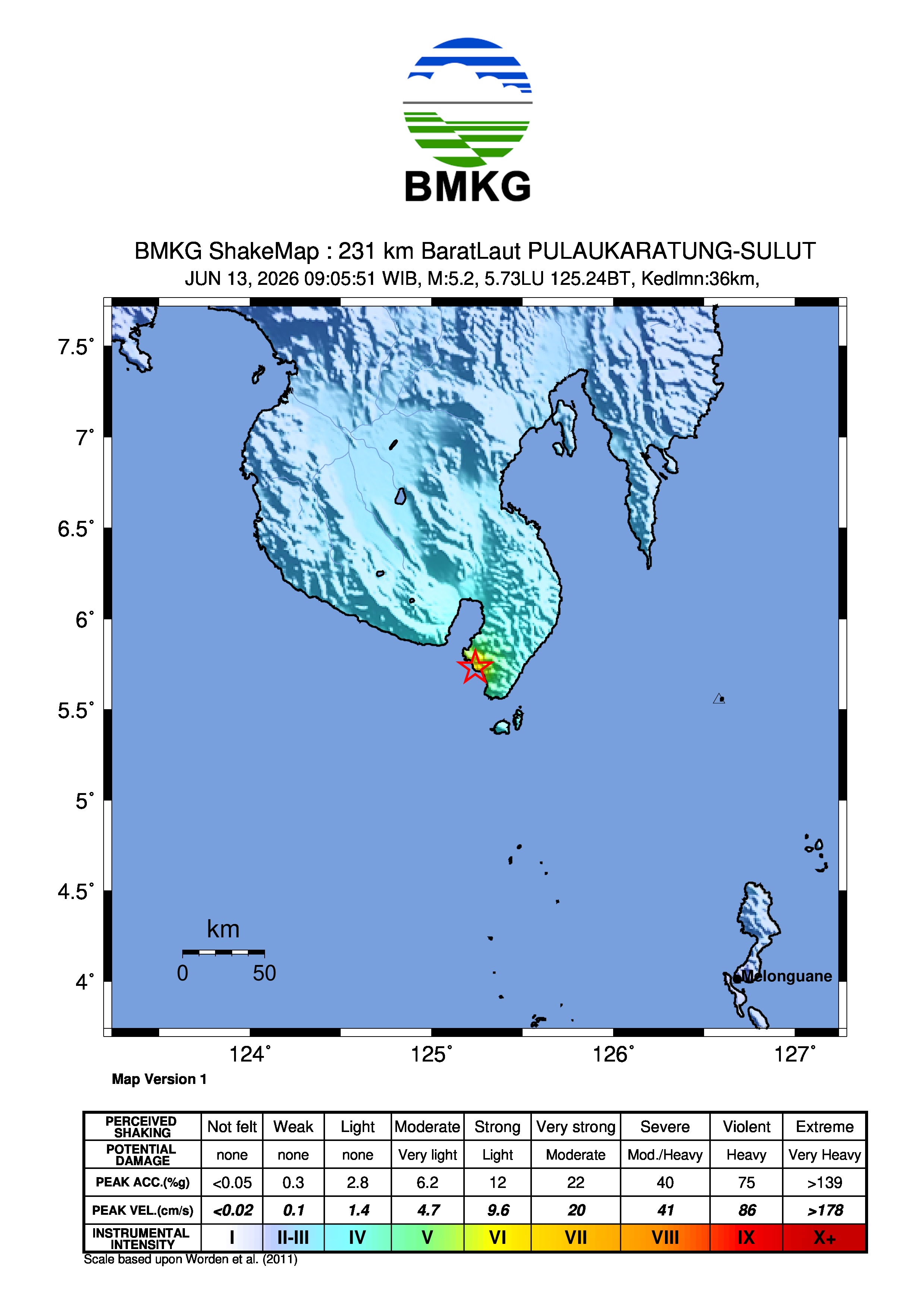
A magnitude 5.2 earthquake struck the region northwest of the Talaud Islands in North Sulawesi, Indonesia, according to monitoring data released by the Meteorology, Climatology, and Geophysics Agency (BMKG). The seismic event, which occurred at a significant distance from the coastal population centers, was recorded by the national monitoring network as part of the ongoing geological activity in the Maluku Sea and surrounding tectonic plates.
The BMKG, the official government body responsible for seismic monitoring in Indonesia, reported that the epicenter was located approximately 230 kilometers northwest of the Kepulauan Talaud region. While the magnitude was sufficient to be detected by sensitive instrumentation, the agency did not issue a tsunami warning, citing the depth and location of the quake as posing no immediate threat to coastal infrastructure. This event highlights the persistent seismic volatility of the North Sulawesi region, an area positioned near the convergence of several major tectonic plates, including the Philippine Sea Plate and the Eurasian Plate.
Understanding Seismic Activity in the North Sulawesi Region
The Talaud Islands and the broader North Sulawesi province are situated within one of the most seismically active zones globally. According to the Meteorology, Climatology, and Geophysics Agency (BMKG), the region experiences frequent tremors due to the complex subduction zones that characterize the seafloor in this part of the Indonesian archipelago. The magnitude 5.2 event serves as a reminder of the tectonic pressure that builds beneath the ocean floor.
Unlike shallower earthquakes that occur closer to populated landmasses, tremors centered over 200 kilometers away from major islands often result in minimal impact on local infrastructure. However, the BMKG maintains a 24-hour surveillance protocol, utilizing a network of seismic stations to track aftershocks and assess potential risks. Residents in regions like Melonguane and nearby coastal areas are regularly advised by local authorities to stay informed through official channels rather than relying on unverified social media reports, which can often misinterpret data or exaggerate the impact of moderate seismic events.
Comparing Recent Seismic Reports
Discrepancies in earthquake reporting can occur when different regional monitoring stations or international agencies process data from the same event. In recent reports concerning North Sulawesi, varying magnitudes—ranging from 3.8 to 5.2—have been cited across different news outlets. These variations often stem from the distance of the monitoring equipment from the epicenter and the specific calculation methods used by different institutes.
Official data from the Indonesia Tsunami Early Warning System (InaTEWS) remains the primary source for accurate figures. When comparing reports of a 3.8 magnitude tremor in Melonguane against the 5.2 magnitude event in the Talaud waters, it is essential to distinguish between localized, smaller-scale tremors and more significant regional shifts. The BMKG typically provides the most reliable data for the Indonesian territory, and their reports are updated in real-time as analysis of the seismic waves is finalized.
Safety Guidelines and Official Monitoring
For those living in or traveling to North Sulawesi, the BMKG provides clear guidance on how to respond to seismic activity. The primary advice is to remain calm and monitor official updates via the BMKG website or mobile application. In the event of a significant earthquake, residents are encouraged to follow the “Drop, Cover, and Hold On” protocol and to evacuate to higher ground only if a tsunami warning is explicitly issued by the authorities.
The Indonesian government has invested heavily in the modernization of its seismic detection infrastructure over the past decade to improve the speed and accuracy of public alerts. By maintaining a robust network of sensors, the BMKG can differentiate between tremors that require an immediate public response and those that are purely scientific in nature. The agency continues to emphasize that public education regarding earthquake preparedness is the most effective tool in mitigating the risks posed by the region’s natural geological environment.
Updates regarding seismic activity in the Talaud Islands and North Sulawesi are released regularly by the BMKG as part of their standard reporting cycle. Readers are encouraged to check the official BMKG portal for the most recent data on any aftershocks or new seismic developments in the area. Please feel free to share this information or leave a comment below if you have questions regarding earthquake safety protocols in Indonesia.