Cosmic Filaments Spin with Hidden Hydrogen, Revealing Universe’s Structure
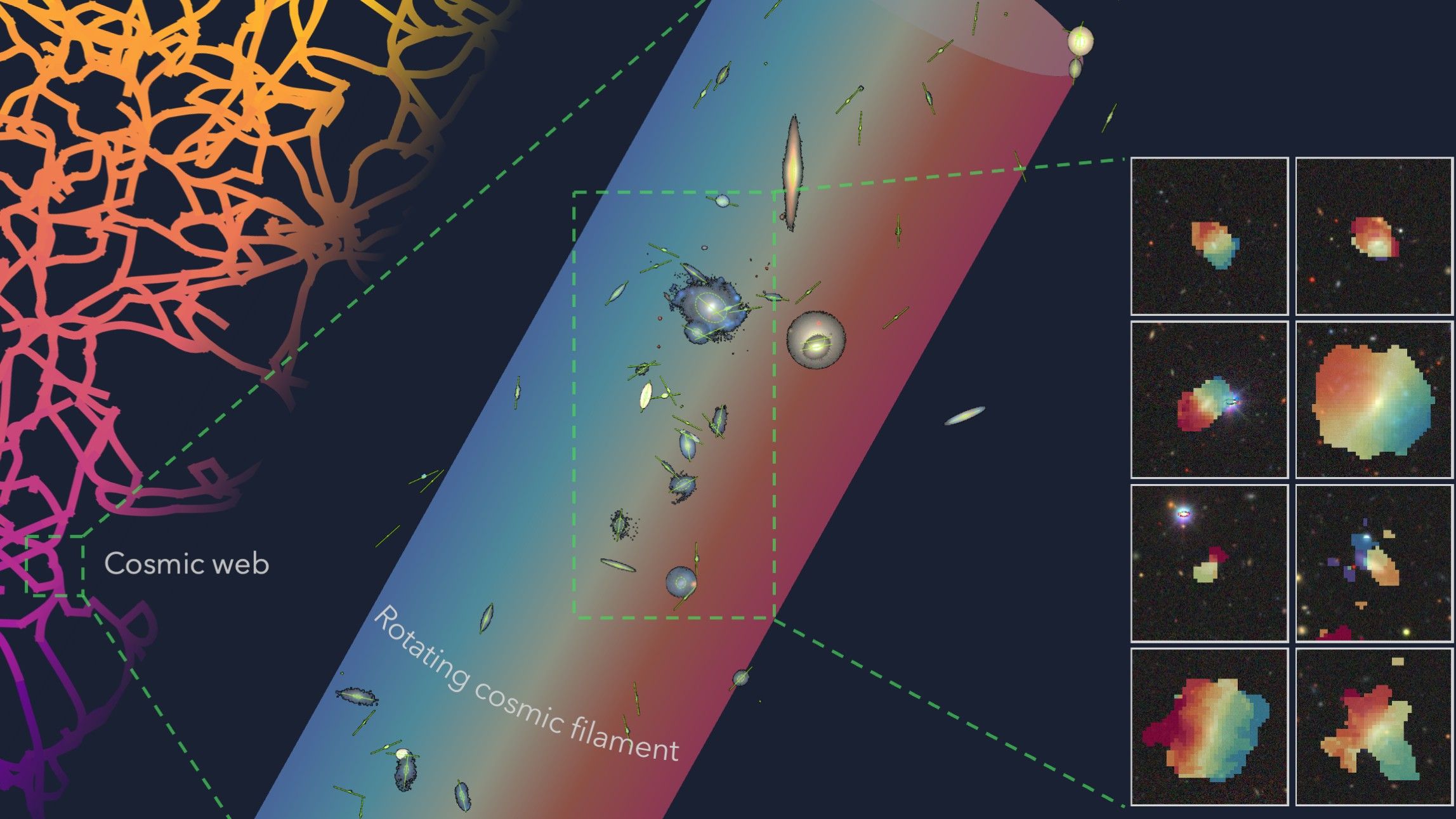
A newly discovered rotating filament of gas within the cosmic web is offering unprecedented insights into how galaxies form and evolve. This remarkable structure, composed of neutral hydrogen, stretches across vast distances and challenges previous understandings of matter distribution in the universe.
Researchers have long theorized about the cosmic web – a network of filaments that connect large clusters of galaxies. Now, direct observation confirms these filaments aren’t static; they rotate. This finding, made possible by the powerful MeerKAT radio telescope, provides a crucial piece in the puzzle of cosmic evolution.
Unveiling the Rotating Filament
The filament itself is composed primarily of neutral hydrogen, a key ingredient for star formation. Its located within a larger structure of the cosmic web, acting as a conduit for matter flowing towards galaxies.
Here’s what makes this finding so meaningful:
* Rotation defies expectations: previously, these filaments were thought to be relatively static. The observed rotation suggests a dynamic process influencing galaxy formation.
* Hydrogen as a key indicator: The detection of neutral hydrogen allows scientists to map the filament’s structure and movement.
* Confirmation of cosmic web theory: This observation provides strong evidence supporting the existence and behavior of the cosmic web.
How Was This Discovery Made?
This groundbreaking observation stems from the ongoing MeerKAT International GHz Tiered Extragalactic Exploration (MIGHTEE) survey. This ambitious project utilizes the MeerKAT telescope to map a large swathe of the sky in radio waves.
The MIGHTEE survey is designed to detect faint signals from distant galaxies and the gas surrounding them.It’s already proving to be a treasure trove of data about the universe’s structure and evolution.
Implications for Understanding the Universe
This discovery has far-reaching implications for our understanding of the cosmos. You can think of these filaments as cosmic highways,delivering the raw materials needed for galaxies to grow.
Consider these points:
* Galaxy formation: The rotating filament likely feeds gas into galaxies along its path, fueling star formation.
* Cosmic evolution: Understanding the dynamics of these filaments is crucial for modeling the universe’s evolution over billions of years.
* Interconnected universe: The cosmic web demonstrates that galaxies aren’t isolated islands, but are interconnected through a vast network of matter.
What’s Next in Cosmic Exploration?
Scientists anticipate discovering many more rotating filaments as next-generation telescopes come online.The Vera C. Rubin Observatory, currently under construction in chile, will be instrumental in mapping the cosmic web in unprecedented detail.
Future data from MIGHTEE and other surveys will further refine our understanding of these cosmic threads. This will allow researchers to investigate:
* The prevalence of rotation in other filaments.
* The relationship between filament rotation and galaxy properties.
* The role of dark matter in shaping the cosmic web.
“This is realy helping us understand the universe,” explains researcher Ana Tudorache. This discovery marks a significant step forward in unraveling the mysteries of the cosmos and our place within it. It’s a testament to the power of advanced telescopes and the dedication of scientists pushing the boundaries of our knowledge.