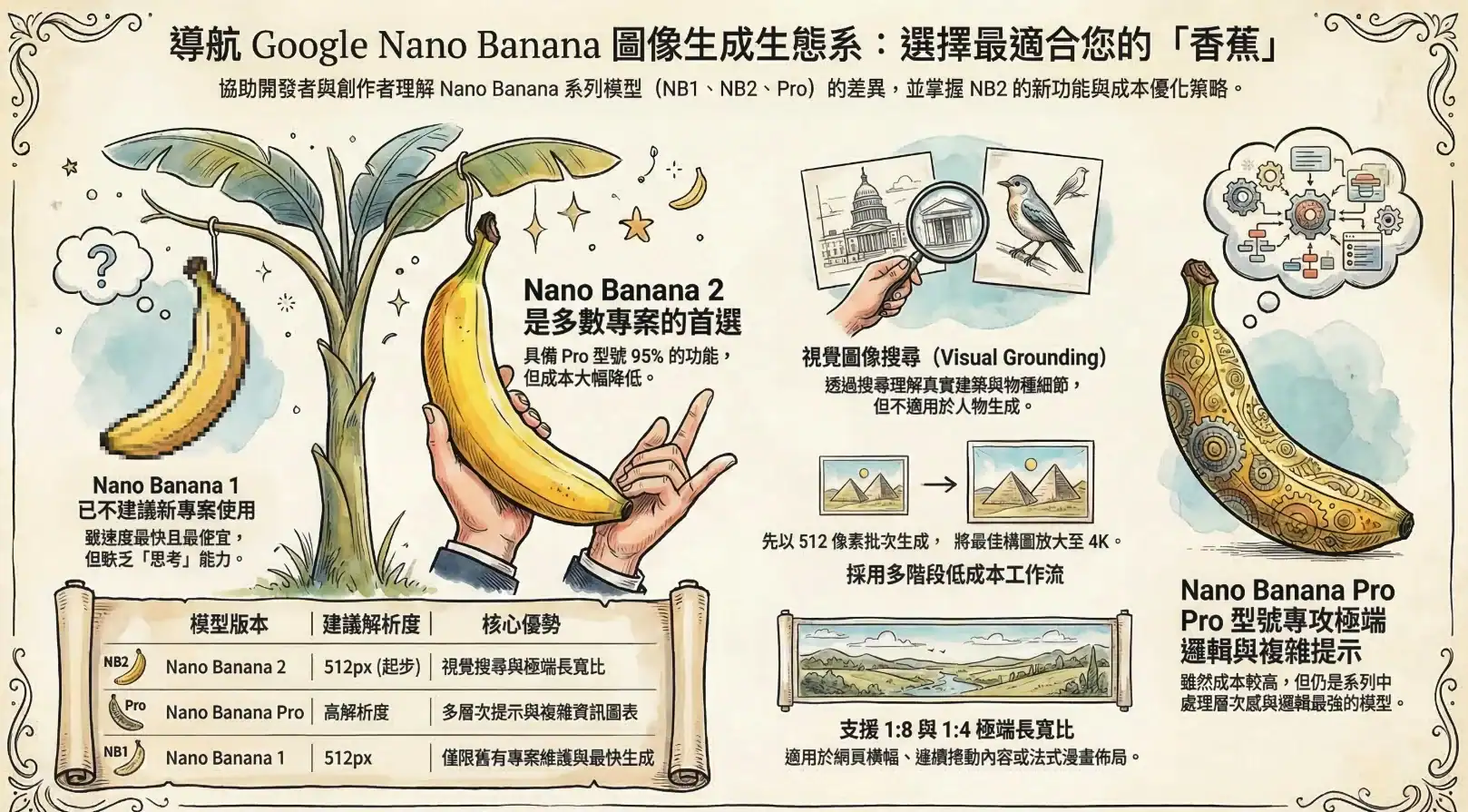
Google has detailed the differences between its Nano Banana image generation AI models, offering guidance to developers and creators seeking the best fit for their needs. The company recently highlighted Nano Banana 2, built on Gemini 3.1 Flash Image technology, as a particularly compelling option. This tiered approach to image generation aims to balance performance, cost, and complexity, providing a range of tools for diverse applications. The core of Google’s strategy revolves around offering accessible AI image creation, and the Nano Banana series is a key component of that effort.
The proliferation of AI image generators has been rapid, with tools like Midjourney, DALL-E 3, and Stable Diffusion gaining significant traction. Google’s entry into this space, with Gemini and now the Nano Banana models, signals a commitment to competing in this evolving landscape. The focus on speed and cost-effectiveness, particularly with Nano Banana 2, positions these models as attractive alternatives for a wider range of users. Understanding the nuances between the three Nano Banana models – 1, 2, and Pro – is crucial for maximizing efficiency and achieving desired results. The models are accessible through Google AI Studio, allowing developers to experiment and integrate them into their projects. Google AI Studio provides a platform for accessing and testing the Gemini 3.1 Flash Image models.
Nano Banana 2: Balancing Performance and Cost
Google is positioning Nano Banana 2 as the default recommendation for most new projects, boasting approximately 95% of the capabilities of Nano Banana Pro at a significantly reduced cost. This makes it an ideal choice for developers prioritizing affordability without sacrificing substantial image quality. According to Google, Nano Banana Pro is reserved for scenarios demanding high complexity, multi-layered prompts, or extreme logical reasoning. Though, the company maintains that Pro remains the most powerful image model within the series. The cost savings associated with Nano Banana 2 are substantial, making advanced AI image generation more accessible to a broader audience. This strategic pricing reflects Google’s intention to democratize access to cutting-edge AI technology.
The older Nano Banana 1, while the cheapest and fastest option, is no longer recommended for new projects due to its limitations as a “non-thinking” model. Google suggests developers needing finer control, better prompt tracking, or the new visual search capabilities opt directly for Nano Banana 2. Notably, at a 512-pixel resolution, Nano Banana 2’s cost is comparable to Nano Banana 1, making it a straightforward upgrade for many use cases. This cost parity, combined with the enhanced features, makes Nano Banana 2 a compelling choice for developers seeking a balance between performance and affordability.
Visual Grounding: Nano Banana 2’s Unique Advantage
A key differentiator for Nano Banana 2 is its integration of Google Search’s visual grounding capabilities. While Nano Banana Pro can already extract textual information from the web, Nano Banana 2 goes further by searching for and incorporating actual images. This allows the model to understand the appearance of real-world objects before generating images, leading to more accurate and realistic results. Google states this feature is particularly effective for depicting specific locations – such as churches, bridges, or town squares – and precise plant and animal species. The demonstration cited a church in Voyron, France, and variations in butterfly species to illustrate this capability. It’s important to note that this visual search functionality currently does not extend to people.
Currently, the visual search feature is available only through the API and has not yet been integrated into the Gemini application itself. This API access allows developers to leverage the power of visual grounding in their own applications and workflows. The ability to ground image generation in real-world visuals represents a significant advancement in AI image creation, enabling more nuanced and accurate depictions. Google DeepMind details the capabilities of the Gemini image models, including the Flash series.
Optimizing Cost and Performance with Nano Banana 2
Nano Banana 2 supports image generation at 512 pixels, significantly accelerating generation time and reducing costs to levels comparable with Nano Banana 1. Google recommends a multi-stage workflow: first, utilize the batch API (offering a 50% discount) to generate numerous variations at 512 pixels, then upscale the best compositions to 1K, 2K, or 4K resolution. This approach allows developers to leverage the speed and affordability of lower-resolution generation for initial exploration and refinement, followed by high-resolution rendering for final output. Nano Banana 2 supports extreme aspect ratios of 1:8 and 1:4, both vertically and horizontally, making it suitable for web banners, scrolling content, and manga-style layouts.
Google also advises disabling “Thinking Mode” by default for Nano Banana models, as it primarily increases time and computational costs during standard image generation. Thinking Mode is only recommended when the model produces nonsensical results, when creating highly complex infographics, or when combining image search with spatial reasoning. This guidance highlights the importance of understanding the trade-offs between computational resources and image quality, allowing developers to optimize their workflows for specific needs. The Gemini 3.1 Flash Image models, including Nano Banana 2, incorporate a digital watermark to identify AI-generated images. Google AI for Developers provides documentation on the Gemini 3.1 Flash Image preview, including details on the SynthID watermark.
Key Takeaways
- Nano Banana 2 is the recommended choice for most new projects, offering a balance of performance and cost.
- Visual grounding is a unique feature of Nano Banana 2, allowing it to incorporate real-world images into the generation process.
- Disabling “Thinking Mode” can significantly reduce costs for standard image generation tasks.
- A multi-stage workflow (512px generation followed by upscaling) is recommended for optimizing both speed and quality.
As AI image generation continues to evolve, Google’s Nano Banana models represent a significant step towards making this technology more accessible and versatile. The tiered approach, with Nano Banana 2 positioned as the sweet spot for many users, demonstrates a commitment to providing practical and cost-effective solutions for developers and creators. The ongoing development of features like visual grounding promises to further enhance the capabilities of these models, opening up new possibilities for AI-powered image creation. Expect further refinements and integrations with the broader Gemini ecosystem in the coming months.
Google is expected to provide further updates on the Gemini models and their capabilities at the Google I/O developer conference in May 2026. Stay tuned to World Today Journal for continued coverage of advancements in artificial intelligence and their impact on the technology landscape. We encourage you to share your thoughts and experiences with the Nano Banana models in the comments below.
Keep reading