
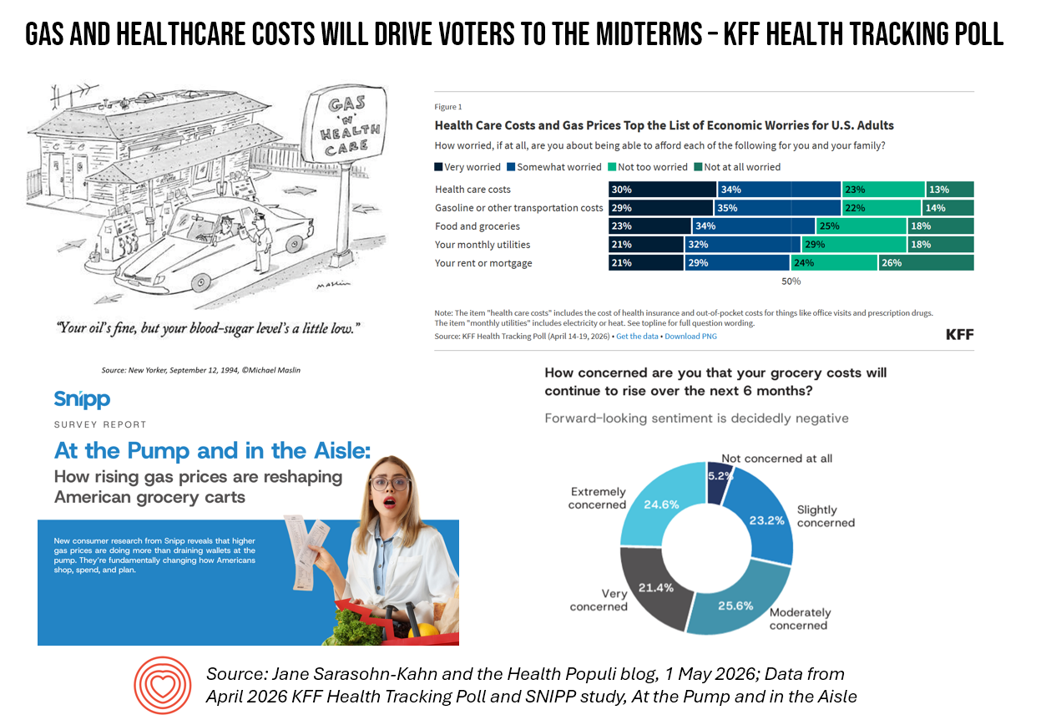
For millions of Americans, the “kitchen table” has become a site of stressful financial calculations. As the United States moves toward the midterm elections on November 3, 2026, a convergence of rising health care costs, volatile fuel prices and increasing grocery bills is shaping the priorities of the electorate. The intersection of these three economic pressures is not merely a matter of household budgeting; it is becoming a primary driver of political mobilization.
New data suggests that cost-of-living concerns are now central to the voting calculus for a broad spectrum of the population. According to the April 2026 KFF Health Tracking poll, which surveyed 1,343 U.S. Adults, health care costs are expected to have a significant influence on midterm voting decisions. The poll indicates that 55% of U.S. Voters believe health care costs will have a major impact
on their decision, whereas another 33% expect a minor impact.
This concern transcends party lines, though the intensity varies. The KFF data shows that 64% of Democrats and 52% of Independents view health care costs as having a major impact on their vote. Notably, nearly one-half of Republican voters also reported that these costs would significantly influence their decision at the polls.
The Triple Threat: Health, Gas, and Groceries
While health care remains a dominant concern, it is not the only economic pressure weighing on voters. The KFF poll reveals that Americans rank health care costs and gas and transportation costs with similar levels of urgency. Approximately 3 in 10 adults reported being very
worried about both, with another one-third describing themselves as somewhat
worried.

Food and grocery costs follow closely behind, with 64% of U.S. Adults placing these expenses in the third position of their primary economic concerns. This “triple threat” of expenses—healthcare, fuel, and food—creates a compounding effect on household stability, forcing families to create difficult trade-offs between essential needs.

How Gas Prices Are Reshaping the Grocery Cart
The ripple effect of fuel prices extends far beyond the gas station. A March 2026 report by Snipp, which polled 1,000 U.S. Adult grocery shoppers, highlights how rising pump prices are fundamentally altering consumer behavior in the grocery aisle. The research found that only 5% of respondents were not concerned at all about rising grocery costs over the next six months.
The financial strain is manifesting in a variety of behavioral shifts. According to the Snipp data, 53% of U.S. Shoppers are buying fewer non-essential items, such as snacks and specialty foods. Other strategies to manage the budget include:
- 40% of consumers are switching to cheaper store brands or private labels.
- 39% are increasing their employ of coupons, loyalty programs, and cashback applications.
- 29% are buying in bulk specifically to reduce the number of shopping trips.
- 27% are reducing spending on household items and personal care products.

The Dangerous Trade-Off: Postponing Care
As a physician, the most concerning trend in this data is not the shift to store-brand cereal, but the potential for “medical rationing” at the household level. When gas and groceries consume a larger share of the monthly budget, health care often becomes the flexible variable.
There is growing evidence that consumers are postponing essential care, services, and the purchase of prescription drugs to balance their budgets. This shift toward “Direct-to-Patient” behaviors is creating a fragmented healthcare experience. Some consumers are opting for self-pay modes for high-demand medications, such as GLP-1 agonists, while others are opting out of health insurance entirely if they lack ACA subsidy support.
the vacuum left by professional medical guidance is being filled by unverified sources. There is a rising trend of individuals substituting “food-as-medicine” advice from TikTok influencers and AI-driven on-ramps for clinical medical information. This trend poses a significant public health risk, as algorithm-driven health advice lacks the nuance of a personalized clinical diagnosis.
Key Economic Pressures and Voter Sentiment
| Concern Category | Primary Impact / Sentiment | Key Statistic |
|---|---|---|
| Health Care Costs | Major impact on midterm vote | 55% of voters |
| Gas & Transport | High level of worry | ~30% “Very Worried” |
| Grocery Costs | Third most pressing concern | 64% of adults |
| Grocery Outlook | Concerned about next 6 months | 95% concerned |
Political Implications for the 2026 Midterms
The 2026 midterm elections, scheduled for November 3, will see all 435 seats in the U.S. House of Representatives and 33 seats in the U.S. Senate up for election, according to Ballotpedia. With a majority of voters across the political spectrum citing health care affordability as a major motivator, the issue is poised to be a central pillar of campaign platforms.
For candidates, the challenge will be addressing a complex web of inflation. The current economic climate is influenced by a variety of factors, including tariffs that have inflated certain household goods and geopolitical instability—specifically the war in Iran—which continues to put upward pressure on petrol prices.
The data suggests that the “kitchen table” is no longer just a place for family discussion; it is a strategic center where voters are weighing the efficacy of current policies against their daily financial struggles. Whether it is the cost of a prescription, a gallon of gas, or a bag of groceries, these micro-economic pressures are aggregating into a macro-political force.
As we approach the general election, the focus will likely shift toward specific policy proposals: the extension or modification of ACA tax credits, strategies for lowering pharmaceutical costs, and efforts to stabilize energy prices. For the voter, the goal is simple: a return to a budget where health and nutrition are not treated as luxury items.
The next major checkpoint for these issues will be the upcoming primary contests and candidate filing deadlines throughout the summer of 2026, as parties finalize the platforms they will present to an economically anxious electorate.
Do you feel these costs are impacting your healthcare decisions or your plans for the upcoming elections? Share your thoughts in the comments below or share this article to join the conversation.