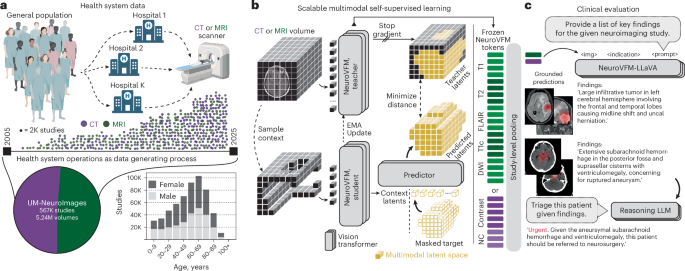
Generalist neuroimaging models, trained on large-scale, de-identified clinical data from routine health system scans, are demonstrating a capacity to improve diagnostic accuracy, streamline report generation, and optimize patient triage. By learning universal representations from diverse MRI and CT datasets, these models function across various clinical tasks, signaling a shift in how medical artificial intelligence is developed and deployed in hospital environments.
The Evolution of Generalist Models in Radiology
Recent advancements in medical artificial intelligence have moved beyond narrow, task-specific algorithms toward more versatile, “generalist” architectures. Unlike traditional AI models designed to detect a single pathology—such as a specific type of stroke or a brain tumor—generalist neuroimaging models are trained on massive, heterogeneous datasets that mirror the complexity of a modern hospital’s radiology department. According to technical documentation on self-supervised learning in medical imaging, this approach allows models to understand the underlying structure of human brain anatomy across different scanner manufacturers, protocols, and pathologies.
The core utility of this approach lies in its ability to extract “representations”—mathematical summaries of image features—that are adaptable to multiple downstream clinical applications. Research into foundational models for medical imaging, as discussed by the Nature Medicine editorial team, suggests that these systems can perform effectively even when labeled data for a specific rare condition is limited. By pre-training on routine clinical scans, the models gain a baseline understanding of normal and abnormal anatomy that can be fine-tuned for specialized diagnostic needs.
Clinical Impact: Triage and Report Generation
The integration of these models into clinical workflows aims to address two primary bottlenecks: radiologist burnout and diagnostic delay. In busy emergency departments, where time-sensitive decisions regarding intracranial hemorrhage or ischemic stroke are critical, AI-driven triage tools can prioritize scans that show urgent findings.
Beyond triage, generalist models are showing promise in automated report generation. By analyzing the pixel data of an MRI or CT scan, these models can draft preliminary findings, which the radiologist then reviews and edits. This workflow reduces the time required for documentation, allowing clinicians to focus more on complex diagnostic interpretation and patient care. The Radiological Society of North America (RSNA) emphasizes that while these tools provide significant assistance, the final clinical judgment remains the responsibility of the board-certified radiologist.
The Role of Private Clinical Data
The effectiveness of these generalist models is directly tied to the quality and diversity of the data used during training. Historically, AI development relied heavily on curated, open-access datasets, which often lacked the diversity of real-world clinical practice. Today, health systems are increasingly using their own internal, de-identified archives to train models that are tailored to their specific patient populations and equipment.
This shift toward utilizing private clinical data necessitates rigorous adherence to data privacy standards, such as the Health Insurance Portability and Accountability Act (HIPAA) in the United States and the General Data Protection Regulation (GDPR) in Europe. Ensuring that training data is properly anonymized is a legal and ethical mandate for institutions developing or implementing these tools. When handled correctly, this data serves as a foundation for building safer, more accurate AI that is less susceptible to the biases often found in publicly available, non-clinical datasets.
Future Directions and Regulatory Oversight
As these models move from research settings to clinical implementation, regulatory bodies are refining their evaluation criteria. The U.S. Food and Drug Administration (FDA) continues to update its framework for AI and machine learning in software as a medical device (SaMD), focusing on the need for continuous monitoring of model performance after deployment. Because clinical environments change—whether through the introduction of new scanning hardware or shifts in patient demographics—these models must be periodically re-validated to ensure they maintain their accuracy over time.
The next checkpoint for this technology involves large-scale, multi-center prospective trials to confirm that the improvements seen in retrospective data translate into better outcomes for patients in diverse hospital settings. Continued collaboration between clinicians, data scientists, and regulatory agencies will be essential to ensure that the promise of generalist neuroimaging models is fulfilled safely and equitably. Readers can monitor updates on the latest approved AI radiology tools through the FDA’s official list of AI/ML-enabled devices.
Please share your thoughts in the comments section below or join the conversation on our social channels.