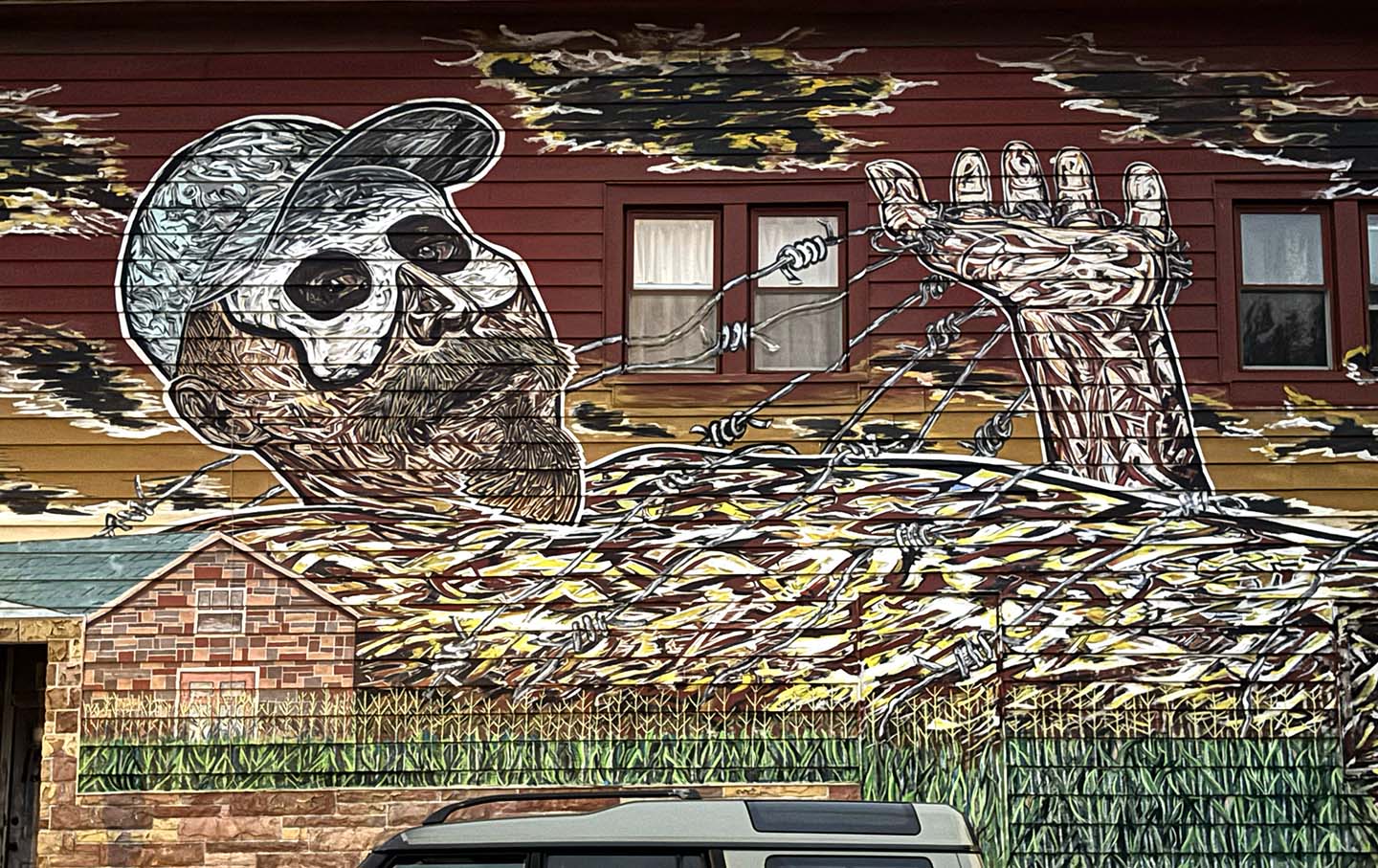
Mexican artist Hector Duarte uses his own home as a canvas to document the systemic struggles of migrants, creating a series of murals and installations that challenge the physical and legal barriers of the U.S.-Mexico border. His work, including the conceptual “Gulliver Can’t Travel,” transforms domestic space into a political statement on displacement, detention, and the precarious nature of immigrant identity.
Duarte’s approach blends personal narrative with broader geopolitical critique, focusing on the human cost of restrictive immigration policies. By integrating art into his living environment, he mirrors the way political instability and border enforcement permeate the private lives of those seeking asylum or residency. His work often references the “invisible” walls and bureaucratic hurdles that define the modern migrant experience.
The artist’s focus on the border is not merely aesthetic but grounded in the reality of thousands of individuals facing deportation or indefinite detention. Through a combination of painting and symbolic installations, Duarte explores how the concept of “home” is fractured for those caught in legal limbo between two nations.
The Symbolism of Gulliver and Border Restrictions
In his conceptual exploration “Gulliver Can’t Travel,” Duarte draws a parallel between Jonathan Swift’s Gulliver and the modern migrant. While Gulliver traveled the world and encountered civilizations of varying scales, Duarte’s subject is immobilized by the rigid structures of national sovereignty and immigration law. This inversion suggests that in the current political climate, the act of movement is no longer a voyage of discovery but a dangerous gamble with one’s legal status.


According to analysis of his installations, the work emphasizes the scale of the border wall—not just as a physical fence, but as a psychological barrier. The “Gulliver” metaphor highlights the absurdity of a globalized economy that demands migrant labor while simultaneously criminalizing the movement of the laborers themselves. This tension is a recurring theme in Duarte’s portfolio, where he contrasts the fluidity of capital with the rigidity of human borders.
Duarte’s work often incorporates materials that evoke the harsh reality of the journey. From the textures of the desert to the sterile environment of detention centers, the art serves as a witness to the physical toll of migration. By placing these themes within his own house, he forces the viewer to acknowledge that the border is not a distant line on a map, but a force that reaches into the heart of the community.
Art as a Response to Immigration Policy
The urgency of Duarte’s work is tied to the evolving landscape of U.S. immigration enforcement. His murals often respond to specific policy shifts, such as the implementation of “Remain in Mexico” (MPP) or the surge in border wall construction. These political mandates create a state of permanent transit for many, where families are separated and legal protections are stripped away.
Duarte utilizes the visual language of the mural—a tradition deeply rooted in Mexican history and social struggle—to give voice to those who are often silenced in official government reports. By documenting the “struggles of immigrants,” he creates a visual archive of resistance. His art does not seek to provide a solution to the immigration crisis but rather to ensure that the human suffering associated with it remains visible.
The integration of his art into his home also serves as a commentary on the “sanctuary” concept. In a world where the state can enter a home to deport a resident, the act of painting the walls becomes an act of claiming space and asserting existence. This domestic gallery becomes a site of both vulnerability and strength, reflecting the dual reality of the undocumented person: the need to remain hidden and the desire to be seen.
The Impact of Visual Narrative on Global Migration
Duarte’s work contributes to a larger global conversation about the ethics of borders. By framing the migrant’s journey as a struggle against an oversized, indifferent system—much like the giants in Gulliver’s travels—he critiques the power imbalance between the individual and the state. This perspective aligns with broader human rights critiques of the UNHCR’s findings regarding the protection of refugees and asylum seekers.
The effectiveness of his work lies in its ability to translate complex legal battles into visceral imagery. When a viewer sees a mural depicting the isolation of a detention center within a home, the abstract concept of “detention” becomes a tangible, suffocating presence. This shift from the political to the personal is a hallmark of Duarte’s contribution to contemporary art.
Furthermore, his work highlights the intersection of art and activism. By making his home a public-facing statement, Duarte challenges the boundary between private life and public duty. He suggests that as long as the border remains a site of violence and exclusion, no space is truly neutral.
The ongoing nature of his project suggests that the work will evolve as immigration laws shift. As new administrations introduce different enforcement strategies, Duarte’s “canvas” continues to expand, documenting the persistent friction between the human drive to migrate and the state’s drive to exclude.
Updates on immigration policy changes and legal challenges regarding border enforcement can be monitored through official government filings and international human rights observers. Those following the intersection of art and social justice may find further context in the archives of cultural institutions dedicated to Latin American art.
We encourage readers to share their perspectives on the role of art in political activism in the comments below.