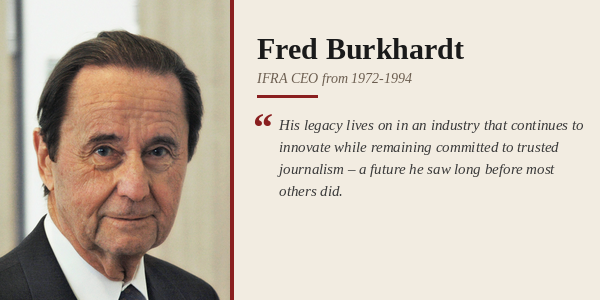
Fred Burkhardt, the influential former CEO of IFRA who anticipated the digital transformation of the global news industry, has died. A visionary leader who served as the public face of IFRA for decades, Burkhardt was instrumental in guiding publishers through the transition from hot-metal typesetting to the modern, internet-connected era. His career, which spanned from the post-war reconstruction of German industry to the dawn of the digital age, remains a benchmark for how trade organizations can foster innovation and collaboration across international borders.
Born in Nuremberg on February 27, 1929, Burkhardt’s professional trajectory was defined by a unique synthesis of engineering precision and strategic foresight. According to historical records of his career, he trained as a typesetter in the aftermath of World War II before pursuing higher education in the United States as a Fulbright scholar in Syracuse, New York. This academic foundation, capped by a 1957 doctorate in economics from Berlin, focused on high-speed and remote typesetting technologies—a specialized field that would eventually reshape the entire newspaper production chain.
Engineering the Transition: From Hot Metal to Digital
When Burkhardt joined IFRA in 1972, the newspaper industry was still largely defined by labor-intensive, mechanical processes. The “hot-metal” era, characterized by letterpress printing and black-and-white layouts, was the standard for publishers worldwide. Under Burkhardt’s leadership over the next two decades, IFRA served as the primary forum for the adoption of phototypesetting, offset printing, and early computerized pagination. By bridging the gap between hardware manufacturers and newspaper publishers, he ensured that technical advancements were not just developed in laboratories but were effectively integrated into newsrooms and printing plants globally.
Burkhardt’s approach to leadership was described by contemporaries as deeply diplomatic. He possessed the ability to convene competing technology suppliers and newspaper executives in a neutral, collaborative environment. This allowed IFRA to evolve from a specialized research institute into an essential international hub. The annual IFRA Expo, which he championed, became the premier meeting place for the global press community to exchange technical knowledge and establish the industry-wide standards that allowed for the rapid scaling of new production technologies.
A Vision for the “Content Business”
Perhaps the most enduring element of Burkhardt’s legacy is his early recognition that the future of journalism would not be tethered to paper. Long before the commercial internet transformed daily life, he argued that newspapers were fundamentally in the “content business,” not the “newsprint business.” This philosophy guided his later years at the organization, where he actively pushed publishers to explore electronic media and computer-based distribution models.
In 1994, Burkhardt launched the Initiative for Newspaper Electronic Supplements (INES), a forward-looking project designed to prepare the industry for the challenges of the digital era. This initiative sought to encourage collective investment and experimentation in online services and digital supplements. While the broader newspaper industry faced significant disruption as the internet eventually matured, the questions Burkhardt raised regarding digital transformation, audience engagement, and the necessity of industry-wide cooperation remain central to the current mission of WAN-IFRA.
Legacy and Industry Impact
Burkhardt’s influence extended well beyond the technical specifications of printing presses. By fostering relationships that crossed national boundaries, he helped create a global network of professionals committed to the future of quality journalism. His work at IFRA established the collaborative framework that continues to support publishers, editors, and engineers today. He is survived by three daughters and their families.
As the industry continues to navigate the complexities of a multimedia, digital-first environment, Burkhardt’s core principle—that technological innovation must serve the underlying mission of trusted, quality journalism—remains a cornerstone of the international media landscape. His career stands as a testament to the importance of foresight in an era of rapid technological change. For those interested in the ongoing evolution of the media sector, further updates on industry research and archival reflections can be monitored through the official WAN-IFRA news portal.
Related reading