
For the past two years, the global conversation around artificial intelligence has been dominated by the capabilities of Large Language Models (LLMs). We have marveled at their ability to draft essays, write code, and mimic human conversation with startling fluency. However, a fundamental critique has persisted among the scientific community: these models are essentially masters of statistical probability, predicting the next most likely word in a sequence without a fundamental understanding of the physical reality those words describe.
As the industry moves toward the next frontier of machine intelligence, a new paradigm is emerging that seeks to bridge this gap between linguistic fluency and physical understanding. This concept is known as world models in AI. Rather than simply predicting text, researchers are working to develop systems that can build internal representations of how the world works—understanding gravity, cause and effect, and the spatial relationships between objects.
The shift from “stochastic parrots” to systems capable of reasoning about reality represents one of the most significant technical hurdles in the quest for Artificial General Intelligence (AGI). If an AI is to truly navigate a kitchen, drive a car, or assist in complex scientific research, it cannot rely on text alone; it must possess a mental model of the environment in which it operates.
Beyond the Next Token: Defining the World Model
To understand why world models are gaining such immense traction, one must first understand the limitations of current generative architectures. Most modern LLMs are trained on massive datasets of human language. While this allows them to simulate logic, they lack a grounded connection to the physical world. They know that the word “dropped” is often followed by “the glass broke,” but they do not inherently understand the physics of momentum, fragility, or gravity that makes that sentence true.
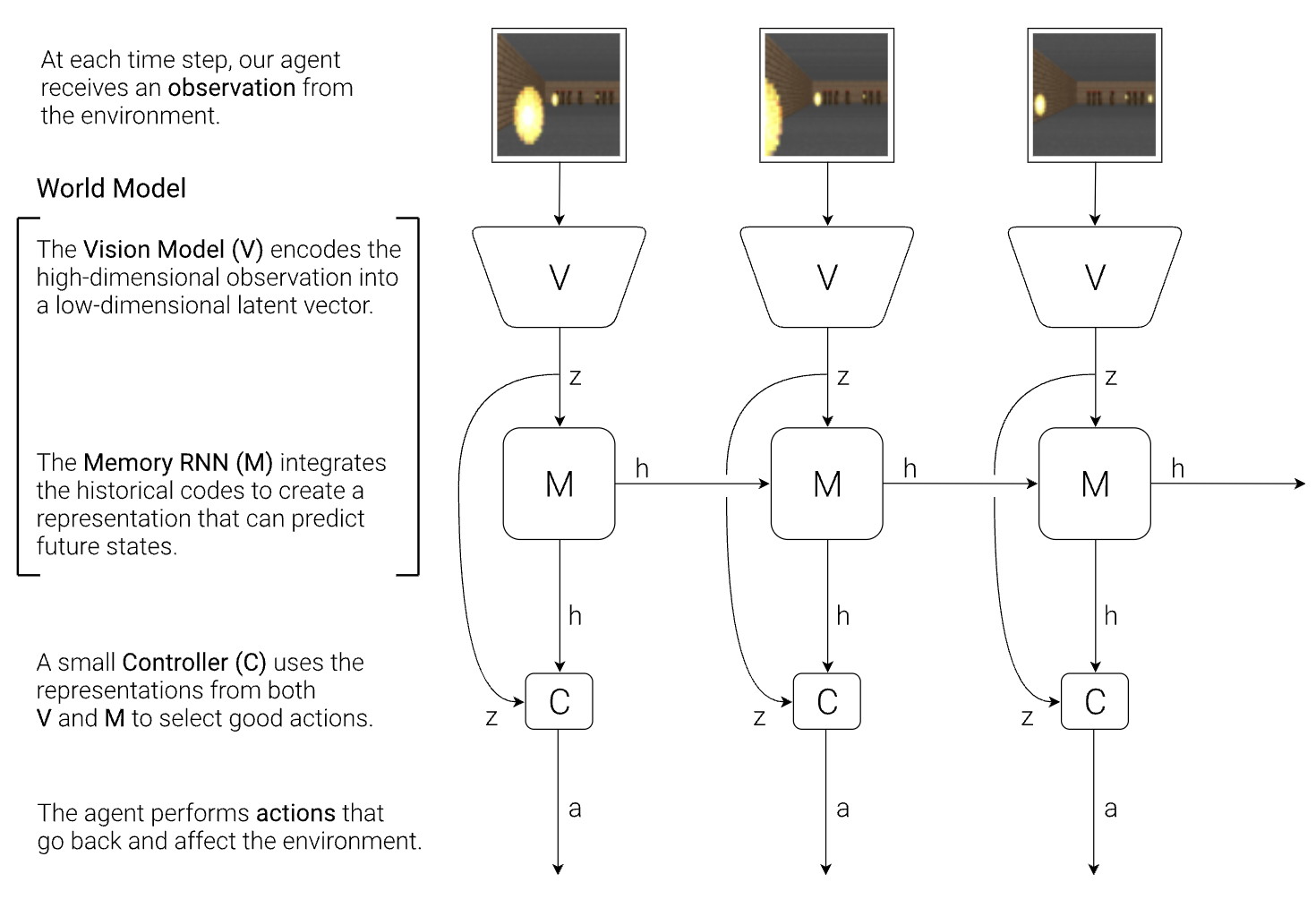
A world model, by contrast, is an AI architecture designed to learn and simulate the dynamics of an environment. It is an internal “simulator” that allows an agent to ask “what if?” Before an autonomous robot moves a heavy object, a world model allows it to simulate the potential outcomes within its own neural architecture. If the simulation predicts the object will tip over, the agent can adjust its plan before any physical action is taken.
This capability is built on several core components:
- Perception: The ability to ingest sensory data (video, touch, or depth sensors) and translate it into a meaningful format.
- Latent Representation: The creation of a compressed, mathematical “map” of the environment that captures essential features while discarding irrelevant noise.
- Predictive Dynamics: The ability to predict how the latent representation will change over time based on specific actions or environmental shifts.
By mastering these components, AI systems move closer to a form of “common sense”—the intuitive understanding of reality that humans take for granted from infancy.
The Architectural Shift: From Generative to Predictive
The development of world models is driving a major debate regarding AI architecture. Much of the current progress has been fueled by generative models—systems designed to create new content. While impressive, many leading researchers argue that the path to true intelligence lies in predictive, rather than purely generative, architectures.
One of the most prominent voices in this movement is Yann LeCun, Meta’s Chief AI Scientist. LeCun has long advocated for a departure from the pure “next-token prediction” model used by current LLMs. He has proposed architectures such as the Joint-Embedding Predictive Architecture (JEPA), which focuses on learning high-level representations of the world through self-supervised learning.
Unlike standard generative models that try to predict every single pixel in a video or every character in a sentence, a JEPA-style architecture attempts to predict the meaningful parts of a scene. For example, if an AI is watching a video of a person walking through a door, it does not need to predict the exact texture of the floor or the way light bounces off a wall; it needs to predict the trajectory of the person and the fact that the door will be open on the other side. This focus on high-level abstraction is believed to be more computationally efficient and more aligned with how biological brains process information.
This shift from “generating content” to “predicting states” is what distinguishes a tool that can write a poem from an agent that can navigate a complex, unpredictable environment.
The Role of Video in Training Physical Intelligence
If text is the primary fuel for LLMs, video is becoming the primary fuel for world models. Recent breakthroughs in video generation models have demonstrated that by training on vast amounts of visual data, AI can begin to learn the “rules” of the physical world. When a model observes millions of hours of video, it implicitly learns that objects do not pass through one another, that shadows move with light sources, and that liquids flow downward.
This visual training provides a form of “embodied” knowledge that text cannot provide. While a text-based model knows the definition of “acceleration,” a video-trained world model has seen the visual manifestation of acceleration across countless different contexts. This allows the model to build a predictive framework that is grounded in visual reality.
The implications for autonomous systems are profound. For self-driving technology or delivery robotics, the ability to accurately predict the movement of pedestrians, the behavior of weather, or the physics of a slippery road is the difference between a successful mission and a catastrophic failure. World models provide the framework for these machines to move beyond rigid, rule-based programming and into the realm of adaptive, intelligent reasoning.
Challenges in Scaling Causal Reasoning
Despite the promise, several significant technical hurdles remain. The most daunting of these is the leap from correlation to causation. Current AI models are exceptionally good at finding patterns—knowing that Event A often follows Event B. However, understanding why Event A causes Event B is a much higher level of cognitive processing.
To achieve true world modeling, AI must move beyond pattern recognition and toward causal reasoning. This requires the ability to perform “counterfactual reasoning”—the capacity to reason about things that have not happened. For an AI to be truly useful in scientific discovery or complex engineering, it must be able to simulate “What would happen if I changed this variable?” and reach a conclusion that is not just statistically likely, but physically and logically sound.
there is the challenge of “scale vs. Efficiency.” Training models to understand the complexity of the real world requires astronomical amounts of data and computing power. Researchers are currently exploring ways to make these models more sample-efficient, mimicking the way a human child can learn the concept of a “ball” after seeing only a few examples, rather than requiring millions of data points.
Key Takeaways: The Future of World Models
- Shift in Focus: The industry is moving from purely linguistic models (LLMs) toward models that understand physical dynamics and spatial reasoning.
- Predictive Architectures: New frameworks like JEPA prioritize predicting high-level environmental changes over generating granular, pixel-by-pixel content.
- Video as Data: Visual data is becoming the cornerstone for teaching AI the laws of physics and cause-and-effect.
- Path to Autonomy: World models are considered a prerequisite for advanced robotics and truly autonomous agents capable of real-world interaction.
- The Causal Hurdle: The next major breakthrough must involve moving from statistical correlation to true causal reasoning.
Conclusion: The Road to Embodied Intelligence
The evolution of world models represents the transition of artificial intelligence from a digital assistant to a physical participant. By developing systems that can simulate and reason about the real world, we are moving closer to machines that can interact with our environment in meaningful, safe, and intelligent ways.
While we are still in the early stages of this transition, the convergence of video-based training, predictive architectures, and advanced robotics suggests that the era of “embodied AI” is approaching. The question is no longer just whether AI can talk to us, but whether it can truly understand the world we live in.
As research continues, the industry will be watching for the next generation of model releases and academic findings at major upcoming conferences, such as the Neural Information Processing Systems (NeurIPS) meeting, which will likely showcase the latest advancements in predictive modeling and causal inference.
What do you think is the biggest hurdle to AI understanding our physical world? Share your thoughts in the comments below and share this article with your network.
Related reading