In Botanical Time
Christopher Woods
Chelsea Green, $40.00
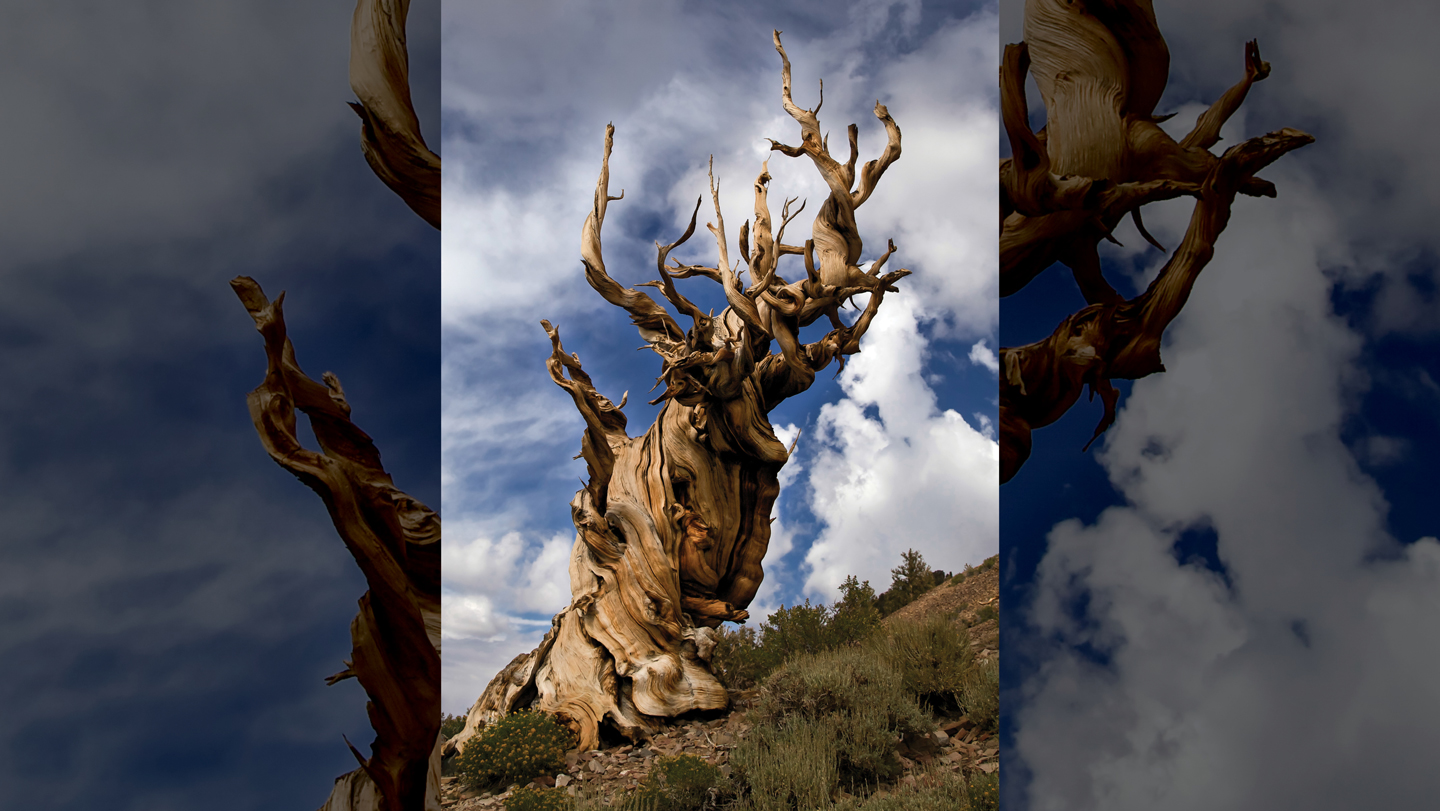
On a talus-strewn slope in eastern California’s mountains, a gnarled tree twists toward the sky. It is Methuselah, a Great Basin bristlecone pine (Pinus longaeva) and one of the world’s oldest trees.At over 4,800 years old, Methuselah germinated several hundred years before Imhotep began constructing ancient Egypt’s first pyramid.
It’s difficult to fathom such a long life span when humans live mere decades. But author and garden expert Christopher Woods’ new book In Botanical Time helps readers do just that, telling the life stories of millennia-old plants and unpacking the science behind their longevity along the way.
One secret to longevity is to slow down growth, Woods writes. That has helped many ancient plants survive in less-than-ideal environments. For example, growing about 2.5 centimeters per century enables Methuselah to focus its energy on surviving frigid temperatures, nutrient-poor soil and howling winds. Accumulating genetic changes that confer traits like disease resistance has also helped.
Other ancient plants have a different approach to growth: cloning. Clonal plants create copies of themselves — often through their roots — allowing them to reach remarkable ages even after the original iteration dies.
Woods describes one Norway spruce (Picea abies) in Sweden that has cloned itself for 9,500 years, sprouting a new trunk from its roots every few centuries. Then there’s Pando. This grove of quaking aspens (Populus tremuloides) in Utah may appear as 47,000 distinct trees, but a look underground reveals the aspens are a single organism with a root system that’s about 14,000 years old. New saplings sprout from Pando’s root system that are genetically identical to the others, meaning even as single trees die, the organism continues to live on.
However, these ancient trees are relative babies compared to a meadow of Neptune grass (Posidonia oceanica) off the coast of Spain. An analysis of the sea grass’ DNA and growth rate revealed the patch to be between 80,000 to 200,000 years old. It grows similarly to Pando, through rhizomes that send up genetically identical shoots.
Woods also regales readers with mythological tales. According to one Greek myth, dragon trees (Dracaena sp.) sprouted from the blood of the hundred-headed dragon slain by Hercules. Two species, D. cinnabari and D. draco, ooze blood-red sap — something so rare and astounding that “it coudl only be ascribed to myth,” Wood writes.
The oldest known dragon tree, growing in the Canary Islands, is estimated to be as old as 1,000. But it’s difficult to nail down precise ages for these trees because the trunk interior is spongy and thus doesn’t have growth rings.For many proposed ancient plants,a lack of growth rings stymies scientists from precisely measuring their age. And when it comes to trees with growth rings, a rotten core can muddle age analysis because the oldest growth rings are missing.
Though sometimes repetitive,woods’ cheeky prose and rich visuals make In Botanical Time an easy and engaging read for plant lovers and superlative seekers. At a time when longevity and wellness are trending topics, this book is a reminder that perhaps the best thing to do is live life a little slower.
buy In Botanical Time from Bookshop.org. Science News is a Bookshop.org affiliate and will earn a commission on purchases made from links in this article.
Keep reading