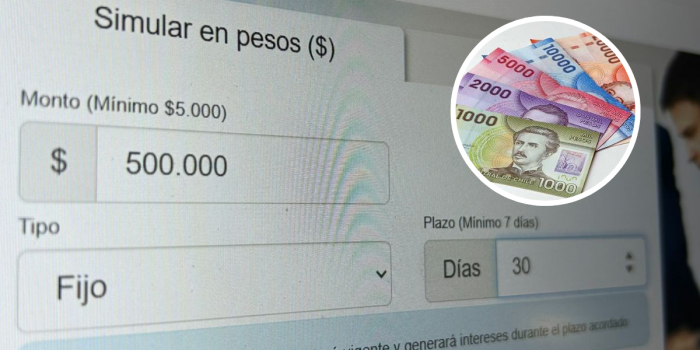
For many retail investors in Chile, the quest for stability in an era of global economic volatility often leads to one of the most traditional financial instruments available: the fixed-term deposit, known locally as a depósito a plazo (DP). As interest rate cycles shift and inflation patterns evolve, the question of how to effectively park small-to-medium amounts of liquidity—such as $500,000 CLP—has become a central concern for household financial planning.
While a 30-day term may seem brief, it serves as a critical tool for liquidity management, allowing savers to earn a predictable return without locking away their capital for extended periods. However, determining exactly how much one can earn from a $500,000 CLP deposit requires more than just looking at a bank’s advertised rate; it requires an understanding of the macroeconomic forces at play in the Chilean market, ranging from the decisions of the Banco Central de Chile to the nuances of local inflation.
In this analysis, we examine the mechanics of fixed-term deposits, the mathematical reality of 30-day returns, and the strategic considerations necessary to ensure that your “safe” investment is actually preserving your purchasing power.
Understanding the Mechanics of the Depósito a Plazo (DP)
A fixed-term deposit is a contract between a depositor and a financial institution. In this agreement, the depositor agrees to leave a specific amount of money with the bank for a predetermined period—in this case, 30 days—in exchange for a guaranteed interest rate. Because the bank is essentially “borrowing” your money to fund its own lending operations, they compensate you with a yield that is typically higher than a standard savings account, albeit with lower liquidity.
For a retail investor, the DP is often considered a “risk-free” asset, provided the institution is covered by the Superintendencia de Bancos e Instituciones Financieras (SBIF)—now integrated into the Comisión para el Mercado Financiero (CMF). This regulatory oversight ensures that the banking sector remains stable and that depositors have a level of protection against institutional failure.
Notice two primary ways these deposits are structured in the Chilean market:
- Depósitos a Plazo en Pesos (CLP): These are denominated in Chilean pesos. The interest rate is fixed at the start, and the return is purely nominal. The primary risk here is inflation; if the inflation rate exceeds your deposit’s interest rate, your real purchasing power declines.
- Depósitos a Plazo en UF (Unidad de Fomento): These are denominated in the inflation-indexed unit used in Chile. While they offer a way to hedge against rising prices, they often require longer commitment periods and may have different liquidity profiles.
For a short-term 30-day horizon, most investors opt for the CLP-denominated version to maintain simplicity and immediate access to their nominal capital at the end of the month.
The Mathematics of the $500,000 CLP Investment
To understand the actual earnings on a $500,000 CLP deposit, one must move beyond the “headline rate” and apply a precise calculation. Banks often quote an Annual Effective Rate (TEA) or a Nominal Annual Rate. Because a 30-day deposit is only a fraction of a year, the interest earned is a pro-rated portion of that annual figure.
The standard formula for calculating the interest earned on a fixed-term deposit is:
Interest = Principal × (Annual Interest Rate / 360 or 365) × Number of Days
Let us consider an illustrative example. Suppose a Chilean bank offers an annual interest rate of 6.00% for a 30-day term on a $500,000 CLP deposit. The calculation would proceed as follows:
- Principal: $500,000
- Daily Interest Rate: 0.06 (6%) divided by 360 days ≈ 0.0001666
- 30-Day Return: $500,000 × 0.0001666 × 30 = $2,499
In this scenario, the investor would receive approximately $2,500 CLP at the end of the month. While this amount may seem modest, it is key to view it through the lens of capital preservation and the cost of liquidity. For a small sum, the goal of a 30-day DP is often not wealth accumulation, but rather the “parking” of funds that are intended for a specific upcoming expense, ensuring they are not sitting idle in a zero-interest checking account.
The Macroeconomic Driver: The Role of the Banco Central de Chile
The interest rates offered by commercial banks in Chile are not arbitrary. They are heavily influenced by the Monetary Policy Rate (Tasa de Política Monetaria, or TPM) set by the Banco Central de Chile. The Central Bank uses the TPM as its primary tool to manage inflation and stabilize the economy.
When the Central Bank raises the TPM to combat rising inflation, commercial banks typically respond by increasing the interest rates they offer on fixed-term deposits. Here’s because the cost of capital for banks increases, and they must offer higher yields to attract deposits. Conversely, when the Central Bank lowers the TPM to stimulate economic growth, the interest rates on DPs generally trend downward.
Investors monitoring the 30-day return on their $500,000 CLP must keep a close eye on the Banco Central de Chile’s official communications. The bank’s decisions on the TPM directly dictate the “ceiling” of what a retail investor can expect to earn in a risk-free instrument. For instance, in a high-inflation environment where the Central Bank is aggressively hiking rates, a 30-day DP might suddenly become significantly more attractive than it was in a previous low-rate cycle.
The Inflation Trap: Nominal vs. Real Returns
As a financial journalist, I must emphasize a distinction that many casual savers overlook: the difference between nominal returns and real returns. This distinction is the most critical factor in determining whether a $500,000 CLP deposit is actually “making” you money.
The nominal return is the actual amount of pesos you receive at the end of the 30 days. In our previous example, that was $2,500 CLP. However, the real return is the interest rate adjusted for inflation (the Consumer Price Index, or IPC, in Chile).

If the bank pays you a 0.5% return for the month, but inflation for that same month is 0.7%, your real return is actually negative (-0.2%). Even though you have more pesos in your hand than you started with, those pesos can buy fewer goods and services than your original $500,000 could at the beginning of the month. This is the “inflation trap.”
To navigate this, investors should evaluate the Consumer Price Index (IPC) trends reported by the Instituto Nacional de Estadísticas (INE). If inflation is trending upward, a 30-day DP in pesos may struggle to provide a positive real return, making inflation-indexed products (like those in UF) or other assets a more logical, albeit higher-risk, choice.
Comparing the Banking Landscape: Traditional vs. Digital
When searching for the best rate for a $500,000 CLP deposit, Chilean investors generally find themselves choosing between three tiers of financial institutions:
1. Large Traditional Banks
Institutions such as Banco de Chile, Santander, and Bci offer high levels of security, extensive physical branch networks, and integrated digital platforms. However, because of their scale and lower risk profile, their interest rates for small-scale, short-term deposits are often less competitive than smaller players. They are often the choice for customers who prioritize ease of use and a holistic banking relationship.
2. Mid-Sized and Specialized Banks
Banks like Scotiabank or Itaú may occasionally offer more aggressive rates to capture market share from the larger incumbents. These institutions often strike a balance between the institutional stability of the giants and the more competitive pricing of smaller entities.
3. Digital Banks and Fintech Platforms
The rise of digital-first banking in Chile has introduced a new competitive dynamic. These platforms often have lower overhead costs than traditional banks with physical branches, allowing them to pass those savings on to the consumer in the form of higher interest rates. For a $500,000 CLP deposit, a digital-only platform might offer a significantly higher yield than a traditional bank, provided the investor is comfortable with a purely digital management experience.
| Institution Type | Typical Yield | Liquidity/Ease | Risk Profile |
|---|---|---|---|
| Traditional Large Banks | Lower | Very High (Branches + App) | Extremely Low |
| Mid-Sized Banks | Moderate | High (App-focused) | Very Low |
| Digital/Fintech | Higher | High (App-only) | Low to Moderate |
Strategic Wealth Management for Small Sums
While $500,000 CLP may not constitute a massive investment portfolio, the habits formed with small amounts are the foundation of long-term wealth management. For those looking to optimize their returns, consider the following strategies:
- Laddering: Instead of putting the full $500,000 into a single 30-day deposit, some investors split the amount into two $250,000 deposits with different maturity dates. This can provide more frequent access to cash.
- Reinvestment: To benefit from the power of compound interest, ensure that at the end of the 30 days, the principal and the interest are automatically rolled over into a new deposit.
- Watch the Fees: Always confirm that there are no maintenance fees or “account opening” costs that could negate the interest earned on a small deposit. For a $500,000 sum, a $2,000 monthly fee would completely wipe out a typical 30-day interest return.
Key Takeaways for Investors
- Verify the Rate: Always distinguish between the annual rate and the actual 30-day return.
- Monitor Inflation: A nominal gain is a loss if inflation is higher than your interest rate.
- Check the TPM: The Central Bank’s decisions are the primary driver of the rates you will see in your banking app.
- Compare Digital Options: Don’t assume your primary bank offers the best rate; digital players often provide higher yields for small deposits.
Frequently Asked Questions
Is my $500,000 CLP deposit safe in a Chilean bank?
As long as the institution is regulated by the Comisión para el Mercado Financiero (CMF), your deposits are subject to the regulatory frameworks designed to maintain banking stability in Chile.

Can I withdraw my money before the 30 days are up?
Generally, no. The defining characteristic of a fixed-term deposit is that the funds are “locked” for the duration of the term. If you require immediate access, a standard savings account or a “money market” fund would be more appropriate.
How do I know if the interest rate is good?
A “good” rate is one that exceeds the current monthly inflation rate (IPC) provided by the INE. If the rate is lower than inflation, you are experiencing a loss in real terms.
As the Chilean economy continues to navigate the complexities of post-inflationary stabilization, the decisions made by the Banco Central de Chile in their upcoming monetary policy meetings will be the most important indicator for savers. We recommend monitoring the official announcements from the Central Bank to adjust your deposit strategies accordingly.
What are your experiences with fixed-term deposits in Chile? Do you prefer the security of traditional banks or the higher yields of digital platforms? Share your thoughts in the comments below and share this article with your network.
Worth a look