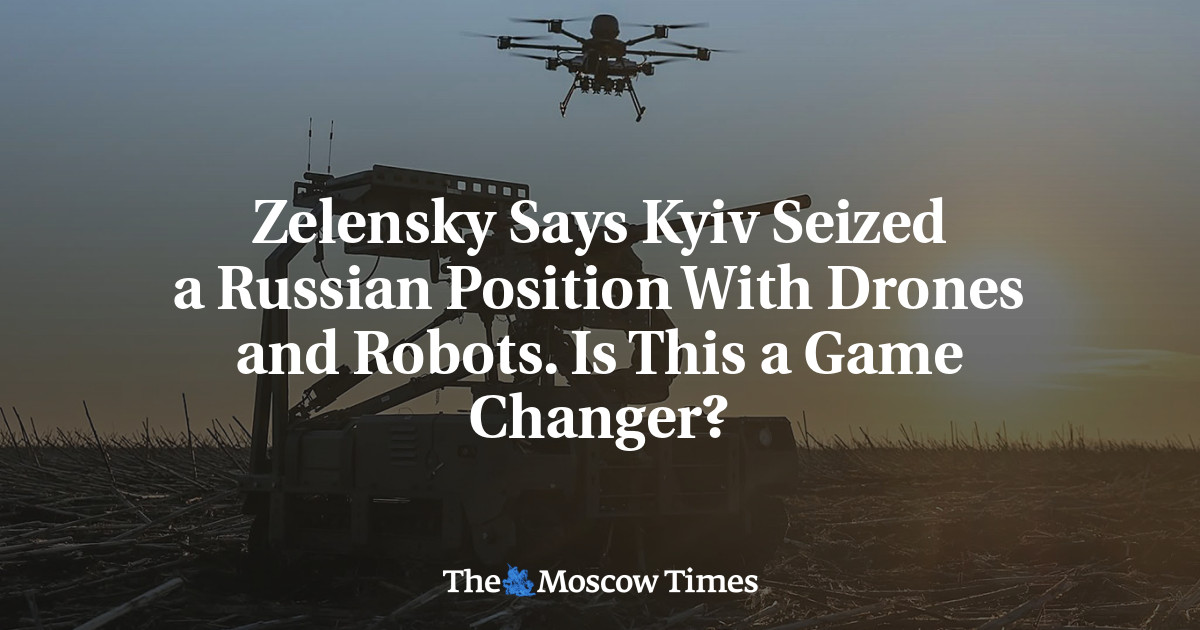
In a development that signals a potential turning point in the evolution of modern combat, Ukrainian President Volodymyr Zelensky announced Monday that his forces have seized a Russian position with drones and robots for the first time in the history of the conflict. The operation, which relied exclusively on unmanned platforms, was carried out without the deployment of infantry and resulted in no losses for the Ukrainian side.
The announcement came during a speech on Defence Industry Worker Day, an annual holiday established in 2023. President Zelensky praised the country’s “era-defining” advances in frontline technology, noting that the shift toward unmanned systems is central to the strategic goal of protecting human life on the battlefield.
According to the president, this groundbreaking maneuver took place in the Kharkiv oblast last year. The operation was executed by Ukraine’s 3rd Separate Assault Brigade, which utilized a combination of first-person view (FPV) drones and kamikaze ground platforms to neutralize and capture fortified positions. The brigade reported that Russian forces emerged from their destroyed fortifications to surrender specifically to avoid being blown up as a robot closed in on their location.
The Role of Unmanned Ground Vehicles (UGVs) and FPV Drones
The success of the operation highlights a significant integration of aerial and terrestrial unmanned systems. While drones have been a staple of the conflict since 2022, the use of unmanned ground vehicles (UGVs) to physically take and hold a position represents a tactical escalation. The 3rd Separate Assault Brigade’s use of kamikaze ground platforms allowed Ukrainian forces to apply direct pressure on fortified enemy lines without risking soldiers in a direct assault.
This operation is part of a broader surge in unmanned activity. President Zelensky revealed that drones have carried out more than 22,000 missions on the frontlines within a three-month period, marking a seismic shift in how the modern battlefield is contested.
Strategic Analysis: Game-Changer or PR Move?
While the Ukrainian government frames the event as a historic milestone, some military analysts suggest a more nuanced interpretation. Ivan Stupak, a Ukrainian military analyst and former SBU security service officer, told The Moscow Times that the operation likely involved the capture of a “small, secondary position” rather than a major strategic breakthrough.
However, Stupak emphasized that the scale of the position is less crucial than the method of capture. He noted that if a position could be taken entirely without human involvement, it opens the door for larger-scale operations to be conducted in the same manner in the future.
This sentiment is echoed by Russian military expert Yury Fedorov, who described Ukraine as a “pioneer” in the development and deployment of various drone types. Fedorov observed a sharp increase in the use of aerial drones across almost the entire front line during February and March.
International Cooperation and the Future of Drone Warfare
As Ukraine seeks to institutionalize these technological gains, it is looking toward international partnerships to scale production. On Tuesday, President Zelensky announced plans for defense cooperation with Germany, including a deal on drone production. Zelensky stated that this agreement could become one of the largest drone production partnerships in Europe.

The competition between Moscow and Kyiv has evolved into a high-stakes race for drone technology and electronic warfare capabilities. Both nations are facing mounting manpower challenges, making the development of unmanned platforms a necessity rather than a luxury. The ability to seize territory without infantry losses is seen as a critical advantage in a war of attrition.
Key Takeaways of the Unmanned Operation
- Zero Infantry Involvement: The position in Kharkiv oblast was taken exclusively by unmanned ground systems and drones.
- Zero Personnel Losses: Ukraine reported no casualties during the operation.
- Psychological Impact: Russian troops surrendered to avoid being destroyed by approaching robotic platforms.
- Scale of Deployment: Over 22,000 drone missions were conducted in a three-month window.
- Industrial Scaling: Ukraine is partnering with Germany to expand drone production capabilities.
The shift toward “robot armies” reflects a broader trend in global geopolitics where autonomous and semi-autonomous systems are transforming traditional military doctrines. By removing the human element from the initial assault phase, Ukraine is attempting to rewrite the cost of offensive operations.
The next confirmed checkpoint for this technological trajectory will be the implementation of the drone production deals with Germany, which are expected to increase the volume of unmanned systems available to the Ukrainian Armed Forces.
World Today Journal encourages readers to share this report and join the conversation in the comments regarding the ethical and strategic implications of unmanned warfare.