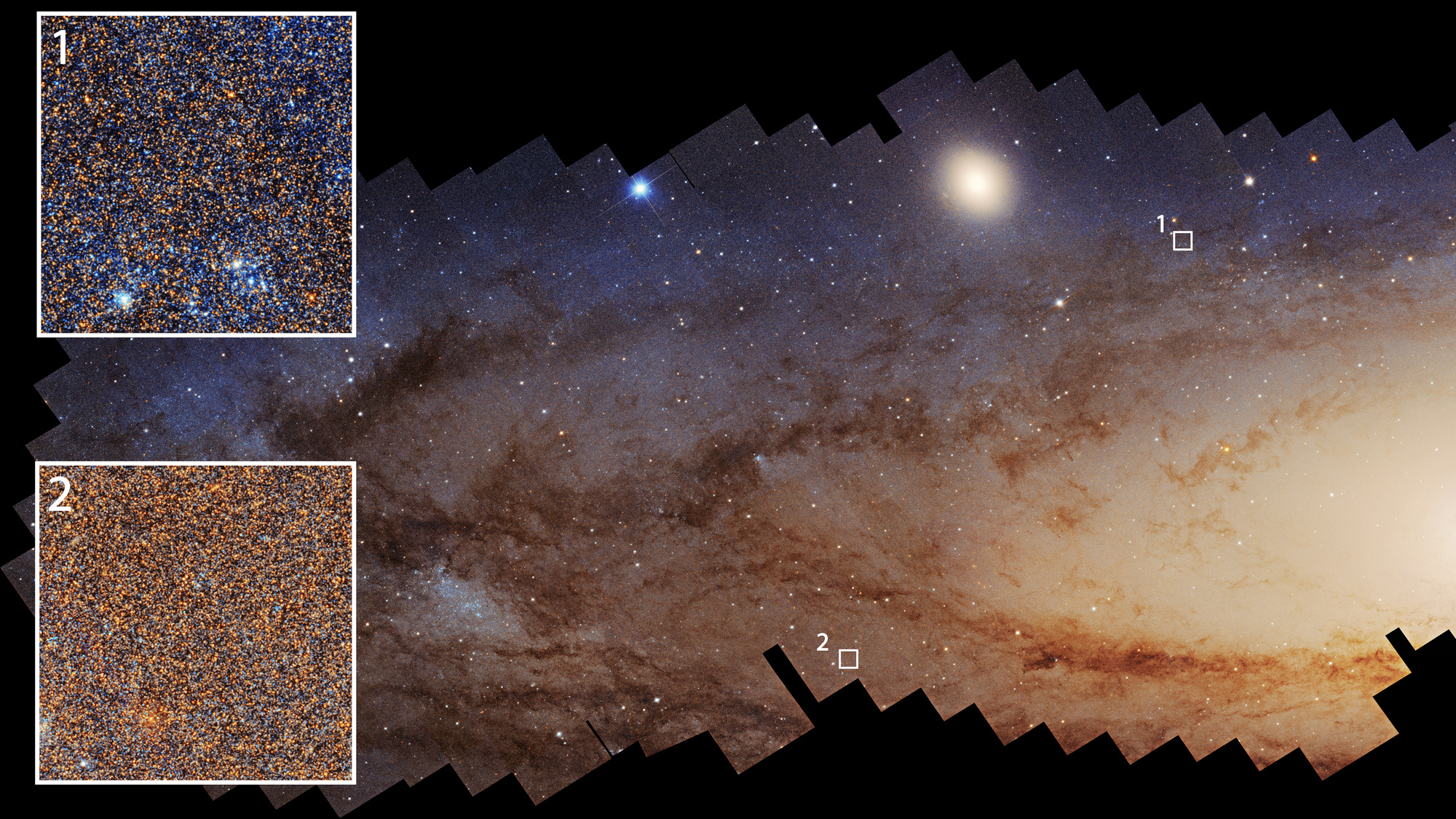
Astronomers analyzing deep archive records from the Hubble Space Telescope have uncovered new evidence that the Andromeda galaxy is steadily slowing down its production of new stars. According to data shared by researchers on July 27, 2026, our nearest major galactic neighbor is gradually winding down from a massive historic burst of activity as it tracks along a trajectory toward a potential future collision with the Milky Way.
Located roughly 2.5 million light-years away in the constellation Andromeda, Messier 31 (M31) serves as an essential laboratory for astronomers trying to understand galaxy formation and evolution. As a giant spiral galaxy possessing roughly twice the mass of our own Milky Way, Andromeda provides a massive cosmic testing ground. A new study published July 27 in The Astrophysical Journal combines two major Hubble surveys that mapped roughly two-thirds of the galaxy’s sprawling disk, capturing approximately 200 million individual stars.
The findings indicate that Andromeda has been pumping the brakes on star creation over the past 500 million years. Researchers determined that the galaxy produced new stars at a rate of around one solar mass per year half a billion years ago. By 40 million years ago, that pace had been cut in half, and today the rate has dropped to just one-fifth of a solar mass each year. Rather than suddenly running out of gas and dust, the galaxy appears to be experiencing a natural cooling-off period following an earlier spike in activity.
Tracing Andromeda’s Stellar History and Starbursts
Long before this recent deceleration, Andromeda experienced a dramatic surge in star creation roughly 2 billion years ago. Astronomers estimate that this single starburst event generated about one-fifth of all the stars currently residing within the galaxy. Scientists widely suspect that this ancient spike was triggered by a cosmic collision and merger with another galaxy, likely the compact elliptical galaxy M32, which currently maintains an orbit around Andromeda.
The new investigation also looked closely at whether M32 might be influencing the current slowdown in star formation. Researchers observed that regions closest to the companion galaxy show a more recent decline in star activity, keeping M32 on the list of potential influences, though definitive proof remains elusive. Most of the recent star generation in Andromeda has been isolated within a distinct ring located roughly 32,000 light-years from the galactic center. The diminishing output within this specific ring accounts for the vast majority of the overall decline detected across the disk.
Examining individual stars across such vast distances requires extraordinary technical capabilities. “We need to measure the individual stars because they are the fossil record of the galaxy’s formation,” Ben Williams, an astronomer at the University of Washington and study co-author, explained in a NASA statement. “Hubble is the only telescope that can give you high enough spatial resolution over a large enough area to be able to do that in Andromeda.”
Next Steps in Galactic Observation
While researchers continue mining archival data from the Hubble telescope, the scientific community is preparing for the next major leap in space-based infrared and optical astronomy. Teams are turning their attention toward NASA’s Nancy Grace Roman Space Telescope, which is scheduled to launch on a SpaceX Falcon Heavy rocket as soon as August 30. Featuring a field of view at least 100 times larger than Hubble’s, the Roman Space Telescope will scan the entirety of the Andromeda galaxy and its surrounding halo with unprecedented clarity.
For amateur astronomers and stargazers on Earth, Andromeda remains one of the most accessible deep-sky objects. The galaxy is visible to the naked eye under dark skies and is best observed during the month of November, even from locations experiencing moderate light pollution. While current orbital mechanics suggest Andromeda and the Milky Way are on a collision course roughly 5 billion years from now, astronomers continue to refine their models as new instruments come online.
Researchers will present further updates as data processing continues from ongoing space telescope archives.