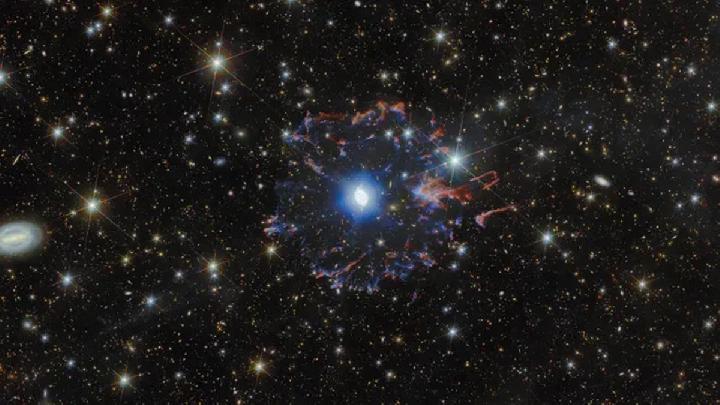
The cosmos continues to reveal its breathtaking beauty and complexity, and recently, astronomers have unveiled a stunning new image of the Cat’s Eye Nebula (NGC 6543). This iconic planetary nebula, located approximately 3,300 light-years away in the constellation Draco, has captivated scientists for decades. A collaborative effort between NASA’s Hubble Space Telescope and the European Space Agency’s (ESA) Euclid mission has produced an unprecedented view, showcasing the intricate layers of gas and dust expelled by a dying star. This latest observation provides invaluable insights into the final stages of stellar evolution and the processes that shape these ethereal cosmic structures.
The Cat’s Eye Nebula earned its name from its resemblance to the eye of a feline in early telescopic observations. Though, this seemingly simple shape belies a remarkably complex structure. It was in 1864 that the nebula’s true nature was revealed – it isn’t a planet, but rather expanding gas ejected from a star nearing the end of its life. Examining the spectrum of its light revealed the presence of molecules characteristic of gas, distinguishing it from stars and galaxies. The new images, captured in March 2026, demonstrate the power of combining different observational capabilities to unravel the mysteries of the universe. Euclid’s wide-field view complements Hubble’s high-resolution imaging, providing a comprehensive understanding of both the nebula’s overall structure and its intricate details.
Unveiling the Layers of a Dying Star
Planetary nebulae, despite their name, have nothing to do with planets. They are formed when a low- to medium-mass star, like our Sun, exhausts its nuclear fuel. Unable to sustain the outward pressure from nuclear fusion, the star begins to shed its outer layers into space. This ejected material forms an expanding shell of gas and dust, illuminated by the hot, remaining core of the star. The resulting structure is often characterized by intricate patterns, shaped by stellar winds, jets of gas, and interactions with surrounding material. The Cat’s Eye Nebula is a prime example of this complexity.
The Hubble Space Telescope, renowned for its sharp imaging capabilities, has captured the core of the nebula with exceptional detail. Using its Advanced Camera for Surveys, Hubble reveals the multi-layered bubbles, pointed jets, and circular shells of gas that compose the nebula. These structures are not static; they represent different episodes of mass loss from the central star, each leaving behind a distinct “fossil record” in the nebula’s form. Each bubble corresponds to a specific instance of the star shedding material, with concentric rings marking the boundaries of these events, according to ESA. The images showcase a central star surrounded by white bubbles and loops of gas, shining with a powerful blue light, and a broken ring of red and blue gas clouds further out.
Euclid, provides a broader perspective, capturing the nebula in both visible and near-infrared light. This wider view reveals faint arcs and filaments of gas extending beyond the central region, providing context for the detailed structures observed by Hubble. Euclid’s observations are particularly valuable for understanding the nebula’s interaction with its surrounding environment. The mission is designed to map the geometry of the dark universe, but its capabilities likewise extend to studying nearby objects like the Cat’s Eye Nebula.
The Dynamics of Stellar Ejection
The new images reveal high-speed gas jets emanating from the top and bottom of the nebula, depicted in shades of pink. These jets are thought to be driven by the interaction between the star’s magnetic field and the ejected material. The collision of these jets with the slower-moving gas creates shock waves, resulting in dense clumps of material. These interactions are crucial in shaping the nebula’s intricate structure and contribute to its dynamic evolution. The data also reveals the presence of high-energy, high-velocity gas bursts, further illustrating the turbulent processes at play.
The process of stellar ejection isn’t a smooth, uniform event. As a star nears the end of its life, it undergoes periods of instability, leading to episodic mass loss. These episodes create the layered structures observed in the Cat’s Eye Nebula. The different layers represent material ejected at different times and velocities, resulting in a complex interplay of light and shadow. Understanding these dynamics is crucial for refining our models of stellar evolution and predicting the fate of stars like our Sun.
Euclid and Hubble: A Powerful Partnership
The collaboration between Hubble and Euclid exemplifies the power of combining different observational approaches. Hubble’s high resolution allows astronomers to study the fine details of the nebula’s structure, while Euclid’s wide-field view provides a broader context. This synergy allows for a more complete and nuanced understanding of the nebula’s formation and evolution. The combined data set will be invaluable for researchers studying planetary nebulae and stellar evolution for years to come.
Euclid, launched in July 2023, is designed to investigate the mysteries of dark matter and dark energy, which make up 95% of the universe. As ESA details, while its primary mission is cosmological, its capabilities extend to studying objects within our own galaxy, like the Cat’s Eye Nebula. The mission’s ability to observe in both visible and near-infrared light provides a unique perspective on these objects, revealing details that would be invisible to other telescopes. Hubble, launched in 1990, continues to provide groundbreaking images and data, pushing the boundaries of our understanding of the universe. Its longevity and versatility have made it one of the most important scientific instruments in history.
What the Cat’s Eye Nebula Tells Us
The Cat’s Eye Nebula serves as a microcosm of the processes that occur in all dying stars. By studying its structure and dynamics, astronomers can gain insights into the fate of our own Sun. While the Sun is not massive enough to end its life in a spectacular supernova explosion, it will eventually shed its outer layers, forming a planetary nebula. Understanding the processes that shape these nebulae is crucial for predicting the future of our solar system.
The detailed observations of the Cat’s Eye Nebula also provide valuable information about the chemical composition of the ejected material. Analyzing the light emitted by the nebula allows astronomers to identify the elements present and their relative abundances. This information can help us understand the processes that occur within stars and how they enrich the universe with heavier elements. These elements are the building blocks of planets and life itself.
The study of planetary nebulae like the Cat’s Eye Nebula is not just about understanding the death of stars; it’s also about understanding the birth of new ones. The material ejected by dying stars provides the raw ingredients for the formation of new stars and planetary systems. This cycle of stellar birth and death is fundamental to the evolution of the universe.
Key Takeaways
- The Cat’s Eye Nebula (NGC 6543) is a planetary nebula formed by a dying star.
- New images from Hubble and Euclid reveal the nebula’s intricate structure and dynamics.
- The nebula’s layers represent different episodes of mass loss from the central star.
- Studying planetary nebulae helps us understand stellar evolution and the fate of our Sun.
- The collaboration between Hubble and Euclid demonstrates the power of combining different observational approaches.
Further analysis of the data from Hubble and Euclid is expected to reveal even more secrets about the Cat’s Eye Nebula and the processes that shape planetary nebulae. Astronomers will continue to study this iconic object, seeking to refine our understanding of stellar evolution and the universe we inhabit. The next major data release from the Euclid mission is scheduled for late 2027, which will likely include further insights into the nebula’s surrounding environment. Stay tuned for further updates as our understanding of this celestial wonder continues to evolve.
What are your thoughts on these stunning images? Share your comments below, and don’t forget to share this article with your friends and family!
Related reading