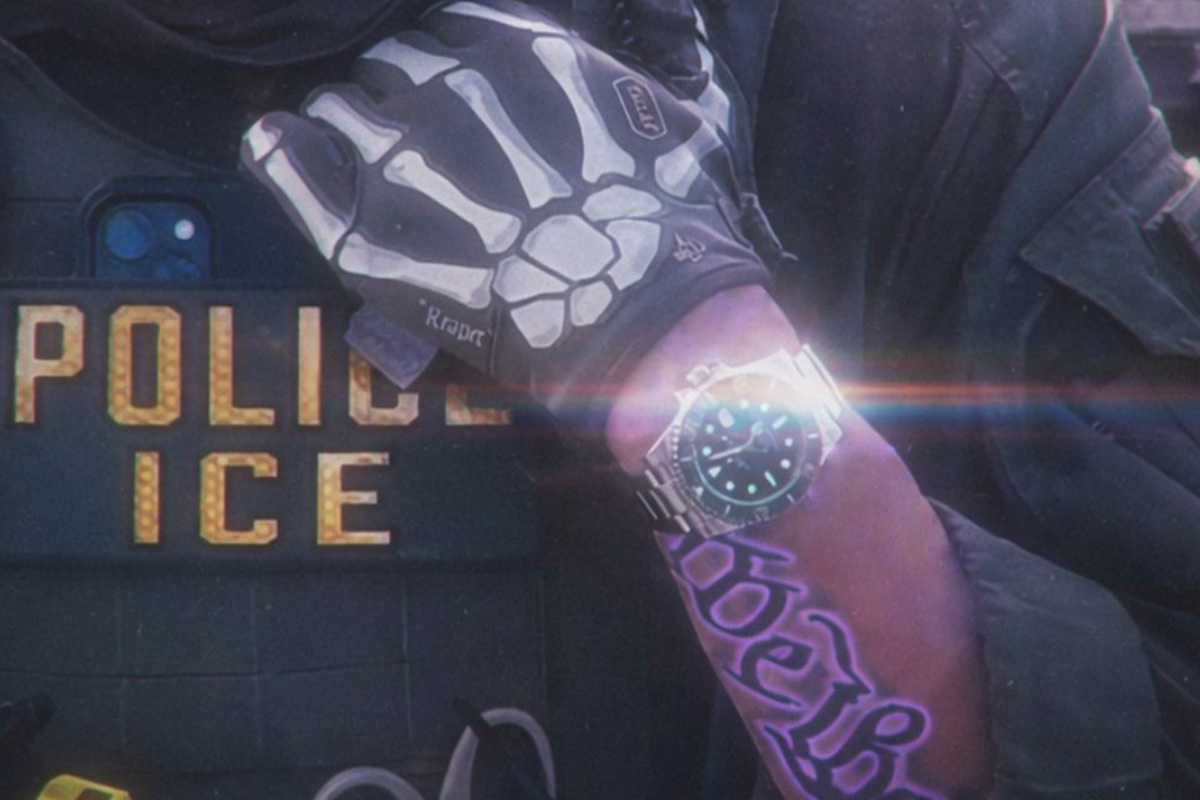
A recent image circulating on social media has ignited a polarized debate regarding the conduct and appearance of federal law enforcement officers. The photograph, which depicts an Immigration and Customs Enforcement (ICE) agent, has drawn significant attention due to the subject’s choice of attire—specifically a prominent wristwatch and a visible tattoo bearing the phrase “We The People.” As the image traveled across various digital platforms, users quickly began speculating about the financial value of the watch, with some online commentators claiming it to be a high-end luxury timepiece worth upwards of $10,000.
This incident serves as a modern prism through which the public evaluates the intersection of federal service, personal expression, and perceived political alignment. While the photograph has been widely shared, officials have not confirmed the make, model, or provenance of the watch in question, nor have there been official statements regarding the agent’s adherence to agency dress codes. The debate highlights a broader, ongoing discourse concerning how members of law enforcement agencies, such as the Department of Homeland Security’s Immigration and Customs Enforcement, are perceived by a deeply divided public.
The Intersection of Federal Policy and Personal Expression
For those monitoring federal employment standards, the conversation surrounding the agent’s appearance often touches upon the Office of Personnel Management (OPM) guidelines regarding professional conduct. While federal employees maintain certain First Amendment rights, those rights are frequently balanced against the need for neutrality and the maintenance of public trust in government institutions. The presence of visible tattoos and high-value accessories on duty often triggers questions about internal agency policies.
According to standard Department of Homeland Security (DHS) personnel policies, while there is no blanket federal prohibition against tattoos, individual agencies may implement specific grooming and appearance standards to ensure a professional image. However, the viral nature of this specific image stems less from a potential policy violation and more from the symbolic weight viewers have attached to the “We The People” tattoo. By framing the agent as a “patriot” on one hand, or as a symbol of overreach on the other, social media participants are engaging in a wider cultural struggle over what it means to represent the United States government in an era of intense political scrutiny.
Fact-Checking the Digital Narrative
One of the most persistent elements of the online reaction has been the focus on the agent’s wristwatch. Enthusiasts of horology and casual observers alike have attempted to identify the watch from low-resolution images. Despite the definitive claims made by some social media accounts, there is currently no verified evidence to substantiate the $10,000 valuation. Identifying luxury watches from a single photograph is notoriously difficult, as many mid-range timepieces share aesthetic similarities with high-end models.
When claims of this nature gain traction, they often reflect the observer’s biases rather than objective reality. Without an official appraisal or a statement from the agency, the price tag remains pure speculation. The tendency to assign a specific, high-end monetary value to the item functions as a rhetorical device, intended to either heighten the perceived controversy or bolster the perceived status of the officer. As of this reporting, no official inquiry has been launched into the agent’s personal property, and the agency has maintained its standard position of not commenting on the personal attire of individual field personnel unless a formal complaint is filed.
Public Trust and the Role of Federal Agents
The role of an ICE agent is inherently complex, involving the enforcement of United States immigration laws. Because these agents operate at the center of one of the nation’s most contentious policy areas, their public interactions are subject to heightened visibility. When an individual agent becomes the subject of a viral post, it can shift focus from the systemic operations of the agency to the individual’s personal choices.
For the public, this raises a fundamental question: Should federal agents be held to a standard of absolute visual neutrality? Some argue that in a diverse democracy, the appearance of government agents should be as unobtrusive as possible to prevent any perception of bias. Others maintain that agents are private citizens who do not forfeit their personal identity, including their political expressions, simply by putting on a uniform. This tension is not unique to ICE; it is a recurring theme in the broader oversight of Department of Justice and law enforcement agencies across the country.
Moving Forward: Oversight and Transparency
As the conversation continues, it is essential for observers to distinguish between verified facts and the speculative narratives that often accompany viral imagery. The lack of official confirmation regarding the agent’s identity or the specific equipment worn serves as a reminder of the importance of waiting for institutional transparency. In cases where the public believes an agent has violated conduct standards, there are established channels for feedback.
Individuals who believe there has been a breach of protocol can typically refer to the DHS Office of Inspector General, which serves as the independent body responsible for investigating allegations of misconduct or waste, fraud, and abuse within the department. While this specific instance may not rise to the level of a formal investigation, the discourse it has generated is reflective of a public that is increasingly attentive to the conduct of those in positions of authority.
We invite our readers to participate in this discussion by maintaining a focus on verifiable information and the broader policy implications of federal conduct. As we await any potential official statements or policy updates regarding officer appearance standards, we encourage you to share your thoughts in the comments section below. How do you believe federal agencies should balance personal expression with the requirement for professional neutrality?
Keep reading