Scientists operating the IceCube Neutrino Observatory in Antarctica have detected a high-energy neutrino signal that appears to originate from an active galaxy approximately 11 billion light-years from Earth. This observation, detailed in recent reports from the scientific community, provides new data regarding the origin of cosmic rays and the mechanisms of high-energy particle acceleration in the distant universe.
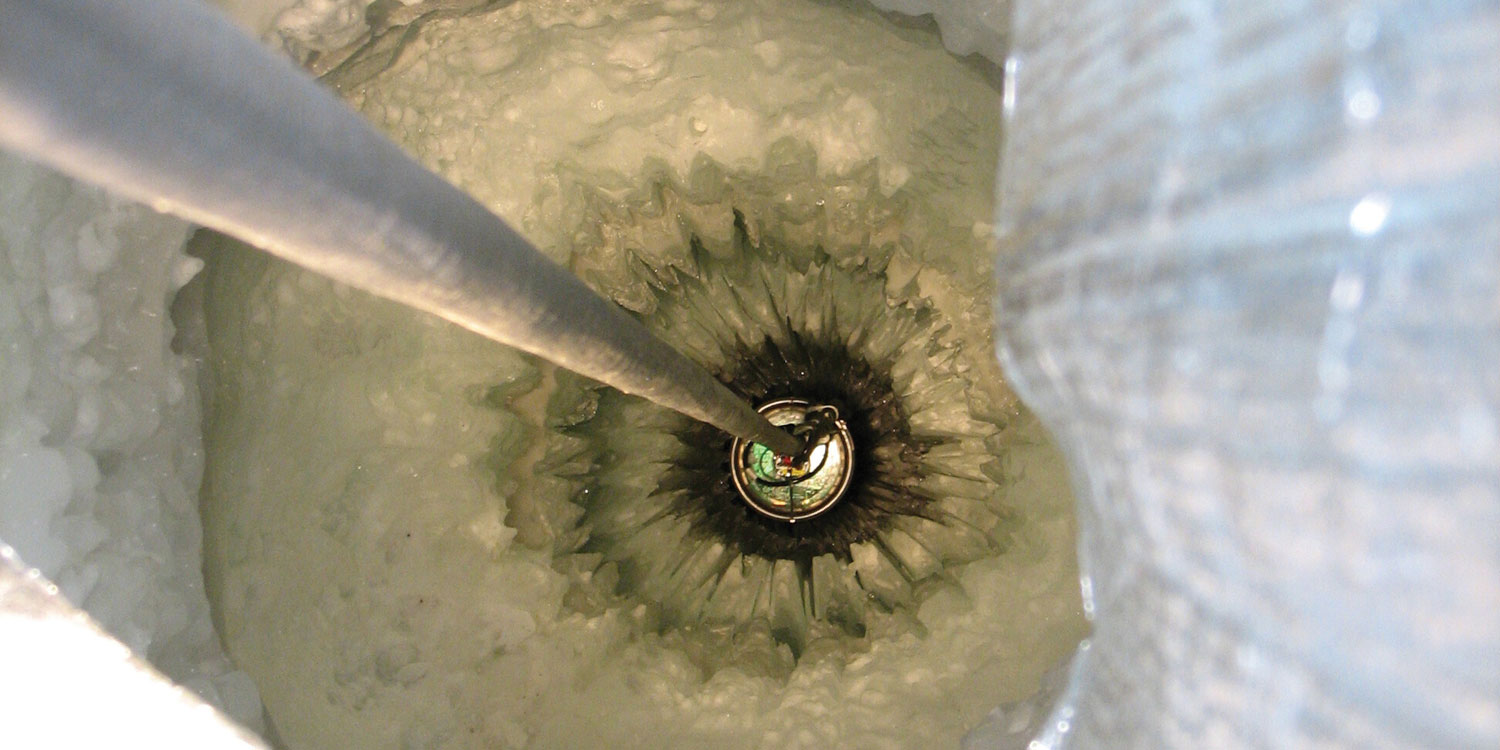
The IceCube collaboration, a global project headquartered at the University of Wisconsin–Madison, utilizes a cubic-kilometer detector embedded deep within the Antarctic ice to capture these elusive “ghost particles.” Unlike light, neutrinos travel through the cosmos virtually unimpeded, allowing researchers to trace them back to some of the most violent and energetic events in space, according to the IceCube Neutrino Observatory official research documentation.
Understanding the Origin of High-Energy Neutrinos
The signal in question originates from an active galactic nucleus (AGN), a region at the center of a galaxy where a supermassive black hole is actively accreting matter. As matter falls toward the black hole, it releases vast amounts of energy, creating conditions capable of accelerating particles to extreme speeds. These particles eventually collide with gas and radiation in the environment, producing neutrinos as a byproduct, as explained by the National Science Foundation, which provides primary funding for the facility.
For decades, physicists have sought to identify the sources of these high-energy particles. Because neutrinos lack electric charge and possess almost no mass, they do not deflect off magnetic fields, meaning they travel in straight lines from their source. This allows astronomers to use them as “messengers” to map the high-energy universe. Identifying a source 11 billion light-years away is significant, as it places the event in a much younger phase of the universe’s development, offering a window into how early galaxies functioned.
The Technical Challenge of Deep-Ice Detection
Detecting a neutrino is a feat of engineering. When a neutrino interacts with an atom in the Antarctic ice, it produces a secondary charged particle that emits a faint flash of blue light known as Cherenkov radiation. The IceCube detector consists of over 5,000 optical sensors distributed across 86 strings frozen into the ice, according to specifications provided by the University of Wisconsin–Madison.
The process of filtering out background noise—such as cosmic ray muons generated in Earth’s atmosphere—is intense. Researchers must employ sophisticated algorithms to isolate these rare, high-energy cosmic events from the constant stream of terrestrial particle interactions. This specific 11-billion-year-old signal required the team to correlate the neutrino detection with electromagnetic observations from space-based telescopes, a method known as multi-messenger astronomy.
Multi-Messenger Astronomy and Future Research
The integration of neutrino detection with traditional telescope data has become a standard for modern astrophysics. By combining data from the IceCube observatory with optical and X-ray observations, researchers can confirm the specific galaxy responsible for the particle emission. This collaborative approach, often involving international networks of telescopes, is essential for verifying the distance and nature of the source, as reported by the European Southern Observatory.
Looking ahead, the IceCube collaboration is planning the IceCube-Gen2 expansion. This upgrade will significantly increase the volume of the detector, allowing for a higher rate of event detection and better sensitivity to lower-energy signals. Scientists hope that this will provide a more comprehensive census of the various types of galaxies that contribute to the cosmic neutrino flux, helping to refine current models of galaxy evolution and black hole activity.
The research team continues to analyze incoming data from the Antarctic winter season, with further findings expected to be published in peer-reviewed journals later this year. For updates on the latest detections and technical status reports, the public can follow the IceCube Newsroom.
What are your thoughts on how multi-messenger astronomy is changing our view of the early universe? Please share your comments or join the discussion on our social media platforms.
Worth a look