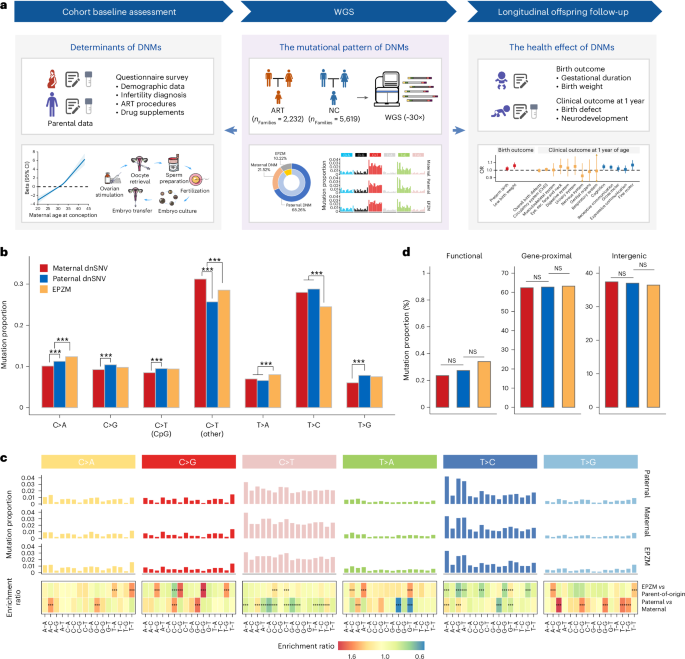
Large-scale whole-genome sequencing of thousands of family trios has mapped out how de novo mutations arise across generations, revealing that both parental age and assisted reproductive technologies shape the number and types of these genetic alterations. The research, published in Nature Medicine, draws on data from 7,851 parent-offspring families to evaluate the landscape of de novo mutations.
De novo mutations represent genetic variants occurring in the germ cells of parents or very early in embryonic development. Understanding their distribution, frequency, and underlying catalysts remains a central focus of modern medical genetics. The study underscores how reproductive choices and biological aging interact with mutagenesis, pointing toward the need to optimize reproductive practices.
As genetic sequencing costs decrease and analytical pipelines grow more robust, population-scale genomic studies offer resolution into human diversity. The findings provide a look at mutational processes.
Genomic Insights from Thousands of Parent-Offspring Families
The core of the investigation involved whole-genome sequencing of 7,851 families, allowing researchers to track inheritance patterns and identify variants that were absent in maternal and paternal genomes. By analyzing genetic loci across these trios, the research team quantified the accumulation of de novo mutations.
The study details the contributions of parental age and the specific influences associated with assisted reproductive technologies (ART).
Implications for Clinical Practice and Reproductive Health
Next Steps in Genomic Research and Surveillance
We invite our readers to share their perspectives and discuss the implications of these findings in the comments section below.
Keep reading