Indonesian authorities are facing growing international scrutiny over a series of “shoot-on-sight” orders implemented in several provinces to combat rising street crime. The policies, which authorize security forces to use lethal force against suspected motorcycle assailants—locally known as begal—have sparked urgent warnings from human rights organizations regarding the potential for police brutality and the violation of international legal standards.
The directives follow a surge in reported muggings across Indonesia, including incidents targeting foreign tourists. In response, local police and military units have established joint task forces, most notably in Jakarta on May 15, 2026. Similar orders have been reported in Makassar, South Sulawesi. Lampung province on Sumatra; and Bekasi, West Java. These measures have already resulted in fatalities, with reports indicating that security forces have killed two suspects each in Lampung and Binjai City, North Sumatra, while injuring at least 50 others since the crackdown began.
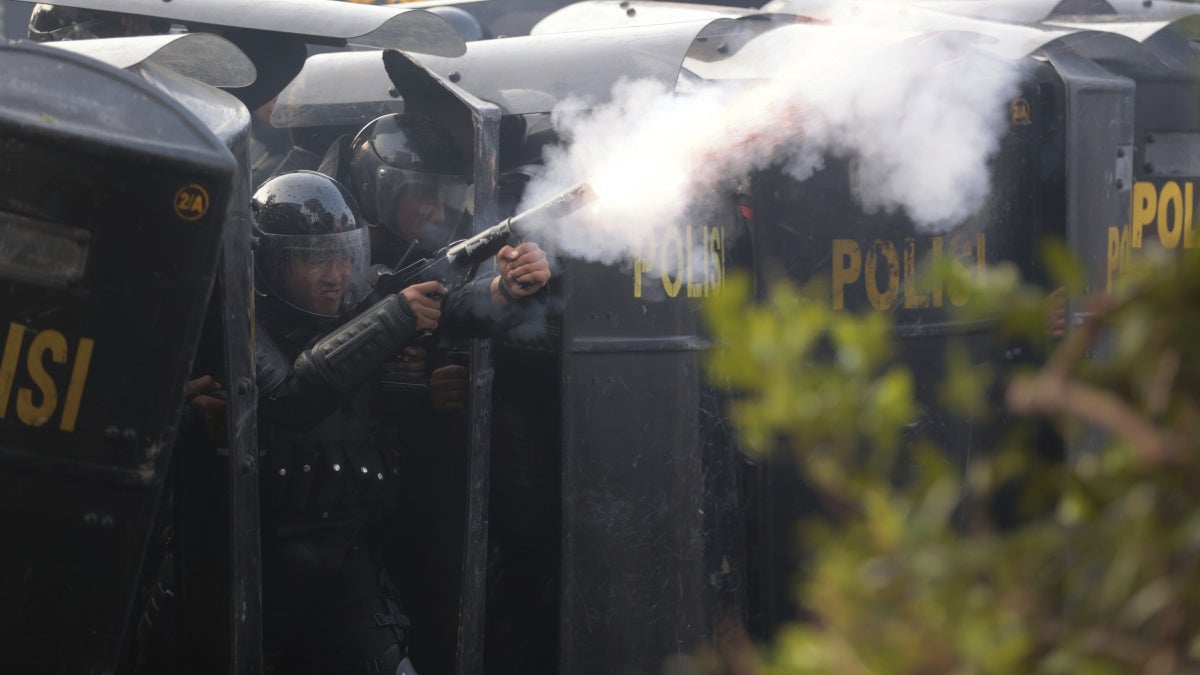
An Indonesian police officer fires tear gas during a demonstration in Surabaya, East Java, Indonesia, August 29, 2025. © 2025 AP Photo/Trisnadi
The Escalation of Security Operations
The security landscape in Indonesia has been particularly tense since a series of high-profile violent crimes, including the May 9, 2026, killing of Police Brigadier Arya Supena in Bandar Lampung while he was attempting to prevent a motorcycle theft. Another incident on May 11, 2026, involved two men stabbing a high school student during a robbery in Binjai City. These events have fueled public demand for more aggressive policing, yet critics argue that the current government response risks repeating historical patterns of excessive force.
Meenakshi Ganguly, the deputy Asia director at Human Rights Watch, has called on Indonesian leaders to publicly denounce the shoot-on-sight policies. “Indonesian leaders need to loudly and forcefully denounce any shoot-on-sight orders or other proposed excessive use of force,” Ganguly stated. She emphasized that the focus should instead be on enacting substantial, long-promised reforms to police procedures that include proper oversight and accountability mechanisms.
The debate is further complicated by the government’s increasing reliance on military personnel for civilian law enforcement duties. In March 2025, the government amended the National Armed Forces (TNI) Act, Law No. 34/2004, to permit active-duty military personnel to hold civilian positions. This move has drawn comparisons to the dwi fungsi (dual function) policy that characterized the authoritarian rule of President Soeharto between 1965 and 1998.
Accountability and the Rule of Law
The current climate follows widespread national demonstrations in August 2025, where citizens in over 100 cities protested against economic inequality and demanded systemic police reform. While the government established the Commission for the Acceleration of Police Reform in November 2025, activists remain skeptical. Concerns persist that proposed revisions to the National Police Law could increase political interference rather than fostering a more professional, rights-respecting force.
Defense Minister Sjafrie Sjamsoeddin has defended the military’s involvement, citing a plan to establish 750 Territorial Infantry Battalions across 518 regencies and cities. The government maintains that such deployments are necessary to curb sharp increases in crime rates in areas lacking sufficient TNI presence. However, human rights advocates point to the historical precedent of the 1982–1985 “Petrus” (Penembakan Misterius) mystery shootings, during which the army was implicated in an estimated 10,000 extrajudicial killings.
International Standards on the Use of Force
Under the United Nations Basic Principles on the Use of Force and Firearms by Law Enforcement Officials, security forces are required to prioritize nonviolent means and exercise restraint. Lethal force is considered a last resort, permitted only when strictly necessary to protect life. The current implementation of shoot-on-sight orders in Indonesia appears to challenge these international obligations, raising questions about the presumption of innocence and the right to due process.

Prabowo Pamungkas, director of the Legal Aid Institute (LBH) in Bandar Lampung, noted that the atmosphere has become increasingly repressive since the policy’s announcement. For victims of violence, the situation is personal; individuals like Nova Eka Putri, who campaigns against street crime, have highlighted that the trauma of such attacks is long-lasting, yet she cautioned that the state’s response must not compromise the safety and rights of the broader public.
As the situation develops, the focus remains on whether the Indonesian government will align its enforcement strategies with the rule of law. The government faces pressure to abandon the use of military personnel in civilian policing and to prioritize the investigation and prosecution of officers accused of using excessive or unnecessary force. Monitoring groups continue to call for transparency in these operations, noting that public safety must be balanced with the fundamental protections afforded to all citizens under the Indonesian Constitution and international human rights frameworks.
There are currently no scheduled public hearings or official government timelines for the rescission of the shoot-on-sight orders. Readers are encouraged to follow official updates from the Indonesian National Police and the Commission for the Acceleration of Police Reform for any shifts in policy or new public safety directives.
Related reading