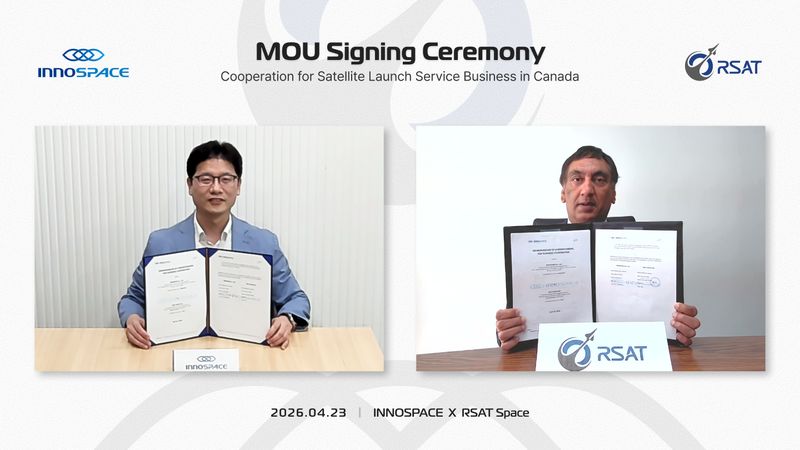
On Monday, April 27, 2026, South Korean private launch vehicle company Innospace announced it had signed a memorandum of understanding (MOU) with RSAT Space, a Canadian aerospace and defense technology firm headquartered in Montreal. The agreement focuses on cooperation in satellite launch services and space systems development, with both parties aiming to explore joint opportunities in North America and other globally agreed-upon regions.
The MOU builds on Innospace’s earlier non-binding letter of intent (LOI) signed in March 2026 with Canada’s Maritime Launch Services (MLS) to secure access to launch facilities. According to the company’s statement, the collaboration with RSAT Space is intended to combine Innospace’s HANBIT launch vehicle development and operational capabilities with RSAT’s expertise in space systems integration, launch mission support, and infrastructure development.
Innospace, founded in 2018, has been developing the HANBIT series of small-to-medium launch vehicles designed for low-cost, rapid deployment of little satellites. The company has conducted multiple ground tests and aims to commence orbital launches from domestic and international sites in the coming years. RSAT Space, established in Montreal, specializes in end-to-end space mission solutions, including satellite integration, ground systems, and launch support for both government and commercial clients.
Under the terms of the MOU, the two companies plan to jointly pursue opportunities in Canadian government and private space projects, particularly those involving Earth observation, communications, and national security satellites. They also intend to develop new business models that integrate launch services with advanced space systems, targeting sectors such as defense, environmental monitoring, and maritime surveillance.
The partnership reflects a broader trend of international collaboration in the small satellite launch market, where companies seek to combine complementary strengths to meet rising global demand. Industry analysts note that access to North American launch sites and local partnerships can significantly reduce regulatory and logistical barriers for Asian aerospace firms entering Western markets.
Innospace has previously engaged with international partners to expand its launch service footprint. In addition to the MLS LOI, the company has participated in joint studies with European launch providers and attended international aerospace exhibitions to showcase its HANBIT technology. RSAT Space, meanwhile, has supported Canadian Space Agency missions and worked with NATO-aligned defense contractors on space-based intelligence projects.
The MOU does not specify financial terms, timelines for joint projects, or exclusivity clauses. Both companies stated that detailed implementation plans will be developed in follow-up working group meetings over the next six months. No launch dates or mission manifests were disclosed as part of the announcement.
Industry observers suggest that successful collaboration could position Innospace as a competitive alternative to established small launch providers like Rocket Lab and Virgin Orbit (now defunct), particularly for customers seeking non-U.S.-based launch options. For RSAT Space, the partnership offers a potential pathway to offer integrated launch-and-solutions packages to its existing client base.
As of the announcement date, neither company has released technical specifications for any co-developed systems under the MOU. Future updates are expected through official press releases, regulatory filings with South Korean and Canadian authorities, or presentations at upcoming space industry events such as the International Astronautical Congress or Satellite 2027.
For readers interested in tracking developments, official updates from Innospace can be found on its corporate website and through Korea’s Ministry of Science and ICT aerospace division announcements. RSAT Space shares project milestones via its LinkedIn page and occasional contributions to Canadian defense industry publications.
What does this partnership mean for the evolving global space launch landscape? It underscores how mid-sized aerospace firms are increasingly forming cross-border alliances to pool technical capabilities, share market access risks, and respond to government and commercial demand for flexible, responsive launch services outside traditional aerospace hubs.
Stay informed about international space industry collaborations by following verified aerospace news sources and official agency updates. Share your thoughts on how such partnerships might shape access to space for emerging economies and private enterprises in the comments below.
Keep reading