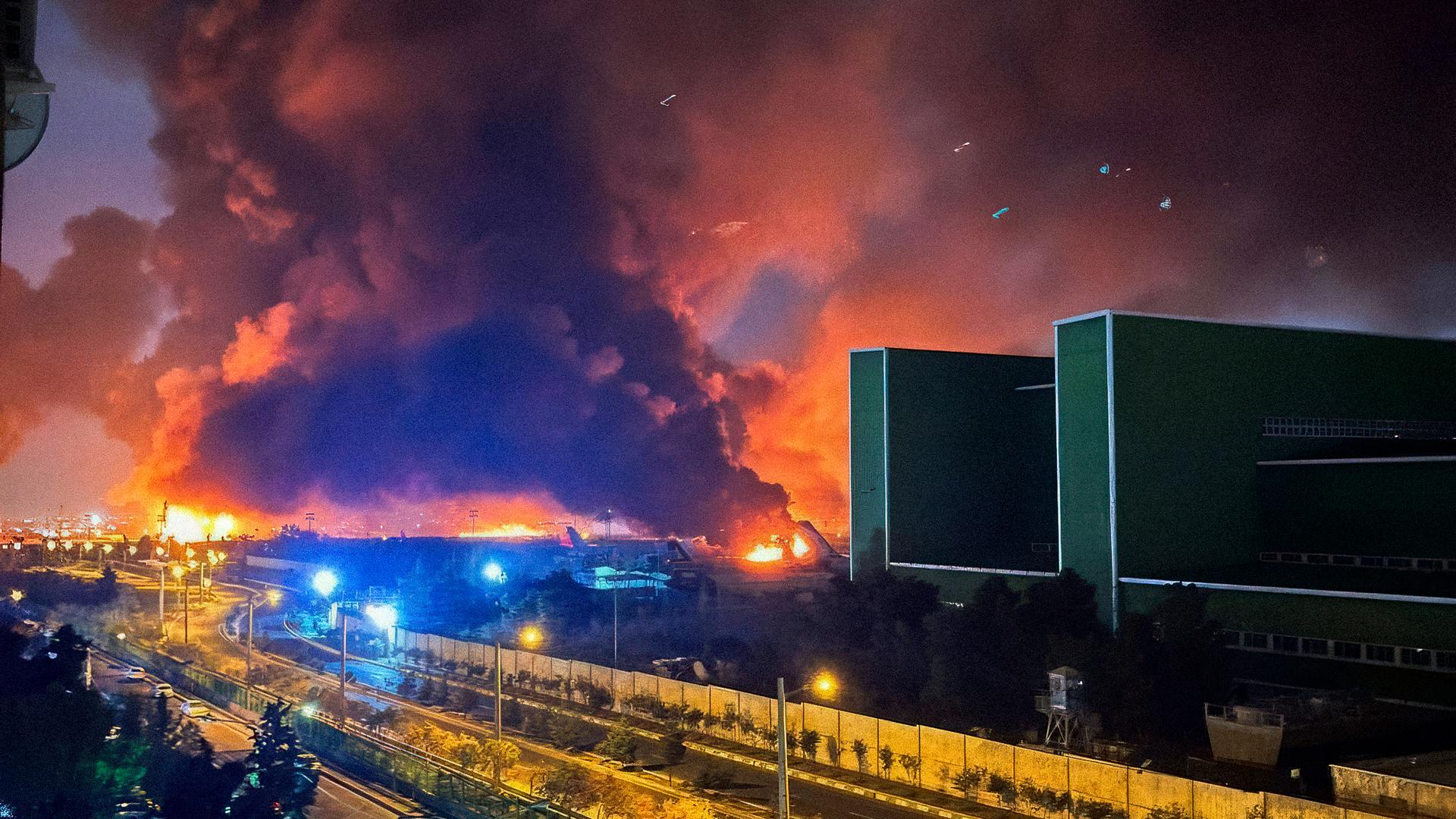
Sofia, Bulgaria – Tensions in the Middle East escalated sharply on Saturday, March 8, 2026, as reports emerged of new Iranian attacks targeting Gulf states and renewed strikes in the region. The exchange of hostilities has been accompanied by increasingly bellicose rhetoric from both Washington and Tehran, raising fears of a wider conflict. Iranian Foreign Minister Seyed Abbas Araghchi warned that further escalation would be met with a robust response from Iran’s armed forces, directly responding to statements made by U.S. President Donald Trump.
The current crisis stems from a complex web of regional conflicts and longstanding animosity between Iran and the United States, exacerbated by Israel’s ongoing military operations. Whereas Iran initially signaled a willingness to de-escalate tensions under certain conditions – namely, assurances that neighboring countries would not allow their territory to be used for attacks against Iran – Foreign Minister Araghchi accused the U.S. Of misinterpreting these overtures and instead pursuing a path of escalation. This accusation follows remarks by Iranian President Masoud Pezeshkian, who proposed a framework for reducing tensions contingent on regional security guarantees.
Escalating Attacks and Regional Repercussions
Reports indicate that Bahrain, Qatar, and the United Arab Emirates all reported being targeted by new Iranian attacks. The situation in Dubai proved particularly dire, with one civilian killed by falling debris and damage sustained to the facade of a skyscraper. Sheikh Mohammed bin Zayed Al Nahyan, President of the United Arab Emirates, declared that his country now considers itself to be at war. According to reports, Here’s a significant shift in the UAE’s posture, signaling a heightened level of concern and a commitment to defending its territory.
In Iraq, security sources reported that multiple rockets were intercepted over the U.S. Embassy in Baghdad, indicating a potential attempt to target American personnel. Simultaneously, air raid sirens sounded again in the greater Jerusalem area of Israel, suggesting continued threats from the region. These incidents underscore the rapidly expanding geographic scope of the conflict and the increasing risk to civilian populations.
Trump’s Rhetoric and Iran’s Response
The escalating violence has been mirrored by increasingly aggressive rhetoric from both sides. President Trump reportedly stated on his social media platform, Truth Social, that Iran would be “pummeled to hell,” a statement that drew a sharp rebuke from Iranian officials. Foreign Minister Araghchi responded directly, warning that if Trump seeks escalation, “it is precisely what our Powerful Armed Forces have long been prepared for, and what he will get.”
Araghchi further accused Trump of miscalculating Iran’s capabilities and determination, claiming that the U.S. President misinterpreted Iran’s initial signals of openness to de-escalation. He emphasized that Iran’s armed forces are fully prepared for further escalation, placing the responsibility for any intensification of conflict squarely on the U.S. Administration. Araghchi also alleged that the U.S. “misadventure” has already cost the American military $100 billion and resulted in the loss of American lives, a claim that has not been independently verified but reflects the depth of animosity between the two nations.
The Cost of Conflict
The financial toll of the escalating conflict is a growing concern. Araghchi’s claim of a $100 billion cost to the U.S. Military, while unconfirmed, highlights the significant economic burden associated with prolonged military engagement in the region. Beyond the direct financial costs, the conflict is disrupting global energy markets and creating instability that could have far-reaching economic consequences. The disruption to shipping lanes in the Persian Gulf, a critical artery for global oil supplies, is a particular worry for international markets.
Regional Implications and International Concerns
The involvement of multiple regional actors, including the Gulf states and Iraq, raises the specter of a wider regional war. The UAE’s declaration that it considers itself at war is a particularly alarming development, signaling a potential shift towards direct military involvement. The situation in Iraq, with rockets targeting the U.S. Embassy, underscores the risk of the conflict spilling over into a country already grappling with significant political and security challenges.
International calls for de-escalation have grown louder, but their impact remains limited. The United Nations Security Council is expected to convene an emergency session to discuss the crisis, but divisions among member states – particularly between the U.S. And Russia – are likely to hinder any meaningful action. The European Union has urged restraint from all parties, but its influence in the region is limited. The international community faces a difficult challenge in preventing the conflict from spiraling out of control.
Looking Ahead
The immediate future remains highly uncertain. The next key development to watch will be the outcome of the expected United Nations Security Council emergency session. Further escalation appears likely if the U.S. And Iran fail to find a diplomatic off-ramp. The potential for miscalculation and unintended consequences is high, making the situation extremely dangerous. The coming days will be critical in determining whether the region can avert a full-scale war.
This is a developing story. World Today Journal will continue to provide updates as they become available. We encourage readers to share their thoughts and perspectives in the comments section below.
Related reading