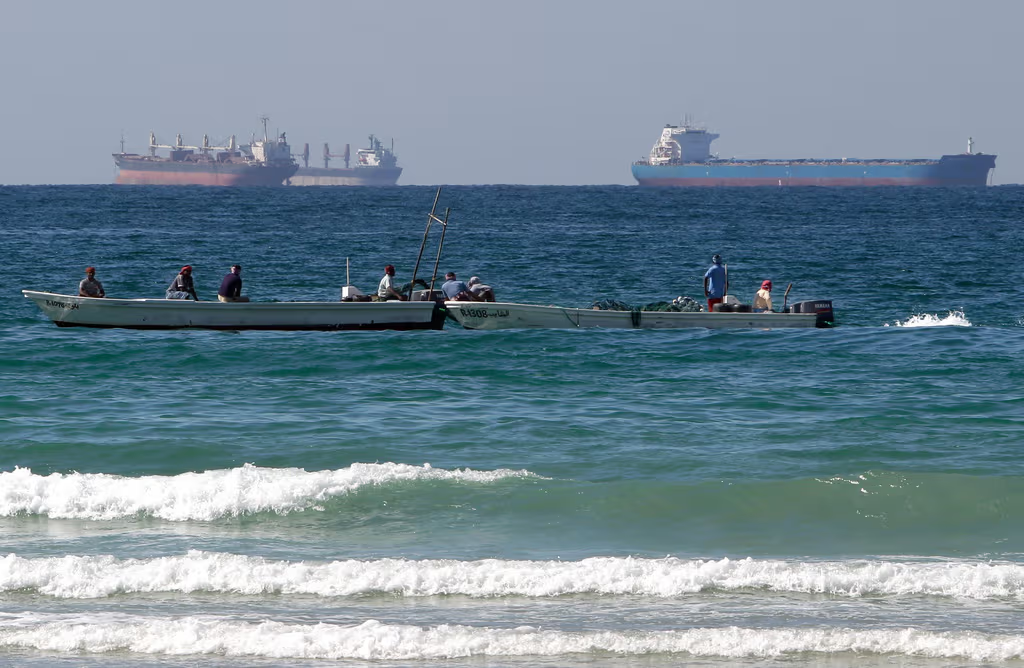
Tensions in the Strait of Hormuz have flared again as Iran announced a partial closure of the vital maritime passage, citing what it described as escalating naval provocations by the United States and its allies. The move, communicated through Iran’s Islamic Revolutionary Guard Corps Navy, has reignited fears of disruption to global oil shipments through one of the world’s most critical chokepoints, where approximately 20% of global petroleum trade passes daily.
Iranian officials stated that the restriction, implemented on April 5, 2025, targets foreign military vessels deemed to be conducting unauthorized surveillance or escort operations in Iranian-claimed waters. While commercial shipping remains permitted under heightened scrutiny, the announcement has already triggered volatility in energy markets, with Brent crude futures rising over 4% in early trading following the announcement.
The development follows a series of increasingly confrontational encounters in the northern Gulf, including the April 2 interception of a U.S. Navy P-8A Poseidon aircraft by Iranian fighter jets near Abu Musa Island—an incident Tehran labeled as “provocative espionage,” while Washington described it as an unsafe and unprofessional intercept in international airspace.
Analysts warn that even limited restrictions on military traffic could signal a broader strategy to pressure the U.S. Into lifting sanctions or renegotiating aspects of the 2015 nuclear deal, now effectively defunct after years of gradual collapse. The Strait of Hormuz, bordered by Iran to the north and the United Arab Emirates and Oman to the south, has long been a flashpoint in U.S.-Iran relations, with previous closures threatened during periods of heightened diplomatic strain.
Background: Why the Strait of Hormuz Matters
The Strait of Hormuz is a 21-mile-wide (34 km) passage connecting the Persian Gulf to the Gulf of Oman and the open ocean. Despite its narrow width, it serves as the primary maritime route for oil exports from Saudi Arabia, Iraq, the UAE, Kuwait, and Iran itself. According to the U.S. Energy Information Administration, an average of 20.5 million barrels of oil per day flowed through the strait in 2023, representing roughly one-fifth of global oil consumption.
Any disruption—real or perceived—can trigger immediate spikes in global energy prices due to market sensitivity to supply risks. During the 2019 tanker attacks attributed to Iran, oil prices jumped over 10% in a single day. Similarly, in January 2020, following the U.S. Assassination of General Qasem Soleimani, Brent crude briefly surpassed $70 per barrel amid fears of retaliatory blockade.
Iran has repeatedly asserted its right to monitor and regulate activity in what it considers its territorial waters, extending 12 nautical miles from its coastline as defined under the United Nations Convention on the Law of the Sea (UNCLOS). Yet, the U.S. And most maritime nations consider the strait a transit passage governed by international law, allowing unimpeded navigation for all vessels, including warships.
This legal disagreement forms the core of recurring crises: Iran seeks to leverage its geographic position to extract concessions, while the U.S. Maintains a persistent naval presence—through the Fifth Fleet based in Bahrain—to ensure freedom of navigation.
Recent Escalations and Diplomatic Fallout
The current round of tensions began in mid-March 2025, after the U.S. Central Command announced an increase in naval patrols in response to what it called “a pattern of unsafe and unprofessional behavior” by Iranian naval forces. Over the following ten days, Iranian fast-attack craft conducted multiple close approaches to U.S. Destroyers and supply vessels, prompting warnings but no direct engagement.
On March 28, Iran’s Foreign Ministry accused the U.S. Of conducting “piratical acts” by detaining an Iranian-flagged cargo ship in the Gulf of Oman, alleging it was seized without legal basis. The vessel, later identified as the MV Saba, was released four days later after U.S. Officials stated it had violated sanctions by transporting prohibited goods—a claim Iran denied.
In retaliation, Iran’s parliament passed a non-binding resolution on April 1 urging the government to “consider all available options” to counter U.S. Actions, including potential restrictions on maritime traffic. Two days later, the IRGC Navy issued the notice to mariners (NOTAM) announcing enhanced monitoring and possible delays for foreign military vessels transiting the strait.
The U.S. State Department responded on April 6, calling Iran’s actions “unilateral and escalatory,” while reaffirming its commitment to regional security partnerships. A spokesperson emphasized that any attempt to impede lawful transit would be met with appropriate measures, though did not specify what those might entail.
Meanwhile, oil-importing nations in Asia—particularly China, India, Japan, and South Korea—have expressed concern through diplomatic channels, urging restraint to avoid disrupting energy supplies vital to their economies. The International Energy Agency has not yet issued an official statement but confirmed it is monitoring the situation closely.
Market Reactions and Global Implications
Financial markets reacted swiftly to the news of the partial closure. On April 5, Brent crude rose from $84.20 to $87.80 per barrel, a gain of approximately 4.3%, while U.S. WTI climbed to $83.10. The movement was mirrored in natural gas prices, with European TTF futures increasing over 2.5% amid fears of broader regional instability affecting liquefied natural gas (LNG) shipments.
Equity markets showed mixed results: energy stocks gained, with ExxonMobil and Chevron rising over 1.5% in pre-market trading, while broader indices like the S&P 500 edged lower on risk-aversion sentiment. The Dow Jones Industrial Average slipped 0.8% early April 6 before recovering modestly by midday.
Analysts at Goldman Sachs noted in a client briefing that while a full closure remains unlikely due to Iran’s own dependence on oil exports, even the threat of disruption can influence pricing behavior. “Markets are pricing in a risk premium,” one strategist wrote. “Until there is clarity on duration and scope, volatility will persist.”
The last time Iran came close to implementing a full closure was in 2012, during intense sanctions negotiations. At that time, U.S. And European naval forces increased presence, and the threat ultimately did not materialize into sustained action. Experts suggest Tehran may be employing a similar tactic now—using the strait as a bargaining chip rather than seeking to inflict lasting economic harm on itself.
What Happens Next?
As of April 7, 2025, no official timeline has been provided for how long the heightened monitoring will last. Iranian authorities have linked the measures to the continued presence of U.S. Warships in the region, suggesting a conditional approach: if tensions de-escalate, restrictions could ease.
The next potential flashpoint could come during the upcoming NATO maritime exercise in the Gulf, scheduled for mid-April and involving vessels from the U.S., UK, France, and Greece. Iran has historically viewed such drills as provocative, particularly when conducted near its territorial waters.
Diplomatic backchannels remain active, with Omani officials reportedly facilitating quiet discussions between U.S. And Iranian representatives—a role Muscat has played repeatedly since 2019. However, no formal talks are currently scheduled, and both sides appear entrenched in their positions.
For now, commercial shipping continues, albeit under closer watch. Maritime insurers have not yet raised premiums for Hormuz transit, but Lloyd’s List reported increased inquiries from shipping companies about war-risk coverage options.
The situation underscores the fragile balance of power in one of the world’s most strategically sensitive waterways. While neither side appears interested in triggering a full-blown conflict, the potential for miscalculation remains real—especially when naval forces operate in close proximity under rules of engagement that allow for interpretation.
Readers seeking official updates can monitor statements from the U.S. Fifth Fleet (U.S. Central Command Naval Forces) and Iran’s Islamic Revolutionary Guard Corps Navy (IRGC News Portal), though the latter often releases information through state media such as Press TV or Tasnim News Agency.
Stay informed, share this analysis, and join the conversation below. What do you believe is Iran’s true objective in restricting access to the Strait of Hormuz? Your perspective helps deepen public understanding of these critical global dynamics.