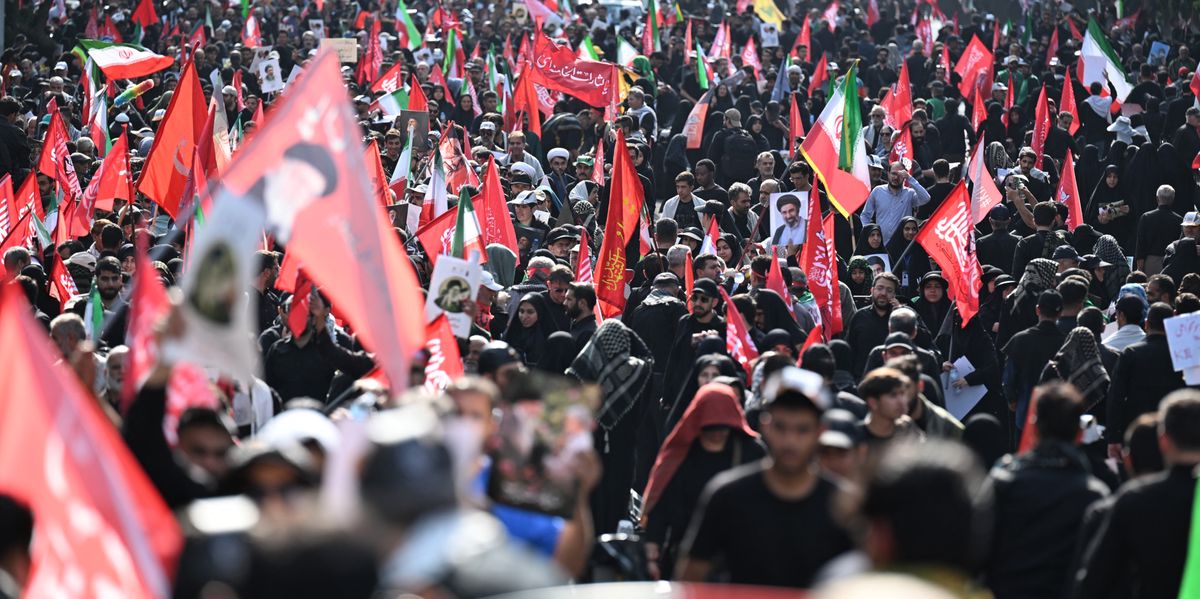
Massive crowds gathered in Tehran this week for the funeral procession of Ali Khamenei, the late Supreme Leader of Iran, marking a significant moment of transition for the Islamic Republic. Millions of mourners filled the streets of the capital to pay their respects, with the scale of the gathering drawing comparisons to historic public displays of devotion in the country. The event, characterized by high-security measures and carefully choreographed state displays, has prompted international scrutiny regarding the future of the nation’s leadership structure and the internal dynamics of the political elite.
As the capital remains submerged in a sea of black-clad supporters, observers are closely monitoring the political implications of the transition. The funeral proceedings serve as both a public manifestation of support for the status quo and a backdrop for quiet maneuvering within the inner circles of power in Tehran. While the state media emphasizes the unity of the faithful, analysts are focused on the structural shifts occurring within the Assembly of Experts and the potential for new power centers to emerge in the coming months.
Public Mourning and the Scale of the Procession
The streets of Tehran have seen an influx of millions of citizens traveling to participate in the funeral ceremonies. State-affiliated outlets have described the turnout as record-breaking, underscoring the mobilization capabilities of the regime’s institutional apparatus. The procession, which moved through major thoroughfares, was marked by rhythmic chanting and the widespread display of portraits of the late leader, reflecting a highly organized effort to project national stability during a period of leadership change.

This public display is being interpreted by regional analysts as a strategic effort to consolidate legitimacy for the successor. By staging a funeral of this magnitude, the state aims to demonstrate that the support base for the ideological foundations of the Republic remains intact despite the death of its long-serving figurehead. For international observers, the event provides a rare window into the current relationship between the state and its core base of support in the capital.
The Question of Succession and Notable Absences
Amid the formal ceremonies, the absence of Mojtaba Khamenei, the son of the late Supreme Leader, has become a primary point of discussion among regional political observers. For years, Mojtaba Khamenei has been frequently cited by foreign intelligence reports and analysts as a potential candidate for the position of Supreme Leader. His lack of a prominent, visible role during the state-managed funeral has sparked a wave of speculation regarding his actual influence and his future within the regime’s hierarchy.

Some observers suggest that his absence may be a calculated move to avoid the appearance of dynastic succession, which could prove controversial within the Assembly of Experts. Others argue that it reflects a deeper, ongoing negotiation behind the scenes regarding the distribution of power between the clerical establishment and the Islamic Revolutionary Guard Corps (IRGC). As the Assembly of Experts continues its deliberations, the lack of a clear, public endorsement or high-profile presence of the late leader’s son remains a notable variable in the transition process.
Institutional Stability and Future Governance
The death of a Supreme Leader in Iran necessitates a swift and decisive response from the Assembly of Experts, the body constitutionally mandated to select and oversee the leader. According to the Constitution of the Islamic Republic of Iran, the assembly holds the exclusive authority to confirm a successor. The current process is being conducted under the watchful eye of the country’s security apparatus, which has maintained a heavy presence across Tehran to ensure the orderly transition of authority.
The transition is occurring against a backdrop of significant economic and geopolitical pressure. While the funeral serves to project strength, the government faces internal challenges regarding economic policy and external pressure from international sanctions. The ability of the new leadership to navigate these issues will be determined by the consensus reached within the assembly and the degree of alignment maintained between the political, military, and clerical wings of the state.
What Happens Next
The next formal checkpoint in this transition will be the official announcement from the Assembly of Experts regarding the permanent appointment of a new Supreme Leader. Until that time, the country remains under the stewardship of existing institutional mechanisms designed to maintain continuity. International observers are awaiting further reports from the Assembly, which is expected to issue a formal statement once its deliberations are concluded.
The situation remains fluid, and further updates are expected as the state moves from the mourning period to the formal consolidation of the new administration. Readers are encouraged to monitor updates from official government channels and verified international news bureaus for developments regarding the assembly’s upcoming announcements. We welcome your thoughts on these shifts in the Middle East; please feel free to share your perspectives in the comments section below.